Star-Packed Period Comedy The Artist Brings Historical Figures Together for a Wild 1906 Mystery
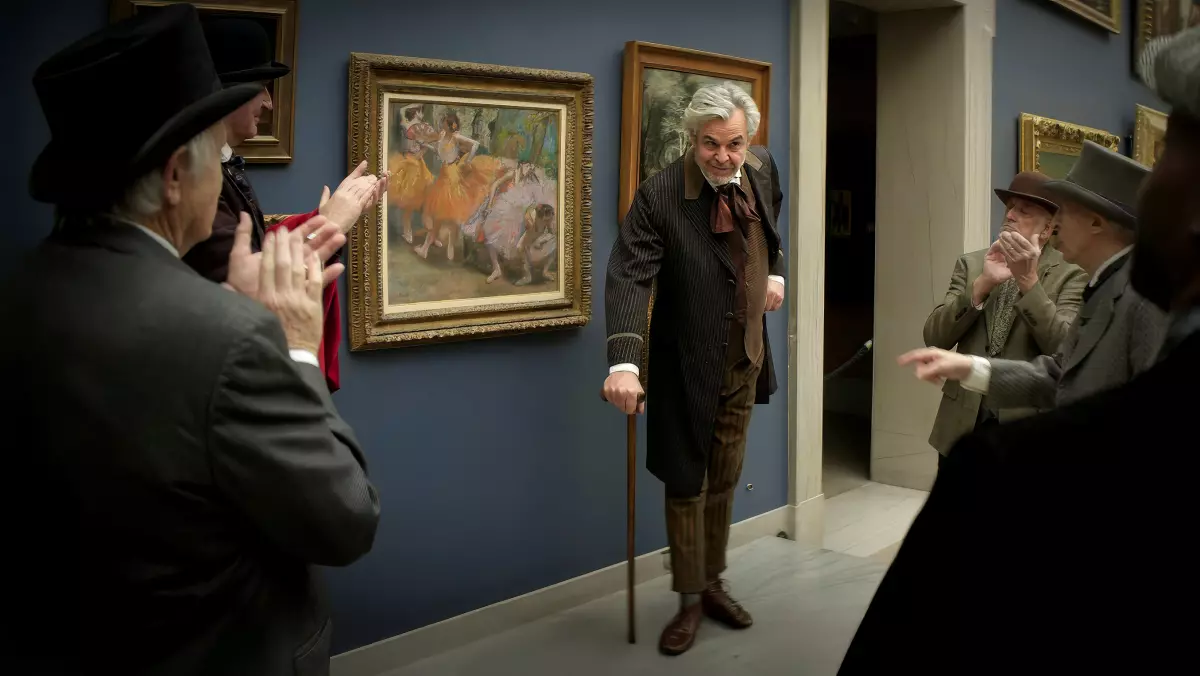
The Artist is a six-episode comedy created, written, and directed by Aram Rappaport, and it streams exclusively on The Network, the free ad-supported platform he founded specifically to distribute his earlier series The Green Veil. The first three episodes debut on a Thursday, with the final three arriving on Christmas Day, giving viewers two tightly scheduled release windows on the same service.
The series features a surprisingly heavy lineup of well-known actors including Mandy Patinkin, Janet McTeer, Danny Huston, Hank Azaria, Patti LuPone, and Zachary Quinto, a cast that practically demands attention. Despite the prestige of its ensemble, the tone leans strongly toward oddball comedy rather than traditional historical drama.
Set in 1906, the story unfolds in and around the Rhode Island estate of Norman Henry, played by Patinkin and labeled on-screen as an eccentric robber baron who resembles what we might call a modern venture capitalist. Norman begins the series dead, wrapped in a carpet and set ablaze in a Viking-like sendoff before the narrative jumps backward to reveal the events leading up to his demise.
His wife, Marian Henry (McTeer), guides viewers through the story using entries from her personal journal, emphasizing that only on the journal’s final page can the audience hope to distinguish fact from fiction and hero from villain. She makes it clear she hates her husband, and notes that he claims to love her in ways that do not feel loving at all.
The household staff lives in tents on the front lawn due to the mansion’s lack of a functioning kitchen, and each worker is summoned by bells labeled the Maid, the Ballerina, the Boxer, and the Doctor. The ballerina, Lilith (Ana Mulvoy Ten), believes Norman will help her perform Coppélia in Paris, though their interactions often feel uncomfortable and imbalanced.
Lilith’s dance instructor, Marius (David Pittu), offers constant bitterness and cutting commentary, while the boxer exists primarily as a sparring partner for Marian, who uses physical combat to channel her frustrations. The show frequently returns to Lilith, sometimes showing her bathing in a metal tub, echoing the types of scenes associated with real impressionist art.
Danny Huston appears as Edgar Degas, the eponymous artist, though this version is not meant to accurately reflect the real French Impressionist. He mutters in French, suffers from poor eyesight, shows slight antisemitism, and spends much of his time looking half-sober while insisting on getting paid.
The show introduces another historical figure when Thomas Edison (Hank Azaria) arrives seeking an investor for his Kinetophone, a real but commercially unsuccessful invention described as a sound-enhanced peep-show device. This leads to a flashback revealing that Marian and Edison once attended college together and that he betrayed her in the past. More real-world names appear when Evelyn Nesbit (Ever Anderson) and her mother (Jill Hennessy) flee New York after Evelyn’s unstable husband Harry K. Thaw (Clark Gregg) murders architect Stanford White, an event that actually occurred.
The series is loud, chaotic, and filled with abrupt slapstick violence alongside more serious confrontations. Profanity is constant, including heavy use of F-words and the C-word, contributing to the show’s tense and volatile atmosphere.
Marian states early that the series is not a conventional story but a cautionary tale centered on her own rebirth, shaped by the men who underestimate and manipulate the women around them. Themes of power, exploitation, and strained gender dynamics underpin nearly every interaction.
Rappaport’s creative choices lean into absurdism reminiscent of late-1960s and early-1970s experimental comedy, a style that likely made the series difficult to place with traditional networks. Whether viewers interpret the final product as bold or baffling, it remains a distinctive project supported by a uniquely accomplished cast.
More information about impressionist painter Edgar Degas can be found through this resource on French art history:
Edgar Degas Biography.