The Gargoyle Gardener
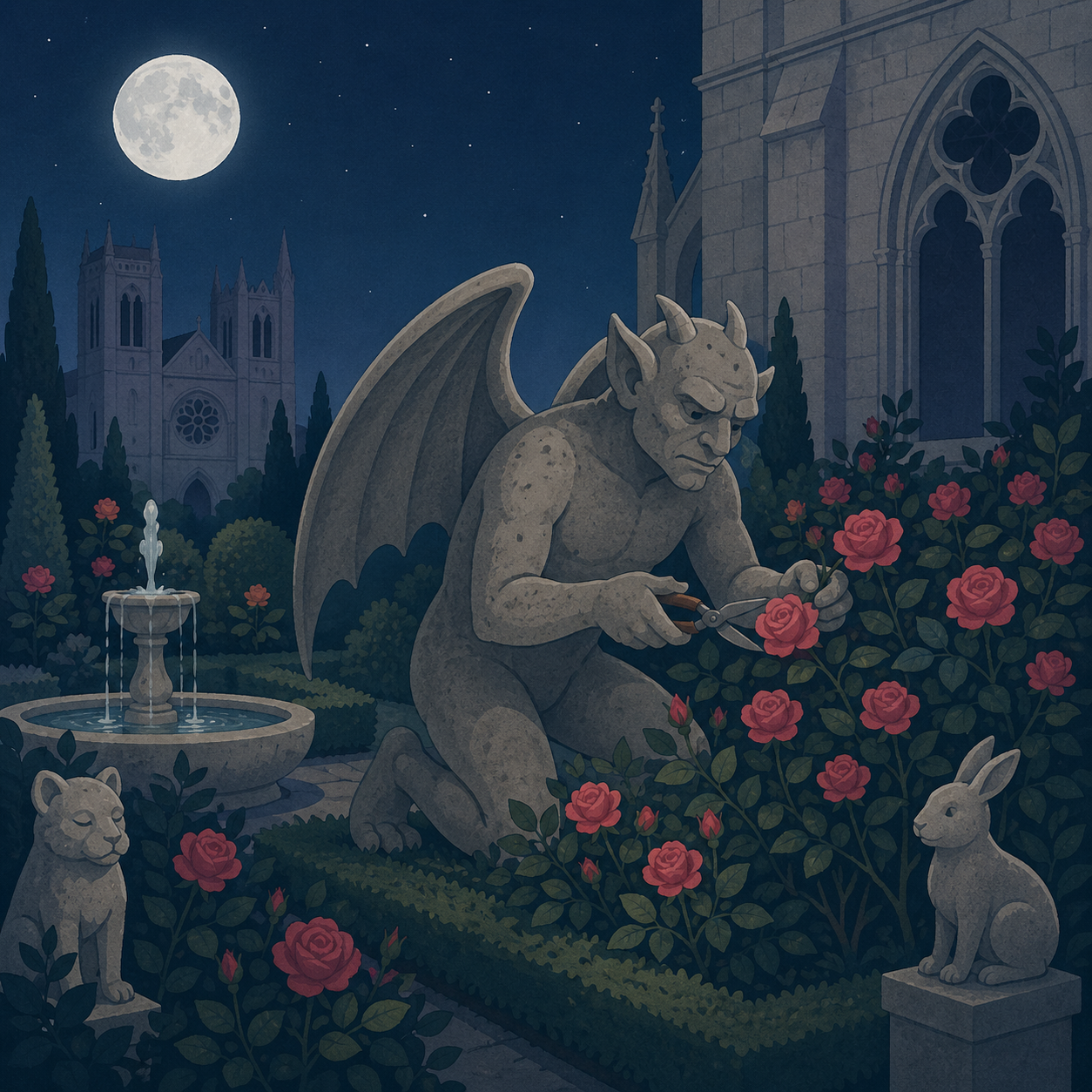
On the western parapet of Saint Orison’s Cathedral, between the bell tower and the broken drainpipe, crouched a gargoyle named Grimbold.
For three hundred and twelve years, he had squatted there with his stone claws curled over the edge of the roof, his blunt wings folded tight against his back, his mouth stretched in a permanent snarl meant to frighten sin, storm, and pigeons. He had horns like bent thumbs, eyes carved deep beneath a heavy brow, and a long tail that wrapped around the ledge like a question mark. Rain had darkened him. Wind had polished his nose. Snow had filled his ears every winter. Moss had once tried to make a home along his left shoulder until a lightning storm burned it away.
By day, Grimbold was only stone.
By night, when the last bell of midnight trembled through the cathedral stones and the moon found the leaded windows, he woke.
It happened as it always had. First came the soft ache in his claws. Then the grinding flex of his shoulders. Then the strange little pop behind his ribs as whatever passed for his heart remembered motion. His eyes, blind all day, opened to the night in shades of silver and blue. The whole city lay below him, roofs glimmering, chimneys sighing, alleys folded in darkness, river fog dragging its hem along the streets.
Grimbold stretched, and flakes of lichen fell from his elbows.
“Another night,” he said, though his voice was a rasp of pebble and gutter-water and no one was near enough to hear.
The other gargoyles stirred along the roofline. There was Marn, who had the head of a lion and the patience of a bishop; Selka, whose wings were cracked but whose tongue was sharper than any chisel; and old Twill, a stunted thing with a frog’s face and one missing foot, who had slept through the last plague and several royal funerals.
They did as gargoyles had always done after midnight. They shook off the stiffness of daylight, prowled the gutters, spat out leaves, chased owls, argued with bats, counted the sins of passersby, and kept watch over the cathedral.
Grimbold did all these things too. He had pride in his post. Saint Orison’s was not merely a church. It was a mountain of faith carved into the center of the city. Its spire stabbed the clouds. Its bells shook the bread from bakers’ shelves. Its windows burned red and gold at sunset. Pilgrims crossed themselves at the sight of it. Children pointed at the gargoyles and squealed. Old women whispered prayers beneath its doors.
Yet, for several years now, something had troubled Grimbold more than thieves, storms, or nesting crows.
The garden was a disgrace.
It spread beneath the south wall in what had once been a square of beauty. Grimbold remembered when the garden had first been laid, long ago, by a round monk with muddy knees and a laugh that shook his whole belly. Brother Ansel had planted rosemary for remembrance, lavender for calm, lilies for feast days, and roses because, as he had said while wiping sweat from his pink face, “Even stone beasts deserve something pretty to look at.”
Grimbold had pretended not to hear. At the time, he had considered roses frivolous things: soft, vain, and forever attracting bees. But secretly he had watched them every night.
He had watched white roses open like moonlit hands. He had watched red ones unfold with the dark, slow drama of a velvet cloak. He had watched yellow roses catch dawn before he froze back into stone. He had learned the smell of damp soil after rain, the patience of roots, the tender green insistence of new shoots rising from winter’s ruin.
Then Brother Ansel had died. Other gardeners came and went. Some were attentive, some careless, some more interested in smoking behind the sacristy than pruning. Eventually, the cathedral’s money grew thin, the city grew loud, and the garden fell out of mind.
By the year of Grimbold’s three hundred and twelfth waking, the garden had become an insult.
Weeds strangled the gravel paths. The rosebushes were tangled masses of thorn and dead cane. The lavender had gone woody and wild. A cracked statue of Saint Fiacre leaned drunkenly near the fountain, whose basin held nothing but rainwater, dead leaves, and one ambitious frog. Ivy crept over the low wall and reached for the stained-glass windows as if it meant to pull the whole cathedral down by patience alone.
Each night Grimbold glared at it from above.
“Look at that,” he grumbled.
Marn, who was dislodging a sparrow’s nest from his mane, glanced down. “At what?”
“At what? At that green catastrophe.”
“It is a garden,” said Marn.
“It was a garden. Now it is a riot with roots.”
Selka clacked her claws on the parapet. “The humans do not look up at us anymore. It follows they do not look down at flowers either.”
“They should,” said Grimbold. “It is their cathedral.”
“They are busy creatures,” said Marn. “Always dying, marrying, repenting, and buying onions.”
Grimbold snorted. A chip of old mortar flew from his nostril. “No excuse.”
Old Twill, hanging upside down from a gutter with his one good foot, said, “Eat the weeds.”
“I am not a goat.”
“Shame. Goats are useful.”
Grimbold said no more that night, but his eyes kept returning to the garden. The disorder offended him in a place deeper than thought. He had been carved to serve beauty through ugliness, to crouch monstrous on holy walls and keep the rain away from saints and sinners alike. He knew what it meant to have a purpose. The garden had lost its purpose. That was a sorrowful thing.
The following night, after the bells released him from stone, he climbed down.
Gargoyles were not graceful climbers in the way of cats or spiders. They moved with the heavy certainty of falling masonry that had changed its mind. Grimbold descended the cathedral wall claw by claw, wing by wing, tail braced in cracks, knees scraping carved saints and old inscriptions. He passed the south transept window, where moonlight turned blue through the glass robes of the Virgin. He passed a sleeping pigeon, which woke, saw his face, and fainted off the ledge before remembering its wings.
At last he dropped into the garden.
His landing shook dew from the weeds.
For a moment he stood still, overwhelmed. From the roof, the neglect had looked terrible. From the ground, it was intimate. Bindweed curled around the roses like pale green snakes. Slugs shone in the cabbage leaves of some forgotten vegetable patch. Dead stems scratched his shins. Somewhere in the thicket, a rat rustled with more confidence than any rat ought to have on consecrated ground.
Grimbold took one step and immediately became entangled in a blackberry cane.
It hooked around his ankle. He lifted his leg. The cane held fast. He tugged. The entire bramble patch shivered in protest.
“Impudent twig,” he muttered.
A thorn scratched his stone calf with a sound like a knife on crockery. Grimbold narrowed his eyes. He took the cane in both hands and pulled.
Roots gave way. Soil burst upward. A long whip of bramble came free, flinging dirt across his chest. Grimbold stared at the root ball dangling from his fist.
Something small and warm stirred in him.
“Hm,” he said.
By dawn, he had torn up half the brambles, uprooted a regiment of nettles, and cleared three flagstones of the path. He had also accidentally crushed a thyme bed, startled the frog into the sacristy drain, and stepped on the handle of an old forgotten trowel, which flew up and struck him between the horns.
When the first gray light touched the spire, Grimbold scrambled back to his perch. As the sun rose, his body stiffened. His claws locked over the parapet. His scowl returned to its daytime shape.
Below, the garden looked as though a small, very angry storm had passed through it.
At seven o’clock, the cathedral verger, Mr. Peel, unlocked the south gate and stopped dead.
Mr. Peel was a narrow man with a long nose, a ring of keys, and a lifelong suspicion of surprises. He stared at the uprooted brambles piled beside the path. He stared at the newly visible flagstones. He stared at the trowel lying in the fountain.
“Father Alden?” he called.
Father Alden, the dean of Saint Orison’s, came out with his spectacles low on his nose and a slice of toast in one hand. He was a kind man with tired shoulders and a habit of seeing Providence in minor conveniences.
“What is it?”
“The garden, Father.”
Father Alden blinked at the cleared path. “Ah.”
“Ah?”
“Someone has been helpful.”
“Someone has been trespassing.”
“Perhaps both.”
Mr. Peel pointed at the heap of brambles. “Who trespasses in the night to weed?”
“A penitent gardener?”
“With arms like a horse?”
Father Alden looked up toward the gargoyles. Grimbold, frozen in stone, stared furiously over the city.
“Well,” said the priest, “we might thank God for small mercies.”
Mr. Peel frowned. “I shall thank Him after I check the locks.”
That night, Grimbold woke with dirt still packed beneath his claws.
Selka peered at him. “You smell like worms.”
“I smell like industry.”
“You have gardened.”
“I have corrected an offense.”
Marn looked down at the south wall. “The humans noticed.”
“They should have noticed years ago.”
Old Twill scratched his chin on the gutter. “Did you eat the weeds?”
“No.”
“Wasteful.”
Grimbold ignored them and began his descent again.
He found, in the gardener’s shed behind the chapter house, a pair of rusted shears, a rake with four missing teeth, a coil of twine, and a book swollen with damp. The book was titled The Gentle Art of Roses, though half the pages stuck together. Grimbold opened it with one claw and squinted at an illustration of a proper pruning cut.
“Cut above an outward-facing bud,” he read slowly. Gargoyles could read, though not all of them admitted it. They learned by watching masons carve names into tombs, by studying banners, by listening to sermons, and by being trapped in one place for centuries with nothing else to do.
He looked at the nearest rosebush. It had many buds, most of them inward-facing, outward-facing, sideways-facing, and possibly despair-facing.
“You,” he said to the bush, “will cooperate.”
The rosebush did not answer.
Grimbold raised the shears. The handles were small for his hands, but he managed. Snip. A dead cane fell. Snip. Another. Snip, snip, snip. He worked cautiously at first, tongue caught between his teeth, then with growing confidence. He cleared the center of the plant, removed crossing branches, trimmed the dead wood, and tied the living stems to an old iron support.
By the end, the bush looked alarmingly bare.
Grimbold consulted the book.
“Severe pruning may appear drastic,” he read, “but encourages vigorous growth.”
He nodded. “As do sermons.”
He moved to the next rose.
Night after night, Grimbold worked. He learned the language of tools. The rake was for gathering leaves, yes, but also for leaning upon while considering matters. The hoe was good for weeds, though it objected to stones. The watering can leaked from three places, but if held at the right angle it rained generously. Twine held climbing roses better than strips torn from old choir notices, though both would do. Gloves were useless; his claws pierced them immediately.
He learned the moods of plants. Lavender resented being cut too far into old wood. Rosemary liked poor soil and discipline. Foxgloves were beautiful but not to be trusted. Ivy was a villain with excellent persistence. Roses, he discovered, were noble, vain, vicious, generous creatures. They stabbed him constantly. He admired them for it.
The city slept while Grimbold labored beneath the moon. He cleared paths, edged beds, divided clumps of iris, dug compost into exhausted soil, and hauled fallen branches away. He washed the fountain basin and returned the frog, who looked offended but remained. He righted Saint Fiacre with a lever, three bricks, and several words not approved by the clergy.
And always, before dawn, he left something behind.
The first sculpture was an accident.
He had broken a piece of limestone from the old wall while wrenching out ivy. The fragment was soft compared to his own weathered body, and while thinking about how to stake the delphiniums, he began scraping it with one claw. When the bell rang four, he looked down and found he had carved a small stone snail with a solemn face.
“Hm,” he said.
He placed it beside the fountain.
The next day, two choirboys found it.
“Look!” cried Peter Bell, whose cassock was always too short. “A snail!”
“It is not a real snail,” said Thomas Wren, who distrusted wonder on principle.
“I know that. It’s stone.”
“Who put it there?”
Peter looked around the garden, which seemed different every morning now. The paths were clearer. The roses were trimmed. Little heaps of weeds appeared by the gate as though delivered by invisible barrow.
“The garden ghost,” Peter whispered.
Thomas’s eyes widened. “There is no garden ghost.”
“Then who made the snail?”
Thomas had no answer, which irritated him. He picked up the snail, but Father Alden, passing by with a prayer book, said, “Leave him be, Thomas. He seems comfortable there.”
By the end of the week, the snail had been joined by a beetle the size of a plum, three curled leaves, and a tiny bishop with a watering can.
Rumors took root faster than bindweed.
Some said an old gardener had returned from the grave. Others said a shy sculptor was beautifying the cathedral anonymously. Mr. Peel suspected students from the art college and began locking the gate twice. The locks did nothing. Grimbold came by the wall.
Within a month, people began visiting the south garden again.
At first they came after Sunday service, curious about the rumors. They found the roses sending out fresh red shoots, the fountain cleaned, the paths swept, and small stone creatures tucked among the plants. Children crouched to discover lizards beneath hostas, owls in the crooks of apple branches, mice beside the steps, and once, astonishingly, a tiny stone dragon asleep in a flowerpot.
Father Alden watched them with quiet pleasure.
Mr. Peel watched them with suspicion.
“No one works for free,” he said.
“Some do,” said Father Alden.
“Not well.”
The priest gestured toward the garden. “Well enough, I think.”
Mr. Peel narrowed his eyes at a newly carved squirrel holding an acorn. “It has a mocking expression.”
“Perhaps the acorn is heavy.”
“It is mocking me specifically.”
From his perch, Grimbold was not displeased.
He did not care for applause. Applause was for organists, actors, and saints’ days. But he liked seeing people notice the garden. He liked the way old women paused to smell roses. He liked the way children hunted for sculptures. He liked the way grief changed shape in the garden: mourners came from funerals hollow-eyed and silent, then found themselves sitting by the fountain, watching bees move through lavender. He liked, most of all, the roses.
By summer, they had rewarded him.
The first bloom opened on a June night.
Grimbold had been repairing a border of boxwood when the scent reached him. It was not a loud scent. Not like lilies, which announced themselves like trumpet blasts. This was deeper, rounder, with a sweetness held in reserve. He turned.
On the oldest rosebush, the one Brother Ansel had planted nearest the wall, a single crimson rose had unfolded.
Grimbold stood before it as if before an altar.
The petals were dark at their edges and glowing near the heart. Dew gathered along them, each drop holding a crooked image of moon and gargoyle. The bloom moved slightly in the night breeze, alive in a way stone could never be and yet somehow kin to all patient things.
“Well,” Grimbold said softly. “There you are.”
He did not touch it. His claws were too rough.
The rose trembled.
For the rest of the night, he worked more gently than usual.
The garden became famous by accident.
Someone from the city newspaper came to write about the cathedral roof repairs and instead saw the stone sculptures. The next week, an article appeared under the title MYSTERY ARTIST TRANSFORMS CATHEDRAL GARDEN. It included a blurry photograph of Father Alden standing beside a rose arbor and looking embarrassed. Visitors began arriving from other parishes, then from other towns. Donations appeared in the poor box marked For the Garden. A woman brought packets of seed. A retired schoolmaster donated two pear trees. The art college students, tired of being accused, held a public sketching afternoon among the flowerbeds.
Mr. Peel installed a sign: PLEASE DO NOT REMOVE THE SCULPTURES.
Below it, someone added in pencil: THE GARDEN GHOST IS WATCHING.
Grimbold found this deeply satisfying.
“I am not a ghost,” he told Selka that night.
“No,” she said. “You are a gardener. Much worse.”
Marn had begun accompanying him sometimes, though he claimed only to enjoy the view from the lower buttresses. He was too large to be delicate, but he could carry bags of manure from the shed without complaint. He considered compost philosophically.
“All things return,” Marn observed, emptying a sack into a barrow.
“That is not philosophy,” said Grimbold. “That is rot.”
“Rot is philosophy with worms.”
Old Twill helped only once, by eating several slugs. He then declared himself indispensable and retired to the roof for six nights.
Selka refused to garden, but she liked the sculptures. She perched nearby while Grimbold carved and offered criticism.
“The rabbit’s ears are too cheerful.”
“It is a rabbit,” said Grimbold.
“Rabbits know fear. Put fear in the ears.”
He did. The rabbit was much improved.
As the garden flourished, so did Grimbold’s secret pride. He rose each midnight with purpose. He studied seed catalogs discarded in the verger’s office. He memorized the phases of the moon, the best time to transplant, the signs of mildew, the difference between a climbing rose and a rambling rose. He built a trellis out of old ironwork salvaged from the crypt. He trained honeysuckle over the gate. He planted night-blooming stock beneath the windows so its perfume would rise after evening prayers.
He also became bold.
Too bold, perhaps.
One night in late August, he was clipping spent blooms by the path when he heard the south gate creak.
Grimbold froze.
A small figure slipped into the garden carrying a lantern.
It was not Mr. Peel. It was not Father Alden. It was a girl of about twelve, thin as a beanpole, with two dark braids and a coat too large for the season. She moved with the practiced caution of someone accustomed to being unwelcome. In one hand she held the lantern. In the other she carried a cloth bundle.
Grimbold crouched behind the rose arbor, though crouching did little to hide a seven-foot gargoyle with wings.
The girl set the lantern on the fountain edge and unwrapped the bundle. Inside was a broken stone wren.
Grimbold knew it at once. He had carved it three nights earlier and placed it near the choir door. Its tail had snapped off.
The girl sniffed. “I told Jamie not to touch it,” she whispered.
She took something from her pocket: glue, stolen perhaps from a schoolroom. With careful fingers, she tried to fit the tail back onto the bird.
Grimbold watched.
The girl’s hands shook. The tail slipped. She caught it, swore softly, then looked around as if expecting saints to scold her.
“You need a pin,” Grimbold said without thinking.
The girl screamed.
The sound flew up the cathedral wall and startled every pigeon on the south roof into explosive flight.
Grimbold clapped both hands over his mouth.
The girl stumbled backward, knocking over the lantern. The flame went out. Moonlight silvered her terrified face as she stared at him.
For one second, neither moved.
Then she opened her mouth to scream again.
“Do not,” Grimbold said.
She shut it.
He tried to make his voice gentle. Unfortunately, his gentle voice sounded like a coffin dragged over gravel.
“I will not hurt you.”
The girl’s eyes traveled from his horns to his claws to the shears in his hand.
Grimbold looked at the shears. “These are for roses.”
“That does not make me feel better,” she whispered.
“No. I see that.”
He set the shears on the ground and stepped back. His tail knocked a pot over. It shattered.
The girl flinched.
“Apologies,” he said.
She stared harder. “You are the garden ghost.”
“I am not a ghost.”
“You are a demon?”
“Certainly not.”
“A monster?”
Grimbold considered. “Architectural.”
Her fear faltered. “What?”
“I am a gargoyle.”
“Gargoyles do not garden.”
“Plainly, some do.”
The girl looked around at the moonlit beds, the trimmed roses, the small stone animals watching from leaves and ledges. Her breathing slowed.
“You made them,” she said.
“Yes.”
“And the flowers?”
“I encouraged them.”
She picked up the broken wren. “My brother broke this. He did not mean to. He is little and awful.”
“Most little brothers are.”
“I wanted to fix it before anyone saw.”
Grimbold held out one claw. “May I?”
She hesitated, then placed the wren and its tail in his palm. Her fingers brushed his stone skin. She frowned.
“You are cold.”
“I am stone.”
“But alive.”
“Only at night.”
“That sounds inconvenient.”
“It has limitations.”
The girl forgot, for a moment, to be afraid. “My name is Mara.”
“Grimbold.”
“That is a gargoyle name.”
“It has served.”
He found a thin sliver of wire in the shed, pierced both pieces of the wren with a careful claw, and joined the tail to the body. He mixed stone dust and a little mortar, smoothed the seam, and held the bird up.
“There,” he said. “Stronger than before.”
Mara took it with awe. “You can fix anything?”
“No.”
The answer came more quickly than he expected.
She looked up. “Can you fix people?”
Grimbold was silent.
Mara’s face changed. Childhood curiosity closed like a shutter, and something older stood behind it. “My mother used to come here,” she said. “Before she was sick. She liked the roses. She said the cathedral garden was where sad thoughts learned manners.”
Grimbold glanced toward the oldest rosebush. “Your mother has taste.”
“She died in March.”
“I am sorry.”
He had heard those words from humans often enough to know they were poor tools for grief, but they were the tools available.
Mara sat on the fountain edge. “Father Alden says she is with God.”
“Priests say that.”
“Do you think it is true?”
Grimbold looked up at the cathedral, at the dark windows, at the saints carved in stone, at the spire piercing the stars. He had been made to guard holy things, but not to explain them.
“I think,” he said slowly, “that roots continue where we cannot see them.”
Mara turned this over. “That sounds like something from a sermon.”
“I hear many sermons.”
“Do you believe them?”
“I believe in rain. I believe in stone. I believe that dead canes must be cut away or the rose weakens. I believe that what is buried may rise in spring, though not always in the shape we miss.”
Mara’s eyes filled, but she did not cry.
Grimbold pretended not to notice. Gargoyles understood the dignity of pretending not to notice.
After that night, Mara came often.
She was careful. She came after midnight only when her aunt, with whom she now lived, worked late at the infirmary. She brought things: a spool of copper wire, a cracked mug for seedlings, a book on birds, once a heel of bread which Grimbold accepted solemnly and later gave to the ducks in the bishop’s pond because gargoyles had no use for bread unless it was fossilized.
Mara became his apprentice.
She could weed where his claws were too clumsy. She could tie stems without breaking them. She learned to sharpen shears, though Grimbold insisted she keep both hands well away from the blades. She knew the names of common birds and invented names for insects she did not. She told him which sculptures children liked best, which adults pretended not to like and secretly did, and which parishioners had tried to take cuttings without asking.
“Mrs. Vale stole a sprig of lavender,” Mara reported one night.
“Was she stealthy?”
“No. She got her sleeve caught and blamed the bush.”
“Then the bush has punished her.”
Mara grinned. “Should we plant more lavender?”
“Obviously.”
Together they restored the garden beyond what Grimbold could have done alone. Under Mara’s guidance, the small sculptures became part of a game. A stone fox peered from ferns. A procession of ants marched along the low wall. A mermaid appeared in the fountain basin, visible only when the water was clear. Grimbold carved a series of wrens in honor of the repaired one, hiding them throughout the grounds. Mara wrote a list in a school notebook: The Wren Count. Visitors began trying to find all thirteen.
For the first time in three centuries, Grimbold had a friend who was not made of stone, carved for a roof, or deeply interested in eating slugs.
It troubled him.
Humans were temporary in a way flowers were temporary, but less honest about it. Flowers bloomed, faded, seeded, and returned if luck allowed. Humans hurried about as if permanence might be achieved by appointment books and locked doors. Brother Ansel had been temporary. All the gardeners after him had been temporary. Mara, bright and sharp and wounded, was temporary too.
So Grimbold taught her what he could. Not because he feared losing her, he told himself, but because apprentices should learn.
He taught her to cut above an outward-facing bud, to water deeply rather than often, to welcome ladybirds, to mistrust black spot, to loosen roots before planting, to label seedlings because memory was a treacherous creature, and to never apologize to bindweed.
“Why not?” she asked.
“It interprets kindness as surrender.”
In return, Mara taught him the city.
She told him about the market, where fishmongers shouted as if volume improved cod. She told him about tram bells, schoolmasters, window displays, and how children dared one another to touch the cathedral door at night. She told him about the war memorial where her father’s name was carved, though she had been too young to remember him. She told him about her mother’s laugh, her mother’s hands, her mother’s habit of rescuing half-dead plants from rubbish bins.
“She would have liked you,” Mara said once while planting bulbs.
Grimbold was so startled he snapped a trowel in half.
Autumn came.
The garden changed its robes. Roses gave their last flush of bloom. The pear trees blushed yellow. Leaves gathered in corners faster than Grimbold could rake them. The air smelled of smoke, damp earth, and chrysanthemums. Visitors still came, wrapped in scarves, to admire the sculptures and walk the paths.
Then, in November, the bishop noticed the money.
Noticed, in this case, meant that a clerk showed him the increase in cathedral donations, visitor traffic, and mentions in newspapers. The bishop of Lartham was a magnificent man with silver hair, polished shoes, and an expression of constant benevolent calculation. He arrived at Saint Orison’s in a black motorcar and toured the garden with Father Alden and Mr. Peel.
Grimbold watched from above in daylight, helpless stone.
The bishop admired the roses, though they were mostly hips by then. He admired the sculptures. He admired the visitors admiring the sculptures. Then he said something that made Father Alden’s face tighten.
That night, Mara arrived upset.
“They want to make the garden official,” she said.
Grimbold, who was carving a hedgehog, paused. “It is already a garden.”
“No, official. With tickets for special tours. And a gift stall. And they want to move the sculptures indoors during winter. The bishop said they need to be cataloged and preserved.”
Grimbold stared at the hedgehog. Its nose was unfinished.
“Preserved,” he repeated.
“Father Alden said the garden belongs to everyone. The bishop said exactly.”
“That sounds slippery.”
“Mister Peel said if the artist would reveal himself, proper arrangements could be made.”
Selka, listening from the wall, barked a laugh. “Proper arrangements! I adore humans. They put cages around wonder and call it management.”
Grimbold set down the stone.
Mara looked at him anxiously. “What will you do?”
“Nothing.”
“Nothing?”
“I cannot appear before the bishop with a rake and discuss artistic rights. By day I am stone. By night I am trespassing.”
“But it is your work.”
Grimbold looked around the garden. The paths, the beds, the fountain, the small stone creatures tucked among leaves. His work, yes. But not his alone. The roses had worked. Rain had worked. Worms had worked. Mara had worked. Even old Brother Ansel’s memory had worked.
“What matters,” he said, “is that the garden lives.”
“And if they ruin it?”
His claws curled. “Then I shall be displeased.”
The bishop’s plan unfolded with administrative speed.
A notice appeared: THE CATHEDRAL MYSTERY GARDEN — WINTER EXHIBITION COMING SOON. Mr. Peel, under orders and with great discomfort, began collecting the smaller sculptures in wooden crates. Father Alden argued quietly in offices. Mara tried to hide several wrens in her coat but was caught by a curate. Visitors complained and then bought postcards. The garden, stripped of its hidden creatures, seemed suddenly less alive.
Grimbold was furious.
He had known neglect. Neglect was lazy cruelty. This was different. This was admiration with gloves on, admiration that uprooted the very thing it praised.
At midnight, he dropped into the garden and found three crates stacked near the shed. Inside lay his sculptures wrapped in straw: the snail, the fearful rabbit, the bishop with watering can, the wrens, the fox, the beetles, the tiny dragon.
“They look dead,” Mara whispered.
She had been waiting by the fountain.
Grimbold lifted the snail. Straw clung to its face.
Mara wiped her nose with her sleeve. “Can we put them back?”
“They will only remove them again.”
“Can we hide them?”
“For how long?”
“Then what?”
Grimbold looked toward the cathedral. Its windows were dark. Its tower rose into the clouded sky. All along the roofline, the gargoyles crouched in their ancient places.
A thought took shape in him, slow and heavy and dangerous.
“The bishop wants an artist,” he said.
Mara blinked. “Yes.”
“Then perhaps he should have one.”
Selka, from the wall, leaned forward. “Oh, this will be interesting.”
“No,” said Marn.
Grimbold looked up. “No?”
Marn’s lion face was grave in the moonlight. “We are watchers. We frighten shadows and shed rain. We do not reveal ourselves.”
“Who made that rule?”
“The masons. The priests. Time.”
“Time made weeds too. I pull them.”
Marn’s wings shifted. “Humans fear what moves where they expect stillness.”
“Good,” said Selka. “Fear is bracing.”
Marn ignored her. “They may harm you.”
Grimbold glanced at his stone hands. “They may try.”
“They may fear the cathedral itself.”
That struck deeper.
For centuries, children had pointed up at Grimbold with delighted terror. Pilgrims had taken comfort in monstrous guardians. But a moving gargoyle in a garden might not be comfort. It might be nightmare. It might empty the pews. It might bring hammers, scholars, soldiers, newspapers, cages.
Mara stepped closer. “You do not have to.”
Grimbold looked at her. The lantern light warmed her face. She was trying to be brave enough to let him choose.
He thought of Brother Ansel planting roses for stone beasts. He thought of the first crimson bloom. He thought of mourners breathing easier by the fountain. He thought of sculptures wrapped in straw.
“No,” he said. “I do not have to.”
He set the snail back in its crate.
Then he climbed to the roof.
The next morning, Saint Orison’s woke to a miracle or a scandal, depending on whom one asked.
Every gargoyle on the south side of the cathedral held something.
Marn held a stone garland of oak leaves between his great paws. Selka held a carved raven with its beak open in eternal mockery. Old Twill held three stone slugs and looked inordinately proud. Lesser gargoyles along the transept clutched flowers, birds, vines, and small beasts carved in the unmistakable style of the garden ghost.
Grimbold, on his parapet, held the stone snail.
No one knew how the sculptures had been placed so high. Ladders could not have reached half the perches. The roof door was locked. Mr. Peel nearly swallowed his own whistle.
By noon, a crowd filled the close.
By two, a photographer arrived.
By four, the bishop returned.
Theories erupted. Students had done it. Angels had done it. A secret society of masons had done it. Father Alden smiled in a way that made Mr. Peel suspicious.
The bishop declared it “a most inspired development” and suggested the winter exhibition could include rooftop viewing platforms.
That night, Grimbold said several words that made Mara cover her ears.
“They missed the point entirely,” he snarled, pacing along the parapet.
Selka was delighted. “Of course they did. Humans can miss a point at ten paces in full daylight.”
Marn looked troubled. “What now?”
Below, lanterns glowed around the garden. The bishop had posted two watchmen to catch the mystery artist in the act. They sat near the gate with blankets, pipes, and the bored confidence of men guarding against other men.
Grimbold stopped pacing.
“What now?” he repeated.
He looked at the garden, at the watchmen, at the stripped beds, at the empty places where his creatures had been. He looked at Mara, waiting in the shadow of the bell tower, face upturned.
Then the cathedral bell began to toll midnight.
The sound moved through stone, through bone, through root and rose cane. It rolled over the city. It shook the pigeons. It trembled in Grimbold’s chest.
He descended the south wall in full view of the watchmen.
The first watchman saw him halfway down, pipe falling from his mouth.
The second said, “What is that?”
Grimbold dropped the last twelve feet and landed on the path with a crack that split one flagstone.
The watchmen ran.
To their credit, they ran in opposite directions, increasing the chance that one of them might survive to be disbelieved.
Mara stepped from the shadows. “That was subtle.”
“I am not aiming for subtle.”
He went to the crates, opened them, and began returning the sculptures to their places. Mara helped. So did Marn, after a long sigh, and Selka, who claimed she merely wanted to see the bishop’s face. Old Twill carried the slugs personally.
They worked as the alarm spread.
Lights flared in the deanery. Mr. Peel appeared in a nightshirt, boots, and a helmet from an old pageant costume. Father Alden came with a lantern and no surprise at all. Behind them, half the cathedral staff gathered in various states of terror, fascination, and insufficient clothing.
Grimbold placed the snail by the fountain and turned.
No one spoke.
The garden held its breath.
Mr. Peel raised a trembling finger. “Father.”
“Yes, Mr. Peel?”
“There is a gargoyle in the garden.”
“So there is.”
“It is moving.”
“Yes.”
“With the snail.”
“I see.”
Mr. Peel fainted.
Father Alden handed his lantern to Mara and knelt beside the verger. Then he looked at Grimbold.
“Good evening,” he said.
Grimbold bowed awkwardly. His wings knocked leaves from the pear tree. “Father.”
“I wondered when we might properly meet.”
Mara stared at him. “You knew?”
Father Alden smiled. “My child, gardeners leave footprints. Our mysterious benefactor left claw marks in the compost, pruned roses with the reach of a ladder, and once forgot a chisel on a buttress thirty feet above the ground. I am old, not blind.”
Grimbold felt obscurely embarrassed.
The bishop arrived ten minutes later in a cloak thrown over his nightclothes, his silver hair wild for the first time in public memory. He stopped at the gate when he saw Grimbold.
“What,” he said faintly, “is the meaning of this?”
Grimbold had prepared no speech. He was a gargoyle, not an orator. He knew sermons by endurance, not practice. But the bishop had ordered the garden altered, the sculptures caged, the living mystery made profitable and tidy. Anger gave Grimbold words.
“This garden,” he said, “was planted for beauty. It was neglected. I mended it. Others loved it. You saw that love and tried to put it in boxes.”
The bishop opened his mouth, closed it, and opened it again. “This is highly irregular.”
“So are roses,” said Grimbold. “Cut them to stumps and they bloom. Bury bulbs and they rise. Add manure and beauty happens. The world is irregular.”
Selka applauded silently from the wall.
The bishop drew himself up. “The cathedral has responsibilities. Preservation, safety, order—”
“Order is not the same as life,” Grimbold said.
Father Alden’s eyes warmed.
Grimbold continued, slower now. “Leave the creatures in the garden. Let children find them. Let mourners sit among them. Let the roses climb where roses should. Ask for donations if you must. Humans are always asking for coins. But do not make the garden a museum of itself.”
The bishop looked around.
Perhaps it was the hour. Perhaps it was the sight of living gargoyles perched along the walls with carved birds and slugs in their claws. Perhaps it was Mara, standing beside the fountain with her chin lifted. Perhaps it was Father Alden’s silence, which had the weight of a sermon. Or perhaps the bishop, beneath his polish and calculation, had once loved some small living thing and remembered what happened when admiration became possession.
He exhaled.
“And you,” he said carefully, “would continue to maintain it?”
Grimbold folded his arms. “If not interfered with.”
The bishop glanced at the cracked flagstone where Grimbold had landed. “And perhaps with some agreement about structural damage.”
Grimbold followed his gaze. “I can use the stairs.”
“No,” Mr. Peel murmured from the ground. “Absolutely not.”
Father Alden helped him sit up. “Peace, Mr. Peel.”
The bishop looked at Mara. “And this child?”
“My apprentice,” said Grimbold.
Mara’s face went crimson with pride.
“Does her guardian know she is here?”
Mara’s pride faltered.
Father Alden coughed. “We can address practical matters in daylight.”
“No,” said the bishop, recovering some of his authority. “We shall address them sensibly. In daylight. With tea.”
Thus began the strangest arrangement in the history of Saint Orison’s Cathedral.
The official explanation, printed in careful language, said that the cathedral garden was maintained by an anonymous artist collective working in spiritual partnership with the parish. This fooled no one who had been present that night and satisfied everyone who had not. The bishop, to his credit, did not order Grimbold studied, blessed, exorcised, or insured, though he did ask Father Alden privately whether gargoyles were subject to diocesan oversight. Father Alden replied that, as far as he knew, gargoyles predated the current committee structure.
Mara’s aunt was told a version of the truth.
She was a practical woman named Elise, with tired eyes and strong hands from years at the infirmary. When she first met Grimbold, she stared for a long time, then said, “My niece is not to be dropped from any height.”
“I would never,” said Grimbold, offended.
“She must be home before dawn.”
“Yes.”
“She needs proper sleep on school nights.”
Mara groaned. “Aunt Elise.”
“And if she is learning gardening, she will learn it properly. Latin names, soil health, the lot.”
Grimbold inclined his head. “Agreed.”
Elise looked him over. “You are the one who planted the winter jasmine?”
“Yes.”
“It is too close to the wall.”
Grimbold blinked.
Mara smiled into her scarf.
Elise became, unexpectedly, an ally.
The winter that followed was hard. Frost silvered the beds. The fountain froze. The roses stood bare and thorned against the cold. Grimbold and Mara mulched roots, wrapped tender shrubs, cleaned tools, and planned spring. On bitter nights, when Mara was kept home, Grimbold worked alone beneath the stars, carving more slowly because cold made his fingers stiff even after midnight.
He made sculptures not merely of animals now, but of moments.
A stone hand releasing seeds. A boot with a violet growing through the sole. A small girl kneeling beside a rose, not a likeness of Mara exactly, but near enough that she shoved him when she saw it. He carved Brother Ansel from memory: round, muddy-kneed, laughing forever near the oldest rosebush.
When Father Alden saw that one, he removed his spectacles and wiped them for quite some time.
Spring returned with a force that made every winter doubt seem foolish.
Crocuses pierced the lawn. Daffodils shook gold heads beneath the wall. Tulips rose like painted cups. The pear trees foamed white. The roses, pruned hard in February, threw out red shoots so vigorous that Grimbold walked among them like a general inspecting troops.
“Well done,” he told them.
Mara rolled her eyes. “They cannot hear you.”
“They can hear better than bishops.”
Visitors came in greater numbers than ever, but now the garden had rules that protected its soul. No tickets for ordinary entry. Donations welcome but not demanded. Sculptures remained where they were placed. Children were encouraged to search but not snatch. Cuttings could be requested, not stolen. Mrs. Vale, under the new system, received lavender openly and cried with gratitude, which embarrassed everyone including the bush.
The story of the living gargoyle spread, of course. Secrets with wings seldom stay folded. Some came hoping to see Grimbold move, but by day he was stone, and by night the gates were closed. A few scholars wrote letters. The bishop misplaced most of them. An ambitious journalist hid behind the yew hedge until Selka dropped a pebble into his hat and whispered, “Boo.” He did not return.
The city adjusted.
People are more capable of wonder than they fear and less capable of certainty than they pretend. In time, Saint Orison’s living gargoyle became one of those things everyone knew and no one discussed too loudly. Bakers left stale rolls for “the roof birds.” Children waved goodnight to the gargoyles. Gardeners from around the city sent questions to the cathedral in sealed envelopes: What is eating my roses? How do I revive old lavender? Is it true gargoyles dislike hydrangeas? Grimbold dictated answers to Mara, who improved his spelling and softened his remarks about incompetence.
Years passed.
Mara grew taller. Her braids became a knot pinned at the back of her head. She studied botany, then sculpture, then the restoration of old gardens. She left the city for a time, as humans do when they are young and believe distance is a door to themselves. Grimbold pretended not to mind. He received her letters by way of Father Alden, then, after Father Alden died peacefully in his chair by the library fire, by way of Mr. Peel, who had grown less narrow and more stooped but remained suspicious of surprises.
Mara wrote of glasshouses, alpine flowers, Roman ruins tangled with caper bushes, and roses trained over walls older than kingdoms. She enclosed pressed leaves. Grimbold kept them in a tin box hidden behind a loose stone near his perch.
The garden continued.
Marn carried compost. Selka criticized topiary. Old Twill finally admitted slugs were not a complete gardening philosophy. The bishop retired and was replaced by another, who found among his predecessor’s papers a note reading: Do not interfere with the gargoyle. He knows roses.
Mara returned at thirty with weather-browned hands, a calm gaze, and a leather roll of tools. She stood at the south gate in the blue hour before midnight and looked at the garden as if it were a person she loved.
When the bell struck twelve, Grimbold woke and looked down.
“You are late,” he called.
“By twelve years?”
“Approximately.”
She laughed, and the sound moved through him like spring rain through dry soil.
She became the cathedral’s official head gardener, though everyone knew the title was shared. Under her care, and Grimbold’s, the garden deepened rather than expanded. They planted for bees, for shade, for winter scent, for memory. They made a bed of white roses for Father Alden, who had liked quiet miracles. They planted fierce red roses beneath Grimbold’s parapet, because Mara said they matched his temperament. They placed Brother Ansel’s sculpture where morning light touched his laughing face.
And the stone creatures multiplied.
No one knew exactly how many there were. The official guide listed eighty-seven. Children insisted there were more if one knew where to look. Some sculptures were no bigger than walnuts. Others were large enough to sit beside. A stone fox weathered green. The first snail grew soft at the edges from generations of fingers stroking its shell for luck. The repaired wren remained near the fountain, its mended tail almost invisible unless you knew where to look.
One evening in Mara’s old age, when her hair had gone the color of moonlit mortar and her hands trembled too much for fine pruning, she sat by the fountain wrapped in a shawl. Grimbold crouched beside her, enormous and unchanged, though rain had deepened the lines of his face.
The garden breathed around them.
Roses climbed the walls in crimson, blush, apricot, and white. Lavender hummed with bees settling for the night. The fountain whispered. The cathedral windows held the last bruised colors of sunset. Above, the other gargoyles stretched and muttered awake.
Mara touched the repaired wren with one finger.
“I used to think,” she said, “that you fixed the garden.”
“I did.”
She smiled. “Modest as ever.”
“I have many virtues.”
“You fixed some of it,” she said. “But mostly you noticed it was alive.”
Grimbold considered this.
Mara leaned back. “That is rarer than fixing.”
He looked at the roses. Their blooms opened and fell, opened and fell, year after year. Their roots gripped the dark. Their thorns caught moonlight. They had outlived neglect, admiration, weather, bishops, and grief. Not unchanged, no. Nothing alive stayed unchanged. But alive.
“You were a good apprentice,” he said.
“I became head gardener.”
“Eventually.”
She laughed, then coughed, then grew quiet.
Grimbold did not ask if she was dying. Gargoyles knew the shape of endings. They perched among them. They guarded doors through which all humans eventually passed.
Mara closed her eyes. “When I go, do not carve me too pretty.”
“I would not dare.”
“Make my nose right.”
“Your nose is difficult.”
She opened one eye. “Impudent stone.”
“Temporary mammal.”
She smiled again, satisfied, and sat with him until the stars came out.
When Mara died, the whole city came to the garden.
They filled the paths and stood beneath the roses. Children who had once searched for wrens came with children of their own. Old Mr. Peel, impossibly still alive, leaned on a cane and cried openly. The current dean spoke of service, beauty, patience, and the holy work of tending what cannot be owned. Grimbold, stone by day, crouched above them with rainwater streaking his face.
That night, he did not garden.
He sat by the fountain until nearly dawn, holding a block of limestone in his lap.
For many nights after, he carved.
He did not carve Mara as a child or an old woman, though he remembered both. He carved her kneeling beside a rosebush, one hand extended, not touching the bloom but near it. Her face was turned slightly upward, listening. Her nose, after three attempts and a great deal of muttering, was right.
He placed the sculpture near Brother Ansel.
At its base, in letters small enough that visitors had to kneel to read them, he carved:
SHE NOTICED WHAT WAS ALIVE.
Years folded into decades.
The garden endured.
Cathedrals are built to convince time to slow down, but gardens know better. They accept time, feed on it, answer it in green. Saint Orison’s stone darkened. Its bells were recast. Its roof was repaired twice. Bishops came and went. Mr. Peel became a story told to new vergers. The city grew taller around the cathedral, louder, brighter, stranger. Electric lights replaced gas lamps. Motorcars replaced horses. People carried little glowing rectangles and used them to photograph the snail.
Grimbold remained.
Each midnight, he woke on the western parapet. He stretched his claws, shook rain from his wings, and looked down at the garden.
There was always work.
There were roses to prune, leaves to rake, seedlings to thin, paths to sweep, sculptures to mend, ivy to rebuke, children’s lost toys to place on the wall for morning discovery. There were new gardeners now, trained in schools and by Mara’s old notebooks, who left tools in the shed arranged just so. Some pretended not to know why the shears were sharpened overnight. Others wrote questions on scraps of paper and found answers scratched into slate by dawn.
Grimbold had become less mysterious but no less miraculous. The city no longer needed him to hide in order to wonder. Perhaps that was the garden’s greatest work.
One late spring night, after a soft rain, Grimbold stood before the oldest rosebush. Brother Ansel’s rose. Mara’s favorite. His first triumph.
It was ancient now, its trunk twisted and thick, its bark rough as old rope. Many times experts had suggested replacing it. Many times Grimbold had ignored them. That year, after careful pruning, feeding, and whispered threats, it had bloomed more richly than ever.
A crimson rose opened at eye level.
Grimbold leaned close. Dew trembled on the petals. In one drop, he saw the moon. In another, the cathedral spire. In another, his own monstrous face made small and curved and shining.
He thought of neglect and renewal. Of Brother Ansel’s muddy knees. Of Mara repairing the wren. Of the bishop in his nightclothes. Of all the hands that had touched the snail for luck. Of mourners, children, thieves of lavender, gardeners, gargoyles, worms, bees, and roots unseen.
The bell rang one.
There was plenty to do before dawn. The east bed needed weeding. The fountain had collected leaves. A new block of stone waited near the shed, and he had been considering a family of hedgehogs.
But for a moment, Grimbold only stood in the damp hush of the cathedral garden and breathed in the rose.
“Well,” he said softly, as he had said long ago. “There you are.”
And because he was stone, and because he was alive, and because both conditions had taught him patience, he took up his shears and went back to work.