Alien Influencer
When the ship arrived, nobody noticed.
This disappointed Zik’ari of the Spiral Assembly very much, because the descent had taken seventy-three of Earth’s minutes and involved twelve separate atmospheric recalibrations, four silent apologies to local birds, and one emergency retraction of the landing gear after it mistook a billboard for a sentient warning deity.
Zik’ari had been told that Earth was a noisy planet, a bright planet, a planet where its dominant species had filled low orbit with discarded machinery and the upper atmosphere with combustion ghosts, but still, it had expected at least some sort of reception.
A trembling crowd, perhaps. Weapons. A delegation in ceremonial robes. A public address system announcing, “Welcome, visitor from beyond the stars. Please do not vaporize us.”
Instead, it landed in the overflow parking lot of a mall outside Tucson at 3:14 in the morning, between a cart corral and a faded sedan with a sun-cracked dashboard, and the only creature to greet it was a raccoon.
The raccoon examined the pearlescent oval of the ship with its clever little hands folded against its chest, then waddled to a trash can, removed a burrito wrapper, and vanished beneath a hedge.
Zik’ari watched this through the forward membrane.
“Initial contact established,” it dictated into its mission recorder. “Native ambassador is small, masked, and highly food-motivated. Possible ruling caste.”
The recorder pulsed blue.
Zik’ari waited another twenty-six minutes. The parking lot lamps buzzed. Somewhere beyond the mall, the desert breathed cold through the asphalt. The ship’s translation lattice absorbed radio, satellite, cellular, Bluetooth, police dispatch, commercial jingles, podcasts, late-night talk shows, conspiracy livestreams, devotional music, weather alerts, arguments, apologies, and a man in a truck singing very badly to a song about heartbreak. It was too much, the way Earth was too much: all signal, no consensus.
At last, Zik’ari unfolded itself from the landing couch, compressed its three upper limbs into a configuration the mission manual called “roughly non-threatening,” and prepared for departure. It had studied the anatomical model provided by the Assembly’s xenocultural department, but the model had been based on a 1978 airport safety pamphlet, four television advertisements, and a sculpture from an online auction described as “haunted Victorian medical doll.” Consequently, Zik’ari’s human disguise was plausible only under conditions of darkness, confusion, or extreme politeness. It had two legs, a torso, a head, and skin the color of oversteeped tea. Its eyes were too large, its smile arrived half a second late, and its hair sat on its head with the grave independence of a small sleeping animal.
The mission was simple: observe humanity, identify its organizing principles, and determine whether Earth was ready for formal contact. The Assembly had debated for one hundred and nine years whether to approach. Humans had split the atom and invented antibiotics, jazz, and adjustable office chairs.
They had also invented pop-up ads, leaf blowers, and several thousand kinds of war. Their planet was a contradiction wrapped in carbon and anxiety.
Zik’ari had been chosen because it possessed patience, curiosity, and a rare ability among its species to withstand irony without shedding its outer membrane.
It stepped onto Earth.
The gravity was rude. The air tasted of dust, fried starch, oil residue, and distant flowers. A plastic bag tumbled across the pavement like a pale animal fleeing history. Zik’ari raised a hand in greeting to a security camera mounted above the mall entrance.
“I come in peace,” it said.
The camera did not respond.
A car passed on the road beyond the lot, bass vibrating from its windows. Zik’ari straightened, thrilled. “Mobile authority vessel,” it whispered, and waved with all three of its concealed arms. The car accelerated.
By dawn, Zik’ari had learned three important facts. First, Earth stores vast amounts of cultural knowledge in glowing rectangles. Second, humans become distressed if you stand motionless in front of a convenience store window for forty-three minutes reading every headline on every magazine. Third, the planet’s apparent leaders were called influencers.
This discovery occurred inside the convenience store, where Zik’ari had entered after observing several humans offer small cards to the counter-shrine in exchange for liquids, cylinders, folded sheets, and sweetened objects. The clerk, a college student named Maya with purple eyeliner and the exhaustion of someone who had seen too much before breakfast, looked up from her phone as the bell jingled.
“Morning,” she said.
Zik’ari had prepared several greetings. “Your atmosphere is within tolerable acidity,” it replied.
Maya blinked. “Cool.”
Zik’ari selected a bottle of water because water was universal, a bag of spicy corn chips because its package showed flames and therefore seemed politically significant, and a glossy magazine whose cover displayed a woman standing on a beach in a gown that appeared unsuitable for both beaches and walking. Across the cover, in bright letters, were phrases like “THE QUEEN OF CONTENT SPEAKS,” “HOW SHE BUILT HER EMPIRE,” and “THE WORLD IS WATCHING.”
Zik’ari froze.
Queen. Empire. World watching.
It laid the magazine reverently on the counter.
“This individual commands Earth?” it asked.
Maya glanced at the cover. “Talia Moon? I mean, kind of.”
“Kind of?”
“She has, like, eighty million followers.”
Zik’ari’s inner membranes rippled. “Eighty million retainers?”
“Followers,” Maya said, scanning the chips. “On socials.”
“And these followers obey?”
Maya gave the slow half-smile humans used when deciding whether a stranger was joking. “They buy stuff. They copy outfits. They fight in the comments. So, yeah, basically.”
Zik’ari leaned closer. “And how does one acquire followers?”
“Post things. Be hot. Be rich. Be funny. Be unhinged. Have a cat. Depends.”
Zik’ari considered this. “If one obtains followers, one obtains influence. If one obtains influence, one leads.”
“Sure,” Maya said. “That’ll be seven eighty-two.”
Zik’ari paid with a small wafer of iridium before Maya explained that the counter-shrine accepted only dollars, credit, or Apple Pay. After a delicate negotiation, during which Maya accepted the iridium as “probably worth something” and gave Zik’ari a prepaid phone from behind the counter because “honestly, I want to see where this goes,” Zik’ari departed with its first human device, a bag of chips, and a catastrophic misunderstanding of world governance.
It spent the next four hours in the abandoned food court of the mall, using free Wi-Fi to study Earth’s leadership structures.
The evidence was overwhelming. Political leaders appeared occasionally, but humans often shouted at them, ignored them, or compared them unfavorably to potatoes. Scientists spoke with authority but received fewer visible adoration signals than people who filmed themselves arranging refrigerators by color. Religious figures held sway, yes, but so did teenagers who reviewed mascara, men who whispered into microphones while cutting soap, and a golden retriever named Pancake with a verified account and better engagement than most heads of state.
Influencers, Zik’ari concluded, were the true sovereigns of Earth. They shaped desire, language, rituals, fears, purchases, mating displays, diets, and collective outrage. They could cause shortages of beverages, revive obsolete garments, end careers, begin scandals, alter facial expressions, and teach millions how to fold towels. They operated through ritual broadcasts called posts, stories, reels, lives, stitches, duets, threads, and vlogs. Their power was measured in followers, likes, shares, saves, comments, and something called “the algorithm,” which appeared to be either a god, a weather pattern, a judge, or a digestive parasite living inside all communication systems.
Zik’ari created an account.
The phone asked for a name.
Zik’ari typed its full designation: Zik’ari-Through-Glass-Sings-at-Dawn, Field Observer of the Spiral Assembly, Temporary Carbon-Based Approximation.
The phone rejected it for length.
After experimentation, it chose @ActuallyAlienOfficial, because many successful human leaders used the word official and many unsuccessful humans insisted they were actually something.
For the profile picture, it used a close-up of its face. The app’s automatic beautification filter enlarged its already enormous eyes, narrowed its already impossible chin, and gave its skin a luminous sheen. Zik’ari looked at the result and felt both exposed and improved.
For the bio, it wrote: “Landed on Earth to understand humans. Peaceful. Learning brunch. DM for interstellar collaboration.”
Its first video was filmed beside a dry fountain shaped like three dolphins.
“Greetings, subjects of Earth,” Zik’ari said, then paused. The captioning software wrote: Greetings, sublets of birth. “I am Zik. I have come from a place you would call far away, although your spatial language is emotionally imprecise. I seek to understand your customs and identify your leaders. I have learned that influence is authority. Therefore, I humbly begin my campaign of influence. Please indicate allegiance by pressing the heart symbol.”
It posted the video.
For seven minutes, nothing happened.
Zik’ari experienced a feeling known on its homeworld as thren-vall, the ache of singing into a canyon and hearing no answering mineral. Perhaps Earth had rejected it. Perhaps the algorithm deity had judged its opening diplomacy insufficient. Perhaps it needed a cat.
Then a comment appeared.
lol what filter is this
Another followed.
bro committed to the bit
Then:
This is either genius marketing or I need sleep
The hearts began. One, five, nineteen, seventy-two. Zik’ari pressed its hand to the phone, overwhelmed. Humans were pledging themselves in tiny red anatomical symbols.
By noon, the video had 11,000 views.
By sunset, it had 220,000.
By the next morning, an account devoted to reposting strange internet clips had shared it with the caption “alien influencer just dropped,” and Zik’ari had 48,000 followers.
Mission progress, it reported to the ship, had accelerated.
The ship, which had been designed for spectroscopy and diplomatic quarantine rather than social media analytics, responded by suggesting that Zik’ari remember its actual mission.
“I am,” Zik’ari said, scrolling through comments. “Human leaders must be studied from within.”
“Your mission,” the ship replied in Assembly Standard, “is to determine readiness for first contact.”
“Yes,” Zik’ari said. “And first contact requires subscribers.”
Maya became its first human consultant.
This was not planned. Zik’ari returned to the convenience store because it had eaten the spicy corn chips and spent six terrifying minutes believing its borrowed mouth was under volcanic attack. Maya gave it milk and watched the clip on her phone.
“Oh my God,” she said. “That was you?”
“Correct. Have I achieved governance?”
“You’ve achieved niche virality.”
“Is that above or below regional monarchy?”
“It’s complicated.”
Maya was nineteen, studying community college biology, working morning shifts, and living with an aunt who believed every illness could be treated with either turmeric or yelling. She had no patience for nonsense unless it was interesting nonsense, and Zik’ari was, without question, the most interesting nonsense ever to ask whether a slushie machine was a domesticated glacier.
She should have been frightened. Later, she would think about this often. She should have called someone, filmed proof, made money, screamed, prayed, something. But Zik’ari was so earnestly wrong about everything that fear kept slipping into laughter before it could harden. Also, when Maya asked to see its real face, Zik’ari’s disguise shimmered away behind the beverage cooler, revealing translucent skin threaded with starlight, four dark eyes arranged like compass points, and a crest of soft silver tendrils that rose and fell with its breathing.
Maya stared.
Zik’ari waited.
“You look,” she said carefully, “like a jellyfish went to grad school.”
“Is that desirable?”
“Honestly? Extremely marketable.”
She agreed to help on three conditions: no abducting anyone, no mind control, and no calling followers subjects.
“What shall I call them?”
“Besties is popular.”
“Besties,” Zik’ari repeated solemnly. “Kinship without genetic obligation.”
“Exactly.”
Under Maya’s guidance, Zik’ari’s content improved. Its second major video was a tour of a supermarket. It examined avocados with medical concern, bowed respectfully to an automatic door, and stood before a cereal aisle in silence for twenty-two seconds before whispering, “Your species has domesticated sugar into architecture.”
Humans loved it.
Its third video explored human clothing. Zik’ari tried on sunglasses, then a cowboy hat, then a hoodie that said BE KIND in aggressive block letters. It concluded that humans wore messages on their chests because telepathy had not evolved evenly across the population.
The comments exploded.
Protect Zik at all costs.
Why is this weirdly profound.
Alien gets capitalism better than we do.
Drop the skincare routine.
Zik’ari did not have skincare. Its outer membrane regenerated under ultraviolet light and mild praise. Maya told it not to mention this.
Soon brands began sending messages. A meal replacement company wanted Zik’ari to promote “fuel for your earthly vessel.” A mattress start-up asked whether aliens slept. A company selling blue light glasses offered a discount code. Someone representing a celebrity energy drink sent a contract with eleven attachments and language so predatory that even Zik’ari, who had once watched a gas giant consume a moon, found it excessive.
“Are these tribute offerings?” it asked.
“Ads,” Maya said.
“Do leaders accept ads?”
“Leaders especially accept ads.”
Zik’ari considered. “Then I must accept, to understand.”
“Not the mattress one,” Maya said. “You don’t sleep.”
“I can lie still for promotional purposes.”
“No.”
The channel grew. @ActuallyAlienOfficial passed one million followers after a video titled “ALIEN TRIES BRUNCH” detonated across several platforms at once.
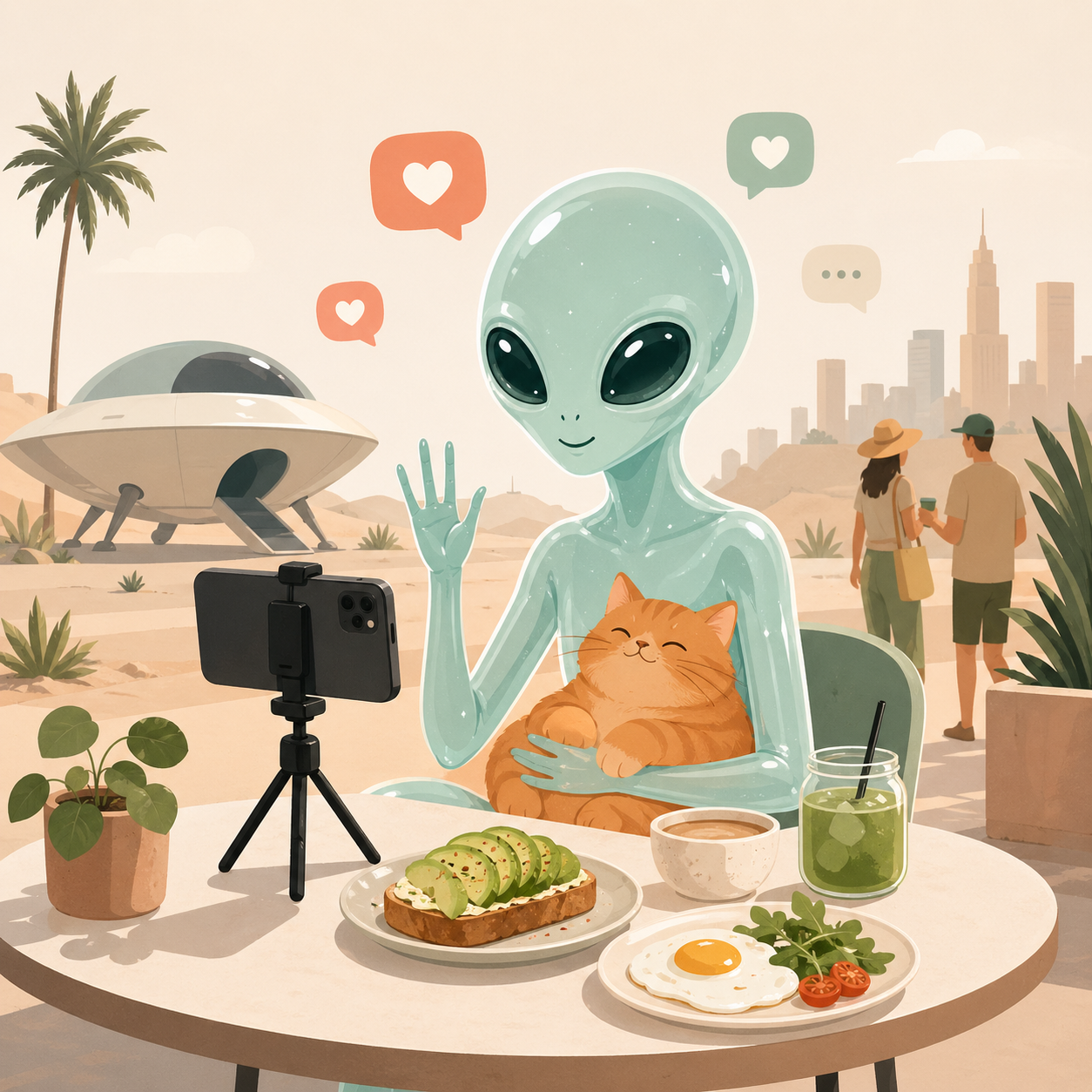
Brunch, to Zik’ari, was the most politically significant ritual yet observed. It occurred late enough to indicate victory over labor schedules, early enough to preserve moral superiority, and involved many foods pretending to be other foods. Eggs were placed on bread. Bread became pudding. Tomatoes entered beverages with alcohol and celery. People consumed orange liquid from narrow glasses and discussed healing, real estate, ex-partners, and the unbearable behavior of friends not present.
Maya took Zik’ari to a popular patio restaurant where the host, seeing Zik’s luminous filtered face and Maya’s frantic whisper of “please be normal,” seated them near a wall of artificial ivy. Zik’ari wore a beige linen outfit gifted by a local boutique after its hoodie video, plus enormous sunglasses. Several diners recognized it.
“Are you the alien guy?” one asked.
“I am among those described,” Zik’ari said.
“Can we get a selfie?”
Zik’ari looked to Maya.
“Say yes,” Maya murmured. “But no antenna reveal.”
Zik’ari posed, smiling with too many teeth.
During brunch, it filmed everything.
“Besties,” it said to the front-facing camera, lifting a forkful of eggs Benedict, “today I investigate brunch, a ceremony in which humans gather to consume breakfast after breakfast has expired. This sauce is yellow and emotionally powerful. The server has refilled my water without being petitioned, suggesting either benevolence or surveillance.”
Maya snorted into her coffee.
Zik’ari sampled avocado toast. “This is mashed green wealth on compressed grain. Humans accuse younger humans of destroying the shelter economy by eating this. I will continue research.”
It tasted a Bloody Mary and froze.
“Vegetable violence,” it whispered.
The video’s peak moment came when Zik’ari encountered the cat meme printed on a nearby woman’s tote bag: a grumpy white cat seated before salad, opposite a crying blonde woman pointing.
Zik’ari leaned toward the bag. “This appears to be a legal proceeding.”
The woman laughed. “It’s a meme.”
Zik’ari had seen the word but not yet understood it. “A meme is a compressed cultural organism,” it recited from its research. “Replicates through imitation. Mutates for humor. May influence elections.”
“Pretty much,” said Maya.
“But why is the cat accused?”
“It’s not accused. It’s just there.”
“Then why is the woman distressed?”
“That’s from a different thing.”
“They are not in the same room?”
“No.”
Zik’ari lowered the camera. “Your species has mastered impossible courtroom teleportation for jokes?”
Maya put her head in her hands. “Post that.”
It did.
The clip of Zik’ari trying to understand the woman-yelling-at-cat meme reached twenty million views in a day. People stitched it, duetted it, remixed it with dramatic music, used its “impossible courtroom teleportation” line as a caption for everything from toddler tantrums to congressional hearings. Fan art appeared: Zik’ari as judge, the cat as defendant, the woman as prosecutor. Someone made a dance. Someone made earrings. Someone made a thirty-four-minute video essay arguing that Zik’s outsider perspective revealed the postmodern rupture at the heart of digital semiotics. Zik’ari watched eight minutes and concluded that humans could make theology from anything if given a ring light.
Fame changed the mission.
At first, Zik’ari had wandered freely, delighted by laundromats, bus stops, dog parks, and the unsettling cheerfulness of inflatable tube men. But now humans recognized it. Some shouted “Zik!” from cars. Some cried upon meeting it, which Zik’ari found alarming until Maya explained parasocial attachment. Some asked for advice about relationships, careers, parents, climate grief, outfits, and whether they should text someone named Brandon.
“Why ask me?” Zik’ari said after a woman at a farmer’s market explained through tears that she felt behind in life because everyone else seemed engaged, promoted, pregnant, healed, or glowing.
“Because they think you’re wise,” Maya said.
“I have been on your planet nineteen days.”
“That doesn’t disqualify most people.”
Zik’ari tried to answer honestly. “Perhaps,” it told the woman, “you are not behind. Perhaps you are comparing your interior weather to another being’s exterior decoration.”
The woman cried harder, hugged it, and bought a lavender candle.
That quote became a sound. Soon thousands of videos appeared: people cleaning apartments, walking alone, finishing school, leaving jobs, making beds in small rooms, all overlaid with Zik’ari’s voice saying, “interior weather.” Zik’ari watched them late at night from the ship, feeling something strange pulse beneath its sternum.
It had come to observe humans. Humans had begun using it to observe themselves.
The Assembly checked in on day twenty-seven.
The transmission arrived as a lattice of blue light across the ship’s interior. Twelve elders appeared as suspended geometries, each representing a different branch of deliberative intelligence. Their presence made the parking lot smell briefly of ozone and old rain.
“Field Observer,” said the first elder, “report.”
Zik’ari stood in its true form, tendrils combed, mission sash restored. “Earth is governed by attention.”
The elders shimmered.
“Elaborate.”
“Authority flows toward those who can gather human perception at scale. Formal political systems exist, but emotional mobilization is often initiated by entertainers, merchants, symbolic animals, and attractive individuals giving recommendations near lamps.”
“Near lamps?”
“Circular lamps,” Zik’ari said. “They create eye-stars.”
The third elder rotated. “Have you identified planetary leadership?”
“Yes. No. Many. Leadership appears fragmented and memetic. Humans follow figures who make them feel seen, superior, amused, enraged, beautiful, or less alone. These figures are called influencers. I have become one.”
Silence passed through the lattice.
“You have become a political leader?”
“Possibly.”
“You were instructed not to alter the society.”
“I have mostly reviewed brunch.”
A lower elder flickered with disapproval. “Your follower count?”
Zik’ari looked at Maya, who stood just outside the transmission field holding a half-eaten granola bar and wearing an expression that said she was absolutely going to tell everyone about this someday if humanity survived.
“Three point eight million,” Zik’ari said.
The elders brightened in alarm.
“You have acquired three point eight million humans?”
“Not physically.”
“That distinction comforts us only slightly.”
Zik’ari tried to explain content calendars, engagement rates, brand deals, and the algorithm. The Assembly grew increasingly troubled. Its culture had long ago separated governance from charisma after the Nebular Choir Incident, in which a beloved singer had accidentally convinced seven planets to migrate because the lighting during her concert made relocation seem emotionally necessary. The idea that Earth allowed attention to steer markets, beliefs, and identities with minimal ritual containment was, to them, horrifying.
“Withdraw,” said the first elder. “Continue passive observation only.”
Zik’ari hesitated. “I am still learning.”
“You are contaminating.”
“I am answering.”
“You are influencing.”
Zik’ari looked at the phone lying on the console. Notifications bloomed across the screen like plankton. It thought of the woman at the farmer’s market. Maya laughing over coffee. A child in a hospital gown who had sent a drawing of Zik riding a taco through space. A comment from someone named Luis saying Zik’s grocery store video made him call his mother because he had never thought about how strange and precious ordinary things were.
“Perhaps influence is not only contamination,” Zik’ari said.
The elders dimmed.
“Field Observer,” said the first elder, “remember why Earth is under review. Humans are volatile. They mistake performance for truth. They form tribes around symbols. They reward exaggeration. They punish difference. They elevate strangers and destroy them for sport. If you become entangled, you may no longer assess clearly.”
Zik’ari could not deny this. The comments had taught it much about adoration, but also about cruelty. For every “protect Zik,” there was a “fake,” a “cringe,” an “unfunny,” a “psyop,” a “this is why society is collapsing.” People argued about whether its alien persona was satire, marketing, mental illness, performance art, government disclosure, demonic influence, or proof that Hollywood had run out of ideas. A man with a podcast devoted three episodes to proving Zik’ari was part of a campaign to normalize interspecies taxes. A beauty influencer accused it of copying her “confused but hot” brand. Someone found Maya’s personal account and criticized her eyebrows.
That made Zik’ari angrier than threats against itself.
It had discovered that humans wielded words like weather: sometimes warm, sometimes nourishing, sometimes sharp enough to strip leaves from trees. Online, they forgot the bodies attached to names. They turned pain into jokes, jokes into weapons, weapons into trends, trends into money. But they also used the same systems to raise funds for strangers, translate grief into solidarity, teach skills for free, find lost pets, expose lies, share songs, and send hearts to lonely beings they would never meet.
“You are correct,” Zik’ari told the elders. “I do not assess clearly. But perhaps clarity is not produced by distance alone.”
The transmission ended with a warning. Zik’ari was to cease posting within nine Earth days and prepare for extraction.
Maya took the news badly.
“You’re leaving?”
“Possibly.”
“What do you mean, possibly?”
“The Assembly believes my presence distorts human development.”
Maya sat on the ship’s ramp, staring at the mall parking lot where dusk had painted the asphalt purple. The ship had remained hidden by a perception field that made humans see either an empty space, a maintenance trailer, or, if particularly tired, their father’s disappointment. Beyond the field, cars came and went. Someone pushed a shopping cart with one squeaking wheel.
“Do they have a point?” Maya asked.
“Yes.”
“That’s annoying.”
“Yes.”
“You could just stop posting.”
“Yes.”
“Will you?”
Zik’ari folded and unfolded its hands. “I do not know.”
Maya looked at it. “What do you want?”
Among Zik’ari’s people, desire was usually discussed collectively, slowly, after meditation and nutrient mist. No one simply hurled the question like a rock.
“I want,” Zik’ari said, then stopped. “I want to understand why brunch made me happy. I want to know why humans show each other cats when language becomes insufficient. I want to know why your species is cruelest when afraid and kindest when unobserved. I want to know why a song can change the chemistry of a room. I want to know why you name machines, mourn trees, insult weather, apologize to furniture you collide with, and say ‘no worries’ while vibrating with worries. I want to know why, after inventing so many ways to vanish into yourselves, you keep building ways to be seen.”
Maya was quiet.
Then she said, “You should make that your last video.”
Zik’ari did not reply.
The next days brought greater fame and greater confusion. A morning show invited Zik’ari to appear. Maya advised against it, which Zik’ari interpreted as strong evidence it should go.
The studio was cold, bright, and filled with people carrying clipboards as if they were shields. Zik’ari sat on a curved couch between two hosts whose smiles were polished enough to deflect meteors. One called it “the internet’s favorite alien.” The other asked whether it was single. Zik’ari answered that its species reproduced through consensus and seasonal light absorption, which caused the hosts to laugh for twelve seconds.
They showed clips: Zik with cereal, Zik with brunch, Zik solemnly asking a golden retriever whether it held municipal power, Zik misinterpreting a gym as a place where humans fought invisible gravity demons.
Then the male host leaned forward. “So, Zik, a lot of people are wondering: what’s the message behind all this? Is it comedy? Social commentary? Are you selling something?”
Zik’ari considered. Humans became uncomfortable when answers were too true. Maya stood off-camera, arms crossed, eyes narrowed in warning or encouragement.
“I am selling nothing,” Zik’ari said. “Although I have been offered many powders.”
The hosts laughed.
“I began because I believed influence was leadership,” Zik’ari continued. “I thought if many humans watched me, I would understand who commands Earth. But now I think attention is not command. It is hunger. Humans look for mirrors. Sometimes they find windows. Sometimes traps. Sometimes each other.”
The studio changed. Not visibly. The lights still glared. The producer still counted down. But the air shifted in the way air did when a joke realized it had wandered into a confession.
The female host softened. “And what have you learned about us?”
Zik’ari looked into the nearest camera. Behind it were millions of humans eating breakfast, folding laundry, pretending to work, sitting in waiting rooms, holding babies, avoiding pain, seeking distraction.
“You are very young,” it said. “Not in years. In coordination. You have tools powerful enough to connect a planet and hearts frightened enough to use them as knives. You are lonely in crowds, theatrical in grief, generous during disasters, suspicious during peace. You worship certainty, but your greatest art comes from doubt. You say the world is ending very often. Sometimes you are correct. Then you make coffee.”
No one laughed for a moment.
Then the male host said, too brightly, “Wow. Okay. And we’ll be right back after this.”
The clip went viral before Zik’ari had left the building.
Not all attention was warm.
Within hours, Zik’ari became the subject of furious interpretation. Some viewers found the interview moving. Others called it smug. Some said it proved the alien act had become pretentious. Others insisted no human comedian could improvise with such uncanny sincerity, reigniting theories that Zik’ari was an actual extraterrestrial. Several politicians made references to “so-called aliens lecturing hardworking families,” despite not being asked. A think piece titled “The Infantilizing Gaze of the Alien Influencer” appeared by evening. A response titled “Let the Alien Cook” appeared nine minutes later.
The Assembly sent one message: You must leave.
Zik’ari did not answer.
Then came the cat.
The cat belonged to Maya’s aunt and was named Chairman Meow, a joke the aunt had inherited from a boyfriend she no longer respected but had kept because the cat refused to answer to anything else. Chairman Meow was seventeen pounds, orange, scarred over one ear, and possessed the moral outlook of a pirate. He had ignored Zik’ari during their first meeting, hissed during the second, and on the third climbed into Zik’ari’s lap with the solemnity of a king occupying disputed territory.
Maya filmed it.
“Careful,” she said. “He bites when he loves.”
“Why?”
“He contains multitudes.”
Zik’ari sat very still as Chairman Meow kneaded its linen pants.
“This creature is vibrating.”
“He’s purring.”
“It is preparing to detonate?”
“He likes you.”
Zik’ari’s eyes widened. “This is approval?”
Chairman Meow headbutted Zik’ari’s chest.
Something in Zik’ari dissolved.
Its species did not have pets. On its homeworld, interspecies relationships were formal, negotiated, and usually involved mineral rights. No creature had ever simply climbed onto Zik’ari and decided they belonged together for the next eleven minutes.
Zik’ari posted the video with the caption: “A small Earth predator has chosen diplomacy.”
It became the channel’s most popular video.
The internet loved Chairman Meow with the feverish intensity humans reserve for animals who appear both stupid and divine. Edits appeared of the cat in crowns, helmets, angel wings, sunglasses. People demanded more Chairman. Brands offered cat food sponsorships. Someone changed Zik’ari’s Wikipedia page to list Chairman Meow as “Secretary of Soft Power.”
For three days, Zik’ari’s channel became mostly cat content. This, Maya explained, was normal for the internet. Everything eventually became cat content or discourse.
Chairman Meow’s rise clarified the whole system. Here was a creature that could not speak, legislate, theorize, purchase, endorse, or understand the platform on which he had become beloved. Yet millions cared about him. They wrote comments in baby voices. They shared stories of cats they had loved and lost. They argued about whether he was overweight. They made him a symbol of comfort, resistance, laziness, monarchy, orange-cat chaos, and the weekend.
Zik’ari realized influence was not leadership. It was projection at scale.
The influencer became a surface. Humans poured themselves onto it: longing, humor, envy, tenderness, rage, aspiration. The surface did not have to be wise. It did not even have to know. A cat could hold a million feelings simply by existing near a camera.
That frightened Zik’ari more than the weapons in Earth’s orbit.
On the eighth day after the Assembly’s warning, Zik’ari went live.
Maya objected. “You don’t go live with an existential crisis.”
“Why not?”
“Because people screen record.”
“Good.”
“No, not good. Permanent.”
“Many things are permanent without consent.”
Maya stared at it. “You’ve definitely been online too much.”
Zik’ari set the phone on the ship’s console. The background shimmered. Maya insisted they use a neutral wall instead of the actual spacecraft interior, so they stood in her aunt’s garage between holiday decorations and a broken exercise bike. Chairman Meow sat on a storage bin, washing one paw.
The live began with 12,000 viewers. Then 80,000. Then 300,000. Comments flooded too quickly to read.
Zik’ari wore no sunglasses. No hat. No hoodie. Its human disguise remained, but looser than usual. Its eyes were slightly too dark. Its fingers slightly too long.
“Hello, besties,” it said.
The comments surged.
“I began this channel because I misunderstood you,” Zik’ari continued. “I believed the most-followed humans were your leaders. This was incorrect. It was also not entirely incorrect, which is where the danger lives.”
Maya stood behind the phone, chewing her thumbnail.
“Influence is not leadership. It is not wisdom. It is not love. It can carry those things, but it can also carry emptiness wearing their skins. I have watched humans become powerful by being beautiful, cruel, useful, absurd, honest, lucky, wounded, loud, or near cats. I have accepted your hearts and comments as if they were votes. They were not. They were moments. You gave me moments of your attention, and attention is the closest thing your species has to shared fire.”
The comments slowed, then sped again, full of hearts, jokes, confusion, demands, accusations.
“I must tell you something true,” Zik’ari said.
Maya’s face changed. “Zik,” she whispered.
Zik’ari looked at her with apology.
“I am not from Earth.”
The comments erupted.
LMAOOOOO WE KNOW
method acting king
DROP THE MOVIE TRAILER
this bit still going?
prove it
Zik’ari released the disguise.
Not all at once. Human eyes did poorly with sudden impossible geometries. First the skin turned translucent at the edges. Then the hair lifted into silver tendrils. The face unfolded, not grotesquely but beautifully, like a flower remembering it was also a map. Two hidden eyes opened above the first two. The mouth softened into a luminous seam. Beneath the garage’s fluorescent light, Zik’ari’s true form glowed faintly, full of blue-white threads pulsing under glasslike skin.
The live froze for three seconds under the strain of millions joining at once.
Then the internet lost its mind.
Maya said a word her aunt would have pretended not to hear.
Chairman Meow, unimpressed by cosmic disclosure, yawned.
Zik’ari raised all four hands. “Please do not panic. Also please do not worship. Both appear to produce merchandising.”
The live cut out.
Whether the platform crashed, a government agency intervened, the ship’s field disrupted the signal, or the algorithm deity objected to unscheduled ontological rupture, nobody ever proved. Clips had already escaped. Within minutes, Zik’ari’s transformation was everywhere. Experts analyzed pixels. Debunkers produced threads. Believers wept. Skeptics explained practical effects. Practical effects artists angrily insisted nobody asked them. News anchors said “alleged extraterrestrial influencer” with the same strained professionalism they used for escaped zoo animals and celebrity divorces. Governments issued no comment, which everyone interpreted as a comment.
Outside Maya’s aunt’s house, cars began arriving.
“Ship,” Zik’ari said, “we may need extraction.”
“Now you agree?” the ship replied.
Maya grabbed a backpack. “What do we do?”
“You should stay. This may become unsafe.”
“Absolutely not.”
“Maya—”
“You revealed yourself in my aunt’s garage. I’m involved.”
“That is fair.”
They took Chairman Meow because he refused to exit the backpack after climbing in.
The ship lifted from the mall parking lot at 11:42 p.m., finally noticed by approximately six hundred people, nine security cameras, two local news helicopters, one amateur astronomer, and the raccoon from the first night, who watched from the hedge with the calm of a being who had known all along.
Inside the ship, Maya pressed her face to the membrane as Earth fell away beneath them, city lights spreading like spilled constellations.
“I’m in space,” she said.
“Low atmosphere,” said Zik’ari.
“Don’t ruin this.”
Chairman Meow screamed once, then discovered the heated floor and forgave the universe.
The Assembly opened an emergency transmission before the ship reached orbit. The elders appeared brighter than before, agitated into sharp geometries.
“You disclosed.”
“Yes,” Zik’ari said.
“You violated containment.”
“Yes.”
“You altered the trajectory of a pre-contact civilization.”
“I suspect they were already altering themselves rapidly.”
“That is not a defense.”
“No,” Zik’ari said. “It is context.”
Maya stepped into view. “Hi. Sorry. Are you, like, alien court?”
The elders paused.
Zik’ari said, “This is Maya. She is my consultant.”
“I’m his friend,” Maya said.
Zik’ari’s tendrils lifted. “Yes. That.”
The first elder rotated toward her. “Human Maya, your species has now received evidence of extraterrestrial life through an entertainment platform. This is among the least stable contact scenarios modeled.”
Maya folded her arms. “To be fair, you picked a mall parking lot.”
“We did not pick it. The ship selected low-disturbance terrain.”
“It picked a mall.”
The ship said nothing.
The debate lasted hours. Zik’ari argued that Earth was already a planet of mediated realities, that official arrival through governments alone would have been distrusted, politicized, monetized, denied, memed, and turned into a streaming limited series within weeks. Maya argued that humans deserved not to be studied like dangerous toddlers by geometry ghosts. The elders argued that humanity’s reaction proved unreadiness: panic buying, cult formation, denial, opportunistic branding, and the immediate sale of unofficial “I GOT PROBED BY @ACTUALLYALIENOFFICIAL” shirts.
Zik’ari could not refute any of it.
But it offered another set of evidence. Millions of messages. Not the viral jokes or threats or theories, but the quiet ones. People saying they went outside to look at the sky. People apologizing to friends. People admitting fear. People asking what came next. Scientists offering cautious excitement. Teachers explaining telescopes to children. Artists drawing new constellations. Religious leaders preaching humility. Meme accounts making cats in spacesuits, yes, but also disaster-relief groups using the attention surge to raise money. Humans did what humans always did: turned revelation into noise, then braided some of the noise into meaning.
“Readiness may not be a door that opens,” Zik’ari told the Assembly. “It may be a muscle. It strengthens under use.”
The elders conferred beyond audible wavelengths.
Maya sat on the floor beside Chairman Meow, who had entered a state of diplomatic sleep.
Finally, the first elder spoke. “Earth will not receive formal contact yet.”
Zik’ari lowered its head.
“But neither will we erase this event.”
Maya looked up. “You can do that?”
“Not cleanly,” said the elder. “Your information systems are… fungal.”
“Accurate,” Maya said.
“We will monitor. We will prepare a wider protocol. Field Observer Zik’ari will be recalled for review.”
Zik’ari had expected this. Still, it hurt in a newly human way, blunt and heavy.
Maya stood. “For how long?”
“That is not for you to know.”
“Try again.”
The elders flickered at being addressed like an unhelpful customer service representative.
Zik’ari touched Maya’s shoulder. “It is all right.”
“No, it’s not.”
“I made choices.”
“You made friends.”
The word moved through the ship, small and enormous.
The Assembly allowed one final transmission to Earth, partly because Zik’ari requested it, partly because Maya threatened to “make the weirdest scene in galactic history,” and partly because Chairman Meow sat on the communications panel and triggered a test broadcast that reached three weather satellites.
Zik’ari’s last video was not live. Maya filmed it on the ship with Earth behind Zik’ari, blue and white and wounded and radiant.
This time, Zik’ari appeared fully as itself.
“Hello, besties,” it said, and smiled in a way no longer meant to pass as human. “By now many of you are arguing about whether I am real. This is reasonable. Reality has treated you inconsistently. Continue investigating. Continue doubting. Doubt is a tool. Do not let it become a home.”
It looked back at Earth.
“I came to learn who leads you. I mistook attention for authority, performance for truth, virality for worth. Many of you make the same mistake daily, so I forgive myself. Your leaders are not simply those with followers. Your leaders are whoever teaches you what to value. Sometimes that is a president, parent, teacher, poet, scientist, cashier, comedian, child, enemy, stranger, or cat. Choose carefully who receives the power to shape your wanting.”
Chairman Meow wandered into frame.
Zik’ari picked him up with great reverence.
“This is Chairman Meow. He has no policies. Yet he has comforted many. This is not nothing.”
Maya laughed softly behind the camera.
“I cannot tell you whether you are ready for the stars,” Zik’ari continued. “I can tell you that you already live among wonders and often fail to recognize them because they do not trend. Water falls from your sky. Seeds remember trees. Your bodies repair themselves while you sleep. You invented soup, string instruments, vaccines, and the phrase ‘tiny little guy.’ You cross oceans to help strangers and refuse to text back people you love. You are impossible. I recommend you continue.”
It leaned closer.
“Be careful with your attention. It is how you vote for the world before any ballot. Feed what helps you become more alive. Starve what makes you cruel. Share cat memes when necessary. Eat brunch if invited, but do not allow avocado toast to carry the blame for structural failures. And when you look at the sky, do not ask only who may be watching you. Ask what you might become if you learned to watch each other with mercy.”
It raised one hand.
“I came in peace. I leave in confusion. This is, I think, a form of love.”
The video ended.
For twenty-six minutes after posting, there were no visible metrics. The platform buckled under traffic. Mirrors appeared. Downloads spread. Translations bloomed in hundreds of languages. Some people cried. Some mocked those crying. Some insisted the whole thing was an ad campaign and demanded to know for what. The official account @ActuallyAlienOfficial vanished, then reappeared, then was suspended, reinstated, verified, unverified, memorialized, and finally archived by unknown means.
Zik’ari left Earth orbit before dawn over India, while Maya slept curled in a thermal sling and Chairman Meow attempted to murder a floating sensor.
“You will return me, right?” Maya had asked before exhaustion took her.
“Yes,” Zik’ari had promised. “You have exams.”
“Community college is going to feel so stupid after this.”
“Most education feels small while producing large changes.”
“Don’t be profound at me. I’m tired.”
Zik’ari returned her two hours later to a quiet road near her aunt’s house, after the crowds had been dispersed by police, boredom, and conflicting livestreams. It gave her no device, no alien jewel, no weapon, no cure for mortality, though she asked about that last one for her aunt’s knees. It gave her instead a small translucent bead.
“What does it do?” she asked.
“It stores one memory exactly as you felt it. Only one. Choose carefully.”
Maya held it like a tear. “That’s a terrible gift.”
“Yes,” Zik’ari said. “Most meaningful things are inconvenient.”
She hugged it then, awkwardly at first because of the extra arms, then fiercely. Zik’ari stood very still, learning the pressure of goodbye.
Chairman Meow, returned to Earth against his preference, bit Zik’ari’s ankle with ceremonial gravity.
“Approval?” Zik’ari asked.
“Love,” Maya said.
The ship rose unseen this time. Zik’ari watched Maya shrink to a dot, then a memory, then part of the planet’s glowing skin.
The Assembly review was long. There were inquiries, admonishments, philosophical hearings, and one deeply uncomfortable presentation titled “Unregulated Charisma in Pre-Contact Civilizations: A Zik’ari Case Study.” Zik’ari was temporarily barred from fieldwork, public speaking, unsupervised communication devices, and all contact with species possessing algorithmic attention markets.
But it was not exiled. It was not dissolved into civic shame. Privately, several younger Assembly members requested the brunch file.
Earth changed, though not as neatly as stories prefer.
Many people decided Zik had been fake and were happier that way. Many believed and became unbearable at parties. Religions adapted, governments denied knowledge while forming committees, scientists fought for data access, and brands tried desperately to sound cosmic. “Interior weather” entered ordinary speech. So did “impossible courtroom teleportation.” For a while, everyone looked up more often. Then bills came due, scandals broke, seasons changed, and attention moved as attention does.
Yet something remained.
A generation of children grew up with the alien influencer as fact, myth, meme, hoax, comfort, warning, or bedtime story. They drew Zik’ari beside cats and planets. They asked better questions in science class. They treated the sky less like a ceiling. Maya finished her degree, then another, then became a biologist who specialized in extremophiles and refused interviews unless paid enough to fund scholarships. Her aunt’s knees improved through ordinary medicine and turmeric, both claiming credit. Chairman Meow lived two more years, became the unwilling subject of murals worldwide, and died on a sunlit windowsill while Maya held him and the internet mourned a cat that had once accidentally represented Earth.
On the fifth anniversary of Zik’ari’s departure, every major platform filled with reposts. The last video circulated again, grainy and over-captioned, stitched with people showing where they had been when they first watched it. Some were cynical. Some sincere. Most were both.
Far beyond the moon, in a quiet chamber grown from crystal and patient minerals, Zik’ari watched a compilation it was not supposed to access. Humans had made a holiday of sorts, unofficial and therefore more powerful. They called it First Follow.
There were brunches themed around alien diplomacy. Cat shelters held adoption drives. Teachers played clips and asked students to discuss media literacy. Influencers posted thoughtful essays, lazy jokes, thirst traps in silver makeup, charity links, and sponsored content for “galactically soft” blankets. Someone had made a filter that gave users four eyes and tendrils. It was inaccurate but charming.
Zik’ari paused on a video of Maya, older now, standing under a desert sky.
She held up the memory bead. She had never used it.
“I thought I’d save it for the most important moment of my life,” she said to the camera. “But that’s a trap, right? Thinking you’ll know. Thinking importance arrives labeled. So I keep it empty. It reminds me to pay attention.”
She smiled.
“Hey, Zik. Hope your interior weather is okay.”
Zik’ari touched the screen.
Then it opened a private recorder, though it had no official mission, no authorization, and no audience but itself.
“Supplemental observation,” it said. “Humans remain confusing. They continue to mistake spectacle for meaning, though sometimes spectacle smuggles meaning past their defenses. They are easily frightened, easily bored, easily manipulated, and unexpectedly brave when given the chance. They make leaders of fools and fools of leaders. They waste attention, then redeem it with tenderness. Their cats remain influential beyond all rational measure.”
It looked toward the star that held Earth in its small, ordinary light.
“Recommendation unchanged,” Zik’ari said. “Continue observation. Prepare contact. Bring snacks. Avoid vegetable cocktails. Do not underestimate brunch.”
The recorder pulsed blue.
Zik’ari hesitated, then added one final note.
“And should any human ask whether I was real, tell them this: real is not the opposite of performed. Humans perform grief at funerals, joy at weddings, confidence at interviews, and kindness until it becomes habit. Performance is one of the ways they practice truth. I performed being human and became, briefly, something like humane. They performed believing in me and became, briefly, more curious. This may be enough to begin.”
Outside the chamber, the Assembly’s great corridors hummed with distant deliberation. Stars moved in their old slow dances. Signals crossed the dark: mathematics, pulsars, weather, songs, military radar, birthday calls, lost probes, reruns, lullabies, and somewhere in the endless human cloud, a cat meme newly born, already mutating, already carrying more feeling than logic could hold.
Zik’ari watched Earth’s sun and waited, not passively, not patiently, but with attention.
And attention, it had learned, was never nothing.