Dracula’s Dentist
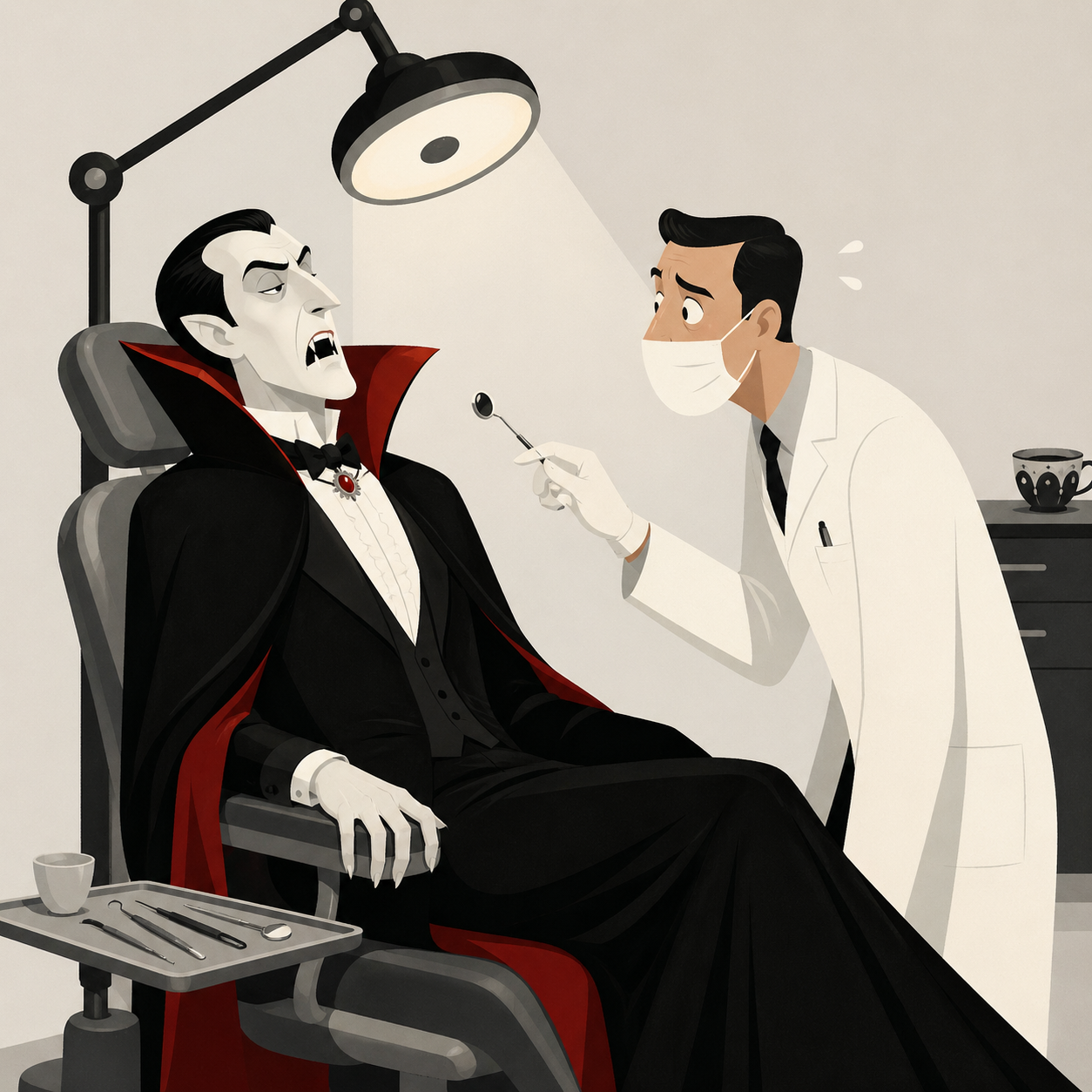
Count Dracula had survived stakes, storms, mobs, mirrors, revolutions, famine, pitchforks, priests, tax assessors, opera critics, and one extremely persistent werewolf who had misunderstood the word “fetch.” He had slept in coffins through earthquakes, dined with kings, terrified peasants, crossed oceans, and once sat through a six-hour lecture on decorative lace without biting anyone.
But at three minutes past midnight on a wet Thursday in late October, the ancient lord of the undead sat bolt upright in his coffin and whispered, with grave horror, “Ow.”
The word echoed faintly around the crypt.
A rat paused on a stone step.
Dracula pressed one long, pale finger to the left side of his jaw. His face, usually arranged in the elegant expression of someone who had personally invented moonlight, twisted into a grimace. He opened his mouth carefully and touched the back of one fang with the tip of his tongue.
Pain flashed through him like sunlight through badly drawn curtains.
“Ow,” he repeated, louder this time.
From the shadows came the rustle of wings. Three bats hanging from the ceiling looked at him upside down with the kind of concern bats reserve for structural collapse and disappointing fruit.
Dracula lowered the lid of his coffin halfway and glared at nothing in particular. “This is undignified.”
He had not had a toothache in two hundred and forty-three years. Vampires were supposed to possess perfect teeth. It was practically in the brochure. Immortality, aristocratic cheekbones, superior night vision, excellent tailoring, and a smile that could make a village drop its candles. He had always taken pride in his fangs. They were not merely tools of the trade. They were symbols. They were ancestral. They had glistened in oil portraits, frightened clergy, and once been complimented by a French duchess who had later become a very temperamental owl.
He sat there for another minute, hoping the pain would remember who it was dealing with and flee.
It did not.
He tried to rise dramatically from the coffin, but halfway through the movement the throb struck again and he made a noise that sounded less like a prince of darkness and more like a kettle being squeezed.
This would not do.
Dracula climbed out, wrapped himself in a black silk dressing gown, and swept through the crypt into the hallway of Castle Dracula. The castle, perched high on a mountain and surrounded by forests that whispered unpleasant rumors, was silent except for rain ticking against the windows and the distant groan of a door that groaned even when no one used it. He passed suits of armor, tapestries showing battles whose winners had all eventually disappointed him, and a portrait of himself from 1720 in which the painter had given him eyebrows like frightened caterpillars.
At the kitchen door he hesitated.
Garlic hung there in ropes.
Dracula recoiled so sharply that his dressing gown fluttered like a startled raven.
“Who put that there?” he demanded.
His butler, Renfield—no relation to the other Renfields, though the family did seem to produce men who enjoyed polishing silver while muttering—appeared from behind a sideboard holding a dust cloth and looking guilty.
“The village market had a sale, my lord.”
“A sale?”
“Yes, my lord. Three braids for two.”
Dracula clutched his jaw and stared at him.
Renfield shrank. “I thought perhaps for guests.”
“For guests?” Dracula repeated. “What sort of guests do you imagine I entertain? Italian chefs? Protective nuns? Competitive grandmothers?”
“No, my lord.”
The tooth throbbed again. Dracula closed his eyes.
Renfield peered cautiously at him. “Are you quite well, Count?”
“I am perfectly well.”
“You appear to be holding your face.”
“I am contemplating.”
“With your jaw?”
Dracula opened one eye. “Leave me.”
Renfield bowed and backed away, but he did not get far before Dracula said, “Wait.”
“Yes, my lord?”
Dracula looked toward the window. Beyond it, far below in the valley, the village of Bistritz shone with a few late lamps. Rain silvered the rooftops. Somewhere down there, amid the bakeries, taverns, suspicious old women, and very confident geese, there was a dentist.
Dracula hated the thought.
Not because he feared pain. He had endured pain. He had been shot, stabbed, cursed, chained, exorcised, and once forced to listen to a child practice the violin for nine consecutive nights. Pain was an old acquaintance.
But dentistry was different.
Dentistry involved lying still under a bright lamp while a professional stranger peered into one’s mouth and made disapproving noises.
It involved little metal hooks.
It involved questions asked while one could not answer.
Worst of all, it involved breath.
Dracula had avoided dentists for centuries mostly because villagers tended to put garlic in everything: soup, bread, medicine, sausages, holy water, wedding bouquets, and once, unforgivably, cake. Human beings were obsessed with the stuff. They walked around breathing it out with the careless cruelty of dragons.
A dentist, by profession, spent all day inside mouths. A dentist’s office was likely an invisible swamp of garlic, mint, cloves, fear, and boiled upholstery.
Still, the pain pulsed again and made the decision for him.
“Renfield,” Dracula said.
“Yes, my lord?”
“Fetch my cloak.”
Renfield blinked. “Your red-lined one?”
“My respectable one.”
“The one with the collar?”
“They all have collars.”
“The enormous collar?”
Dracula slowly turned his head. “Renfield.”
“Yes, my lord.”
“And find me a dentist who does not use garlic.”
Renfield’s mouth opened, then shut, then opened again. “My lord, I do not know whether that is listed in the village directory.”
“Then ask discreetly.”
“How discreetly?”
“As discreetly as one can ask whether a man places deadly herbs near his patients’ tongues.”
“Very good, my lord.”
An hour later, after three frantic bats had been dispatched, two villagers had fainted, one had tried to sell Renfield a charm made of turnips, and the local midwife had threatened everyone with a broom, a name was produced.
Dr. Otto Schnabel, Dental Surgeon, Extractor of Teeth, Corrector of Bites, Friendly Service, Reasonable Rates.
There was a note below his advertisement in the village weekly: No garlic used on premises due to allergy.
Dracula read the clipping by candlelight and felt, for the first time all evening, a small stirring of hope.
“Allergy,” he murmured. “A man of culture.”
“He also advertises painless extractions,” Renfield added.
Dracula gave him a cold look.
Renfield coughed. “Relatively painless, perhaps.”
Dracula dressed with solemn care. He chose a black suit, polished boots, white gloves, a crimson cravat, and his second-most impressive cloak, because the first-most impressive cloak had been damaged during an incident involving a chandelier, a bishop, and a goat. He brushed his hair back, inspected himself in a mirror out of habit, saw nothing, and adjusted his collar anyway.
The toothache had worsened into a dull, relentless pounding, like a tiny villager inside his skull trying to nail boards over a window.
By two o’clock, he descended the mountain in a black carriage drawn by horses that steamed in the cold rain. The wheels hissed over the road. Owls watched from branches. Wolves trotted behind at a respectful distance, hoping this was the kind of outing that ended with leftovers.
Dracula tried to rehearse the appointment.
Good evening, Doctor. I require a minor examination.
No, too imperial.
Hello, my good man. I am here regarding a tooth.
Too suspicious.
I have come about the toothache.
Too honest.
He leaned back against the velvet seat and pressed his hand to his jaw.
“Perhaps,” he muttered, “I shall say nothing and simply point.”
At that moment the carriage struck a rut. Pain exploded through his fang. Dracula banged his head against the roof and hissed so loudly the horses sped up.
By the time he reached the village square, his dignity was wounded, his jaw throbbed, and his patience was as thin as a cobweb in a candle flame.
Dr. Otto Schnabel’s office sat between a bakery and a shop that sold umbrellas, candles, and pessimism. A painted wooden tooth hung above the door. Beneath it, in neat letters, were the words: Healthy Teeth, Happy Life!
Dracula stared at the sign.
“Bold claim,” he said.
The office windows glowed faintly. Renfield had arranged an emergency appointment after discovering that Dr. Schnabel often worked late because he was afraid to walk home in the dark. This was unfortunate for Dr. Schnabel, who had not yet learned that staying in one place after sunset did not necessarily make the night safer.
Inside, the reception room smelled of lavender, polish, and old newspapers. No garlic. Dracula inhaled cautiously and relaxed.
A bell tinkled above the door.
From behind a desk popped a small woman with spectacles, gray curls, and a shawl covered in embroidered teeth. She looked at Dracula, froze, and slowly lowered the biscuit she had been eating.
“Good evening,” Dracula said.
The woman blinked.
“I have an appointment.”
She looked at the appointment book. Her finger trembled as it moved down the page. “Mister… D. Racul?”
Dracula’s eyes narrowed. “That is the name I gave.”
“Yes,” she whispered. “Of course. Mister Racul.”
“Count,” he corrected automatically.
“Count Racul.”
“Dracula.”
Her face became the color of candle wax.
There was a silence.
The biscuit crumbled in her hand.
Dracula remembered that he was meant to seem normal. He arranged his mouth into what he hoped was a reassuring smile, then remembered the fangs and closed it immediately.
“I have a toothache,” he said.
The receptionist stared at his mouth as though it had just given a speech.
“I shall inform the doctor,” she said, and vanished through a door with remarkable speed for a woman of her age.
Beyond the door came a muffled conversation.
“A what?”
“A patient.”
“At this hour?”
“The appointment.”
“Mrs. Vogel, why are you whispering?”
“I am not whispering.”
“You are absolutely whispering.”
“He says his name is Dracula.”
There was a pause.
“Mrs. Vogel, please do not joke about these things. You know my nerves.”
“I am not joking.”
Another pause.
Then a chair scraped violently, something metallic clattered to the floor, and a man said, very softly, “Oh no.”
Dracula sat in the waiting room and picked up a magazine from 1896. He flipped through it without reading. On the wall opposite him was a cheerful poster of smiling children brushing their teeth. The children appeared to have no fangs whatsoever. Beneath them were the words: Brush Twice Daily!
Dracula glanced around, then, with the faint air of a man inspecting a rival kingdom, looked at the display of toothbrushes in a glass cabinet.
He had always considered dental care beneath him. Vampires did not wake in the evening and polish their immortality with bristles. Yet now, as his tooth pulsed like a church bell, he wondered whether arrogance had been his undoing.
The surgery door opened a crack. One eye appeared. Then it vanished. Then the door opened wider.
Dr. Otto Schnabel stepped into the reception room.
He was a thin man with a pointed beard, round spectacles, and the expression of someone who had just been asked to floss a tiger. His white coat was buttoned incorrectly, and one sleeve was damp where he had apparently washed his hands too vigorously. He held a clipboard like a shield.
“Count… Dracula?” he said.
Dracula rose.
Dr. Schnabel flinched.
Dracula stopped rising. “Yes.”
“Welcome,” said the dentist, in a voice that suggested the word had been pulled from him with pliers. “Very welcome. Extremely welcome. Normal welcome.”
“I appreciate your seeing me at such an hour.”
“Not at all. Teeth do not keep regular hours.” Dr. Schnabel laughed once, too loudly. “Ha.”
Mrs. Vogel made a small sound behind the desk, possibly a prayer.
Dracula inclined his head. “I understand you do not use garlic.”
Dr. Schnabel’s eyes widened. “Garlic? No. Never. Terrible stuff. Makes my throat close.”
“Mine as well,” Dracula said.
They looked at each other.
For one dangerous second, both men seemed to recognize a shared vulnerability. Then both looked away.
“Please,” said Dr. Schnabel, gesturing toward the surgery. “Come in. Sit. Recline. Open. I mean, only when asked. Professionally.”
Dracula swept into the room.
The dental surgery was bright, clean, and full of objects designed by people who had never loved anyone. There was a reclining chair beneath a lamp, trays of hooks and mirrors, jars of cotton, a basin, a foot pedal, a drill connected to a belt, and several bottles labeled with words Dracula did not trust.
The lamp was the worst of it. It hung over the chair like a miniature sun.
Dracula halted at once.
Dr. Schnabel bumped into his back and almost apologized to the cloak.
“Is something wrong?” the dentist asked.
“The light.”
“Yes,” said Dr. Schnabel. “Useful for seeing.”
“It is very bright.”
“I can dim it.”
Dracula considered. “Dim it.”
Dr. Schnabel turned a knob. The lamp went from blazing interrogation to warm accusation.
“More,” Dracula said.
The dentist dimmed it again.
“More.”
The lamp became a faint yellow glow.
Dr. Schnabel squinted at the chair. “I may need slightly more light than a haunted pantry.”
Dracula gave him a look.
“Haunted pantry it is,” Dr. Schnabel said.
Dracula approached the dental chair as if it were a throne captured by enemies. He sat. The chair creaked. He gripped the armrests with elegant restraint, which meant his fingers only slightly dented the wood.
Dr. Schnabel washed his hands again.
Then he washed them a second time.
Then he turned, saw Dracula watching, and said, “Habit.”
“Indeed.”
The dentist put on gloves. “Now, Count, what seems to be the trouble?”
“My left upper fang aches.”
Dr. Schnabel swallowed. “Fang.”
“Tooth.”
“Of course. Tooth. Everyone has… shapes.”
Dracula opened his mouth just enough to indicate the location.
Dr. Schnabel leaned forward, then immediately leaned back.
“Ah,” he said.
“Ah?”
“A professional ah.”
“Explain it.”
“I have not yet examined you.”
“Then why did you say ah?”
“To create atmosphere.”
Dracula closed his mouth.
Dr. Schnabel adjusted his spectacles and took up a tiny mirror. His hand shook. The mirror flashed in the dim light.
Dracula watched the instrument approach.
“Doctor,” he said.
Dr. Schnabel jumped and dropped the mirror. It bounced off the tray, pinged against a bottle, and landed in the basin.
“Yes?”
“Do not use anything silver.”
The dentist froze.
“Silver?”
“I dislike it.”
“Many patients dislike metal instruments.”
“I dislike silver particularly.”
Dr. Schnabel looked slowly at his tray of instruments. “How particularly?”
“Fatally.”
The dentist’s face went still.
Mrs. Vogel, who had crept to the doorway, made another small sound.
Dr. Schnabel cleared his throat. “Right. No silver. Very reasonable. Modern dentistry offers options. Steel, mostly. Some nickel. Some rubber. A great deal of dread.”
“Good.”
He picked up a different mirror and inspected it as if confirming it was not secretly holy. “Open, please.”
Dracula opened his mouth.
The dentist leaned in.
To his credit, Dr. Schnabel did not scream. He did make a noise, but it was internal and seemed to travel through several organs before emerging as a polite cough.
Dracula’s fangs were long, white, and sharp as moonlit needles. Behind them, his teeth were unnervingly perfect except for the left upper fang, near the root of which the gum looked irritated. Dr. Schnabel had examined many mouths in his career: mouths of bakers, farmers, barons, soldiers, singers, liars, pipe-smokers, children, and one circus strongman who had cracked walnuts for applause. He had never examined a mouth that looked capable of signing a treaty and then draining a regiment.
He raised the mirror.
Dracula’s nostrils flared.
“Your breath,” the Count said.
Dr. Schnabel froze with his face inches from Dracula’s mouth.
“My breath?”
“It is not garlic,” Dracula said slowly, “but it is anxious.”
The dentist blinked. “Anxious?”
“You smell afraid.”
“I had onions at supper.”
“No. Fear. Also onions. But mostly fear.”
Dr. Schnabel straightened so fast his spine clicked. “Perfectly natural. I mean, not fear. Professional concentration. Dentists concentrate.”
“Your pulse is hammering.”
“Good circulation.”
“Your pupils are dilated.”
“Poor lighting.”
“You are perspiring.”
“It is a warm room.”
“It is October.”
Dr. Schnabel wiped his forehead with his sleeve. “I am committed to patient comfort.”
Dracula stared at him.
The dentist took a deep breath. “Count, I assure you, I treat all patients equally. Nobles. Merchants. Farmers. Children. People with… specialized dietary customs.”
“I have not mentioned my diet.”
“No. No, you have not. And I would never pry. A mouth is a private castle.”
Mrs. Vogel whispered, “Doctor.”
“Thank you, Mrs. Vogel.”
Dracula lay back against the chair and closed his eyes. “Proceed.”
Dr. Schnabel leaned in again. “Open.”
Dracula opened.
The dentist tried to look only at the tooth. This was difficult. A vampire’s mouth had a way of making the observer aware of all the blood in his own body. Dr. Schnabel had never before noticed that he had a pulse in his ears, wrists, throat, and possibly ankles. He held the mirror in one hand and a dental probe in the other.
“Does this hurt?” he asked.
He touched the gum.
Dracula’s eyes snapped open and flashed red.
The dentist’s chair rolled backward with Dr. Schnabel still on it.
Dracula gripped the armrests harder. “A little.”
“A little,” Dr. Schnabel repeated from six feet away.
“A minor irritation.”
“Your eyes did a thing.”
“They often do.”
“Right.”
Dr. Schnabel rolled himself back, very slowly.
The check-up resumed.
“Have you noticed sensitivity to hot or cold?” he asked.
“I do not drink hot things.”
“Cold, then?”
“I enjoy cold.”
“Sweet foods?”
“No.”
“Chewy foods?”
Dracula hesitated. “Define chewy.”
Dr. Schnabel decided he did not want to. “Never mind. Any trauma to the tooth?”
“I was struck in the face with a shovel last week.”
The dentist lowered his instruments. “A shovel?”
“An elderly man mistook me for his son-in-law.”
“Why?”
Dracula considered. “I was standing outside his window.”
“At night?”
“Yes.”
“Wearing that cloak?”
“Naturally.”
Dr. Schnabel pressed his lips together. “I see.”
“He apologized after fainting.”
“Well,” the dentist said, seizing gratefully on ordinary professional ground, “a blow to the mouth could certainly inflame the nerve.”
“I also bit a candlestick.”
Dr. Schnabel stared.
“It was dark.”
“You can see in the dark.”
“It was emotionally dark.”
The dentist looked toward Mrs. Vogel. Mrs. Vogel shook her head, indicating she had no advice for this branch of medicine.
“I shall examine the fang more carefully,” said Dr. Schnabel.
“Tooth,” Dracula said.
“Tooth. Of course.”
The dentist selected another instrument.
Dracula’s hand shot up and caught his wrist.
Dr. Schnabel went white.
“What is that?”
“A scaler.”
“It looks like a hook.”
“It is a hook, but with university training.”
Dracula released him. “Do not jab.”
“I never jab. I gently investigate.”
“Many have gently investigated me, Doctor. Most now decorate dungeons.”
The dentist’s laugh came out as a hiccup.
Dracula opened his mouth again.
Dr. Schnabel worked with the careful delicacy of a man defusing a bomb that might turn into mist. He tapped the fang lightly, then the tooth beside it. Dracula’s foot twitched with each touch. The dentist peered, frowned, tilted his head, and for a few seconds forgot to be terrified.
“There is a crack,” he murmured.
Dracula’s mouth closed.
The instrument remained between his teeth.
Dr. Schnabel’s eyes widened. “Please do not bite down.”
Dracula opened again.
Dr. Schnabel removed the probe with exaggerated calm.
“A crack?” Dracula asked.
“A hairline fracture near the base. Likely caused by impact. Possibly the shovel. Possibly the candlestick. Possibly centuries of biting things one should not bite.”
“I do not bite things. I bite people.”
The words hung in the room.
Mrs. Vogel dropped her biscuit tin.
Dr. Schnabel stared at him.
Dracula’s expression did not change, but after a moment he said, “Socially.”
“Socially,” Dr. Schnabel repeated.
“At dinners.”
“Of course.”
“Figuratively.”
“Naturally.”
Silence settled again, thick and awkward.
Dr. Schnabel turned to his tray. “The good news is that I believe the tooth can be saved.”
Dracula sat up slightly. “Saved?”
“Yes.”
The Count seemed offended that rescue had even been necessary. “It is a noble fang.”
“Tooth.”
“Do not patronize me.”
“I would not dare.”
“What must be done?”
Dr. Schnabel adjusted his spectacles. “I will clean the area, apply a medicinal dressing, and smooth the damaged edge. Later, perhaps a small filling.”
Dracula eyed the drill.
Dr. Schnabel noticed. “Possibly no drilling tonight.”
“Possibly?”
“Very possibly.”
“Doctor.”
“Almost certainly.”
Dracula leaned back. “Good.”
Dr. Schnabel prepared a small swab. “This may taste unpleasant.”
Dracula gave him a look that had ended negotiations in six kingdoms.
“Not garlic,” the dentist added quickly. “Clove oil.”
Dracula sniffed. “Acceptable.”
The swab touched the fang.
The Count made no sound, but every candle in the room went out.
Mrs. Vogel shrieked.
Dr. Schnabel leapt back and collided with a cabinet. Bottles rattled. Something fell into the sink. For several seconds there was only darkness, rain at the windows, and Dracula breathing through his nose with aristocratic fury.
Then the candles relit themselves one by one, blue at the tips.
“Apologies,” Dracula said stiffly. “Reflex.”
Dr. Schnabel placed a hand over his heart. “Of course. Entirely normal.”
Mrs. Vogel whispered, “The candles—”
“Old building,” said Dr. Schnabel.
“They went out.”
“Draft.”
“They relit.”
“Reverse draft.”
Dracula closed his eyes again. “Continue.”
The dentist continued, though he now held the swab at arm’s length. He cleaned the fang, dabbed the gum, and tried not to think about whether he would be found in the morning as a pale husk with excellent posture. The more he worked, the more his professional instincts took over. Fear did not vanish, but it moved aside slightly to make room for irritation.
“Count,” he said at last, “when did you last brush?”
Dracula’s eyes opened.
Mrs. Vogel inhaled sharply.
The rain seemed to pause.
Dracula slowly sat up. “Explain.”
“Brush,” said Dr. Schnabel, who immediately regretted every choice that had led to this word. “Your teeth. With a toothbrush.”
“I am familiar with the object.”
“Good.”
“I have servants.”
“That is not quite the same thing.”
“I rinse.”
“With what?”
Dracula looked away.
“With what?” the dentist repeated, now sounding alarmingly like a dentist and less like prey.
“Wine.”
“Wine?”
“Red.”
“Every night?”
“When appropriate.”
“Is it ever not appropriate?”
Dracula considered. “During invasions.”
Dr. Schnabel pinched the bridge of his nose. “Your enamel is remarkable, which I admit surprises me, but gums require care. Even noble gums.”
Dracula looked wounded. “There is nothing wrong with my gums.”
“You have inflammation.”
“I was struck with a shovel.”
“And you do not floss.”
Dracula went very still.
“Floss?”
“Yes.”
“Doctor, I am a count.”
“Plaque respects no title.”
Mrs. Vogel’s head snapped toward him.
Dracula stared.
Dr. Schnabel realized he had said it with perhaps too much force. Yet something in him had snapped. He had spent twenty years begging villagers not to open walnuts with their molars, not to let babies chew buttons, not to pack toothaches with tobacco, not to tie strings to doors, and not to assume that bleeding gums were a sign of moral vigor. Now, faced with the most terrifying patient of his life, he discovered that professional annoyance could outrun mortal fear.
Dracula’s eyes narrowed. “Are you lecturing me?”
“Yes,” Dr. Schnabel said, then visibly surprised himself. “I mean, respectfully. Your Excellency.”
“Count.”
“Count.”
“I have maintained these fangs since before your grandmother’s grandmother had teeth.”
“And yet here you are.”
Mrs. Vogel covered her mouth.
Dracula’s lips parted.
For one second, Dr. Schnabel thought this was the end. He imagined his obituary: Dr. Otto Schnabel, beloved dentist, died bravely after telling an immortal aristocrat to floss.
Then Dracula began to laugh.
It was not a pleasant laugh at first. It rolled through the room like thunder in a mausoleum. The windows trembled. The painted wooden tooth on the sign outside knocked against its bracket. Dr. Schnabel clutched the tray. Mrs. Vogel clutched herself.
But after a moment, the laugh changed. It became real. Amused. Almost warm.
“Plaque respects no title,” Dracula repeated.
Dr. Schnabel managed a weak smile. “It is one of the first things they teach us.”
“I doubt that.”
“It should be.”
Dracula settled back. “Very well, Doctor. Educate me.”
The dentist blinked. “Truly?”
“I am in pain. You appear competent. And you have survived contradicting me, which suggests either courage or stupidity. Both may be useful.”
“Thank you,” said Dr. Schnabel, who decided to accept this as praise.
He took out a toothbrush and demonstrated on a model jaw. The model had large, friendly teeth and no aura of menace. Dracula watched with grave attention, occasionally asking questions.
“How long?”
“Two minutes.”
“Every night?”
“And morning.”
“I sleep during the morning.”
“Then evening and before dawn.”
“What of coffins? Does one keep the brush inside?”
“I recommend a dry place.”
“Coffins are dry.”
“I meant with airflow.”
“My coffin has excellent upholstery.”
“That is not airflow.”
Mrs. Vogel, still trembling, brought a small paper cup of water. Dracula accepted it with the solemnity of a sacrament.
“And floss?” he asked, as if discussing treaty terms.
Dr. Schnabel pulled a strand from a dispenser. “Between each tooth.”
Dracula held it up. “This would not restrain a moth.”
“It is not for restraint.”
“I see.”
He tried to wrap it around his fingers. The floss snapped.
Dr. Schnabel winced. “Perhaps gently.”
“I am being gentle.”
“You bent the chair arm.”
Dracula looked down. The wooden armrest bore the shape of his fingers.
“Old building,” said Mrs. Vogel faintly.
Dr. Schnabel nodded. “Reverse draft.”
They returned to the procedure.
The dentist smoothed the damaged fang with a hand file, because the drill had been silently declared an object of mutual distrust. The work was slow and delicate. Dracula lay unnaturally still, except for the occasional twitch when the file touched the sensitive spot. Each time, Dr. Schnabel froze.
“Do you need a pause?” the dentist asked after the third twitch.
“No.”
“Your cape is smoking.”
Dracula glanced down. The edge of his cloak had brushed against a candle and released a thin curl of smoke. He pinched it out with two fingers.
“No.”
“Right.”
At one point, Mrs. Vogel brought in a suction tube. Dracula sat up with alarming speed.
“What is that?”
“Suction,” said Dr. Schnabel.
“For saliva.”
Dracula looked deeply offended.
“I do not drool.”
“All mouths produce saliva.”
“Mine does so with discretion.”
“It is standard.”
“No.”
Dr. Schnabel opened his mouth to argue, then imagined placing a suction tube in a vampire’s mouth and losing it forever.
“Very well,” he said. “No suction.”
The procedure continued.
The worst moment came when Dr. Schnabel had to lean close enough that his neck was near Dracula’s mouth. Both of them noticed.
Dr. Schnabel froze.
Dracula froze.
Mrs. Vogel, from the doorway, stopped breathing entirely.
The dentist’s pulse thudded visibly beneath the skin of his throat.
Dracula stared at it.
Dr. Schnabel whispered, “Count?”
Dracula blinked. “Yes?”
“You are looking at my neck.”
“No.”
“You are.”
“I am looking through your neck. At the wall.”
“The wall is behind you.”
Dracula shifted his gaze to the ceiling. “Dentistry is intimate.”
“Not usually this intimate.”
“I am trying to act normal.”
“So am I.”
They looked at each other.
Then Dracula said, with great dignity, “Your collar is crooked.”
Dr. Schnabel adjusted it with shaking fingers. “Thank you.”
“Better.”
The dentist resumed, keeping his neck as far away as physics permitted.
As the minutes passed, the absurdity became impossible to ignore. Here was Count Dracula, lord of darkness, lying in a village dental chair with a paper bib clipped around his neck, trying not to flinch while a terrified dentist poked his fang. Here was Dr. Otto Schnabel, who feared bats, basements, wolves, graveyards, thunder, and overripe pears if seen in moonlight, calmly telling a vampire to rinse and spit.
Except Dracula would not spit into the basin.
“I do not use public basins,” he said.
“It is not public. It is my surgery.”
“How many mouths have used it?”
“That is what the plumbing is for.”
“No.”
Mrs. Vogel produced a porcelain cup from the cabinet. Dracula inspected it suspiciously.
“Clean?”
“Boiled,” she said.
“Blessed?”
“No.”
“Good.”
He rinsed and spat into the cup, then handed it back to her. She took it as though receiving a bomb.
Finally, Dr. Schnabel stepped away and lowered his instruments.
“There,” he said. “The crack is cleaned and smoothed. The dressing should calm the nerve. You may feel tenderness for a few nights. Avoid hard biting.”
Dracula sat up. “Define hard biting.”
The dentist folded his arms.
Dracula sighed. “Very well.”
“And avoid shovels.”
“That was not my fault.”
“Or candlesticks.”
“The candlestick was insolent.”
“Count.”
Dracula inclined his head. “I shall make an effort.”
Dr. Schnabel removed his gloves and washed his hands again, though this time less frantically. “You will need to return in one week for follow-up.”
Dracula stared. “Return?”
“Yes.”
“To this chair?”
“Yes.”
“With the lamp?”
“We can keep it dim.”
“With the tools?”
“I am afraid so.”
“With the lecture?”
“Absolutely.”
Dracula stood. His cloak fell around him like a curtain at the end of a tragedy. “Doctor, no mortal has ever spoken to me as you have tonight and remained unpunished.”
Dr. Schnabel swallowed.
Dracula reached into his coat.
Mrs. Vogel squeaked.
The dentist took one step back.
Dracula withdrew a black leather purse and placed several gold coins on the tray.
Dr. Schnabel stared at them.
“I pay my debts,” Dracula said.
“That is… far too much.”
“I also pay for silence.”
“Ah.”
“Not because I am ashamed,” Dracula added quickly.
“Of course not.”
“But there are reputational considerations.”
“Naturally.”
“I cannot have it known that Count Dracula suffered a toothache.”
“Certainly not.”
“Or that he has been instructed in flossing.”
“Perish the thought.”
Dracula looked at him sharply.
“Figure of speech,” Dr. Schnabel said.
Dracula relaxed.
Mrs. Vogel brought the appointment book, hands still trembling. “Next Thursday at midnight?”
Dracula glanced at Dr. Schnabel.
The dentist tried to look brave and looked instead like a man preparing to shake hands with a cannon.
“Midnight is acceptable,” Dracula said. “But no garlic.”
“No garlic,” said Dr. Schnabel.
“No silver.”
“No silver.”
“No bright lights.”
“Dim lights.”
“No suction.”
“No suction.”
“And you will not mention plaque in a mocking tone.”
“I was not mocking you.”
“You were slightly mocking me.”
Dr. Schnabel hesitated. “Professionally.”
Dracula considered this and nodded. “Professionally is acceptable.”
They walked to the reception room. The rain had stopped. Moonlight lay across the square, turning puddles silver, though Dracula carefully stepped around their reflections. The painted tooth sign swung gently in the wind.
At the door, Dr. Schnabel surprised himself by saying, “Count?”
Dracula turned.
“May I ask a professional question?”
“No.”
“Does blood stain enamel?”
Dracula stared at him.
Dr. Schnabel immediately regretted living.
Then the Count’s mouth curved into a faint smile. It showed only the edges of the fangs.
“Only if one is careless.”
“I see.”
“Red wine is worse.”
“That is actually true.”
“I know.”
“Rinse after both.”
Dracula’s eyebrows rose.
The dentist pointed at him with sudden professional sternness. “I mean it.”
Mrs. Vogel closed her eyes, perhaps to avoid witnessing the end.
Dracula regarded him for a long moment. Then he bowed slightly.
“Good night, Dr. Schnabel.”
“Good night, Count.”
Dracula stepped out into the moonlit street.
The village was quiet. Somewhere, a dog barked once, reconsidered, and went silent. The black carriage waited by the square. Its driver, who was either asleep or dead in the usual temporary way, snapped upright as Dracula approached.
Renfield emerged from the shadows holding an umbrella.
“How was the appointment, my lord?”
Dracula climbed into the carriage. “Adequate.”
“Your tooth?”
“Improved.”
“I am glad, my lord.”
Dracula settled against the velvet seat. The pain had not vanished entirely, but the savage throb had softened to a manageable ache. More importantly, the fang remained intact. He touched it with his tongue and felt the smoothness where the dentist had worked.
Renfield climbed onto the rear step. “Shall we return to the castle?”
“In a moment.”
Dracula looked through the carriage window at the glowing dental office. Inside, he could see Dr. Schnabel and Mrs. Vogel arguing quietly. The dentist was gesturing at the gold coins. Mrs. Vogel was gesturing at the door, possibly suggesting they move to another country.
Dracula almost smiled.
“Renfield.”
“Yes, my lord?”
“Acquire toothbrushes.”
Renfield blinked. “Toothbrushes, my lord?”
“Yes.”
“For… guests?”
“For me.”
The butler’s face did something complicated.
Dracula’s eyes narrowed. “Do you find this amusing?”
“No, my lord.”
“You are trembling.”
“With admiration, my lord.”
“Also floss.”
“Floss?”
“Apparently plaque respects no title.”
Renfield wisely said nothing.
The carriage rolled away from the square and up the mountain road. Behind them, in the dental office, Dr. Schnabel locked the door, unlocked it, checked the street, locked it again, and sank into a chair.
Mrs. Vogel stood over him. “We are leaving town.”
“No, we are not.”
“He is coming back.”
“Yes.”
“He is Dracula.”
“He has gingivitis.”
Mrs. Vogel stared at him.
Dr. Schnabel removed his spectacles and rubbed his eyes. “Mild gingivitis.”
“He could have killed you.”
“He paid in gold.”
“He could have killed you and paid in gold.”
“That would have been less ideal.”
“Otto.”
He looked toward the surgery. The chair was dented. One candle had melted sideways. The porcelain cup sat in the sink, awaiting whatever degree of washing was appropriate after vampire use. The appointment book lay open to next Thursday at midnight.
Dr. Schnabel should have been horrified.
He was horrified.
But beneath the terror was another feeling: professional pride. Count Dracula had come into his office with a damaged fang and left with it cleaned, dressed, and a follow-up appointment scheduled. The world might contain monsters, but monsters, evidently, still needed dental care.
And Dr. Otto Schnabel was, if nothing else, a dentist.
He stood.
Mrs. Vogel looked alarmed. “What are you doing?”
“Preparing notes.”
“Notes?”
“Of course. Proper records must be kept.”
He sat at his desk, opened a file, dipped his pen, and wrote:
Patient: Count Dracula.
Complaint: Left upper canine pain.
Cause: Probable trauma from shovel and/or candlestick.
Treatment: Cleaning, smoothing, clove dressing.
Recommendations: Brush twice daily. Floss. Avoid hard biting.
Comments: Nervous patient. Strong grip. Do not use garlic, silver, bright light, or suction. Keep neck covered.
He considered the final line, then underlined it twice.
Up at the castle, Dracula entered his chamber shortly before dawn. Renfield had removed every braid of garlic from the kitchen and hidden them in the abandoned chapel, which caused three ghosts to complain but solved the immediate problem. On the dressing table, arranged with ceremonial care, lay a black-handled toothbrush, a spool of floss, and a small glass.
Dracula stood before them for several minutes.
The toothbrush seemed very small.
He picked it up.
He bared his teeth experimentally, then remembered there was no reflection to guide him. Irritated, he summoned a bat.
The bat fluttered in and hung upside down from the curtain rod.
“Observe,” Dracula commanded. “Signal if I miss anything.”
The bat blinked.
Dracula applied toothpaste. It foamed at once with alarming enthusiasm. He inserted the brush and began scrubbing with the intensity of a man sanding a coffin lid.
The bat squeaked.
“What?”
The bat squeaked again and flapped one wing gently.
“Too hard?”
A squeak.
Dracula reduced the pressure, humiliated.
Two minutes was longer than he expected. Empires had risen faster. He brushed the fronts, the backs, the biting surfaces, the gumline. He paused several times to spit, privately grateful that no dentist was watching. By the end, his mouth felt strange. Clean. Minty. Unthreatening.
He disliked it.
He also liked it.
The floss was worse. It slipped. It snapped. It tangled around one finger. At one point he hissed, and the bat fell from the curtain rod. But eventually he managed to guide it between the teeth, carefully, gently, as instructed.
When he finished, dawn pressed pale fingers against the horizon.
Dracula climbed into his coffin, lay down, and touched his tongue to the repaired fang.
The ache was fading.
He closed his eyes.
Just before sleep took him, he murmured, “Plaque respects no title.”
Then, despite himself, he laughed.
The following Thursday, precisely at midnight, Dr. Schnabel stood in his surgery wearing a high-collared shirt, a thick scarf, and a leather apron that made him look less like a dentist and more like a butcher afraid of weather. Mrs. Vogel had placed a crucifix in the drawer, then removed it, then put it in her handbag, then decided her handbag was too close to the appointment book and moved it to the umbrella stand.
“No garlic?” Dr. Schnabel asked for the ninth time.
“No garlic,” said Mrs. Vogel.
“No silver?”
“No silver.”
“Lamp dim?”
“Dim.”
“Emergency plan?”
“Which one?”
“Any of them.”
Mrs. Vogel looked toward the window. “Fainting remains my preferred option.”
The bell tinkled.
Dracula entered carrying a small velvet pouch.
Dr. Schnabel’s knees weakened, but he remained upright. “Good evening, Count.”
“Doctor.”
“You are punctual.”
“I am immortal, not rude.”
“Of course.”
Dracula glanced at the scarf. “New fashion?”
“Cold draft.”
“Reverse?”
“Possibly.”
Mrs. Vogel took his cloak with hands that only shook a little. Dracula sat in the dental chair without being asked. This time he did not dent the arms. Dr. Schnabel noticed and was absurdly pleased.
“How has the tooth been?” he asked.
“Improved.”
“Any pain?”
“Some tenderness on Tuesday. I blamed a shepherd.”
“Did the shepherd strike you?”
“No.”
“Then why blame him?”
“He was nearby.”
“I see.”
“Also, I have brushed.”
Dr. Schnabel looked up. “You have?”
“Twice nightly. Evening and before dawn.”
“And flossed?”
Dracula reached into the velvet pouch and withdrew a tangled, mangled knot of floss.
“This substance is treacherous.”
The dentist tried not to smile. “It takes practice.”
“I have conquered armies with less resistance.”
“Show me.”
Dracula did. His technique was terrible but earnest. Dr. Schnabel corrected him. Dracula listened, though with the expression of a monarch receiving peasant advice about crown maintenance.
The examination went better this time. The gum was less inflamed. The crack was stable. The fang—Dr. Schnabel now permitted himself to think the word—looked excellent.
“You are healing well,” he said.
“Naturally.”
“And the brushing has helped.”
“Naturally.”
“You were right to come in.”
Dracula looked at him sideways. “Do not become sentimental.”
“I would never.”
Dr. Schnabel leaned back. “No filling needed tonight.”
Dracula’s face brightened for half a second before returning to aristocratic gloom. “Acceptable.”
“There is one small issue.”
The gloom sharpened. “What issue?”
“You grind your teeth.”
“I do not.”
“There is wear consistent with grinding.”
“I do not grind. I brood.”
“Do you clench your jaw while brooding?”
Dracula said nothing.
Dr. Schnabel nodded. “You grind.”
“I brood intensely.”
“Call it what you like. You may need a night guard.”
Dracula stared at him. “A what?”
“A guard worn over the teeth while sleeping.”
“I sleep in a coffin.”
“That does not protect your teeth.”
“I am protected by curses older than your village.”
“Not from enamel wear.”
Mrs. Vogel turned away, shoulders shaking.
Dracula slowly rose from the chair. “Doctor, I will brush. I will floss. I will avoid candlesticks. I will even, under protest, rinse after red wine. But I will not lie in my ancestral coffin wearing a rubber muzzle.”
“It is not a muzzle.”
“It guards the mouth.”
“Yes.”
“Against me.”
“In a manner of speaking.”
“It is a muzzle.”
Dr. Schnabel opened his mouth, reconsidered, and closed it.
Dracula swept his cloak around himself. “We shall revisit this outrage never.”
“Next month, then?”
Dracula paused.
The dentist held his gaze.
At last Dracula said, “Next month.”
Mrs. Vogel wrote it down.
And so began the strangest professional relationship in Bistritz.
Once a month, always at midnight, Count Dracula visited Dr. Schnabel’s office. The village noticed, of course. Villages notice everything, especially when it involves black carriages, wolves, and a dentist buying better curtains. Rumors spread. Some said Dr. Schnabel had been hypnotized. Some said he was making dentures for corpses. Some said Count Dracula had developed a taste for peppermint. The baker insisted the Count had smiled at him once and his yeast had refused to rise for a week.
The truth was stranger and much less dramatic.
Dracula had dental appointments.
He grew particular about his toothbrushes. Too soft, and he accused them of cowardice. Too firm, and Dr. Schnabel accused him of gum destruction. He preferred unwaxed floss because waxed floss felt “deceitful.” He refused cinnamon toothpaste because it reminded him of a fire in 1604. He accepted mint only after Dr. Schnabel found one “without cheerful labeling.”
The night guard remained a point of battle.
Dr. Schnabel mentioned it in November.
Dracula changed into mist and seeped under the door.
He mentioned it in December.
Dracula pretended to be asleep in the chair.
He mentioned it in January.
The wolves outside howled in protest, though Dr. Schnabel suspected Dracula had signaled them.
By February, the dentist had learned to wait until after the cleaning, when Dracula was calmer and less likely to vanish. “Count,” he said, “your jaw pain will continue if you clench while sleeping.”
“I do not clench.”
“You cracked another candlestick.”
“It startled me.”
“It was on a table.”
“Exactly. Lurking.”
“Night guard.”
“No.”
“You came to me because one fang hurt. I helped. Trust me now.”
Dracula’s expression changed. Slightly. For anyone else, it would have been invisible. But Dr. Schnabel had learned to read the minute shifts in that pale, ancient face: irritation, pride, amusement, hunger, suspicion, and the rare, grudging flicker of respect.
“I will consider it,” Dracula said.
In Dracula’s vocabulary, this was practically surrender.
The fitting was one of the most awkward evenings of Dr. Schnabel’s life, and considering the competition, that meant something. Making an impression of a vampire’s teeth required Dracula to bite into a tray of soft material and hold still. The tray was too ordinary. The material tasted of chalk. Dracula disliked being instructed to “bite normally,” because normal was a word that had never had much to do with him.
“Bite down,” Dr. Schnabel said.
Dracula bit.
“Not through the tray!”
Dracula relaxed.
“Hold.”
A pause.
“Do not talk.”
Dracula’s eyes narrowed.
“I know you want to complain. Do not.”
The Count sat rigidly, mouth full of impression material, eyes blazing with undelivered commentary. Mrs. Vogel stood nearby with a timer, visibly enjoying herself for the first time since this arrangement had begun.
When the tray came out, the impression was perfect.
Dracula rinsed six times.
“This humiliation,” he said, “will remain between us.”
“Of course.”
“And Mrs. Vogel.”
“I have seen nothing,” said Mrs. Vogel.
“You watched the entire procedure.”
“I watched professionally.”
Dracula gave her a long look, then nodded. “Professionally is acceptable.”
A week later, the night guard arrived: clear, carefully shaped, and small enough to fit in a pocket.
Dracula held it up between two fingers. “This is the object that will protect the immortal fangs of Count Dracula?”
“Yes.”
“It resembles a transparent horseshoe.”
“It will help.”
“I despise it.”
“Wear it.”
That evening, Dracula placed the night guard into his mouth, climbed into his coffin, and lay in the darkness feeling foolish beyond measure. He had faced heroes who trembled at his name. He had appeared in nightmares. He had been painted by masters and cursed by saints. Now he wore a custom dental appliance.
For several minutes, he considered throwing it into the fireplace.
Then he noticed his jaw did not ache.
He kept it.
Spring came late to the mountains. Snow withdrew from the road. The village square filled with mud, chickens, and cautious optimism. Dr. Schnabel’s business improved. People who had avoided him out of fear of drills now came because if he could treat Dracula, he could surely handle Farmer Pavel’s molar. Mrs. Vogel began telling patients, “Open wide, please. Wider. The Count manages better than that.” This was remarkably effective.
Dracula, meanwhile, became insufferable about dental hygiene.
He lectured Renfield on brushing technique. He ordered the wolves’ teeth inspected from a distance. He forbade the castle servants from opening bottles with their teeth. He had the kitchen remove the red wine from crystal decanters and place water beside it “for rinsing purposes.” He even sent a note to a rival vampire in Prague that read: Your left canine appears neglected. Seek professional care. Plaque respects no title.
The rival vampire sent back a bat carrying only a rude gesture.
One night in May, Dracula arrived at the surgery looking unusually troubled.
Dr. Schnabel noticed at once. The Count’s cloak was fastened wrong. His cravat was crooked. His eyes were shadowed.
“Tooth pain?” the dentist asked.
“No.”
“Jaw?”
“No.”
“Night guard broken?”
“No.”
Dracula sat in the chair. “There is an event.”
“What event?”
“A gathering of certain old acquaintances.”
“Vampires?”
“Do not use labels.”
“Undead nobility?”
“Better.”
“And?”
Dracula looked away. “They may notice.”
“Notice what?”
“That my fangs are exceptionally clean.”
Dr. Schnabel stared. “That is bad?”
“It suggests effort.”
“Effort is good.”
“Not among my peers.”
“Your peers prefer decay?”
“My peers prefer appearing above maintenance.”
Dr. Schnabel leaned against the counter. “Count, forgive me, but that is ridiculous.”
“Yes.”
They both paused.
Dracula looked annoyed at himself for agreeing.
Dr. Schnabel folded his arms. “You are worried they will mock you for taking care of your teeth?”
“I am not worried.”
“Concerned.”
“No.”
“Preoccupied.”
“Possibly.”
Mrs. Vogel, from the desk, called, “Self-conscious.”
Dracula’s head turned slowly toward the reception room.
Dr. Schnabel coughed. “She means professionally.”
Dracula sighed. “They are old-fashioned.”
“You are old-fashioned.”
“They are older-fashioned.”
The dentist considered. “Then tell them your dentist insisted.”
“I will not admit to having a dentist.”
“You arrive here monthly in a carriage drawn by black horses.”
“The village may speculate.”
“The village has named my new polishing paste ‘Dracula’s Shine.’”
Dracula stood so quickly the chair rolled back. “They have what?”
Dr. Schnabel shut his eyes. “I was hoping you had not heard that.”
Mrs. Vogel entered, carrying a small tin. “It sells very well.”
On the tin was a painted bat with sparkling teeth.
Dracula took it. The room grew cold.
Dr. Schnabel whispered, “Mrs. Vogel.”
She lifted her chin. “The proceeds paid for the new roof.”
Dracula stared at the tin. His face was unreadable.
Then his shoulders began to shake.
At first Dr. Schnabel feared rage. Then came the laugh: deep, rolling, impossible to resist. Mrs. Vogel smiled. Dr. Schnabel laughed too, partly from relief and partly because the painted bat did look absurdly proud of itself.
“Dracula’s Shine,” the Count said.
“We can rename it,” Dr. Schnabel said.
“No.” Dracula placed the tin in his pocket. “Send a crate to Prague.”
By the end of the year, Dr. Schnabel no longer fainted at bats on the windowsill. Mrs. Vogel no longer hid emergency charms in the umbrella stand, though she did keep one in her shoe for personal reasons. Dracula no longer flinched at the dental chair. He still disliked the lamp, the basin, and the word “muzzle,” but he arrived on time, paid generously, and once complimented Dr. Schnabel’s new instrument cabinet as “suitably ominous.”
The toothache that had begun it all became a story neither man told honestly.
Dracula referred to it as “a minor fang incident.”
Dr. Schnabel called it “a complex nocturnal consultation.”
Mrs. Vogel called it “the night you both nearly died of politeness.”
And in a way, she was right.
For what had nearly undone them was not the fang, or the drill, or the fear, or even the absence of garlic. It was the desperate effort of two very different creatures to behave normally in a situation that was anything but. Dracula had tried to be a patient without admitting weakness. Dr. Schnabel had tried to be a dentist without admitting terror. Each had seen through the other almost at once, and each, out of pride or kindness or professional obligation, had pretended not to.
Years later, when villagers spoke of Dr. Schnabel, they did not say he was the bravest man in Bistritz, though perhaps he was. They said he was the only dentist in the region who could look Count Dracula in the mouth and say, “You are missing the back molars,” without being turned into a fogbank.
As for Dracula, he continued to haunt the mountains, command the wolves, glide through moonlit ruins, and terrify anyone foolish enough to arrive at the castle after dark carrying a sharpened stick. He remained a creature of elegance, danger, and ancient appetite.
But every evening, after rising from his coffin and before sweeping into the night, he brushed for two full minutes.
He flossed carefully.
He rinsed after red wine.
And sometimes, when the moon was high and the castle was quiet, he would bare his gleaming fangs at the darkness and whisper, with dreadful satisfaction, “Healthy teeth, happy life.”
Then he would pause, scowl at the phrase, and add, “Within reason.”