The Napping Ninja
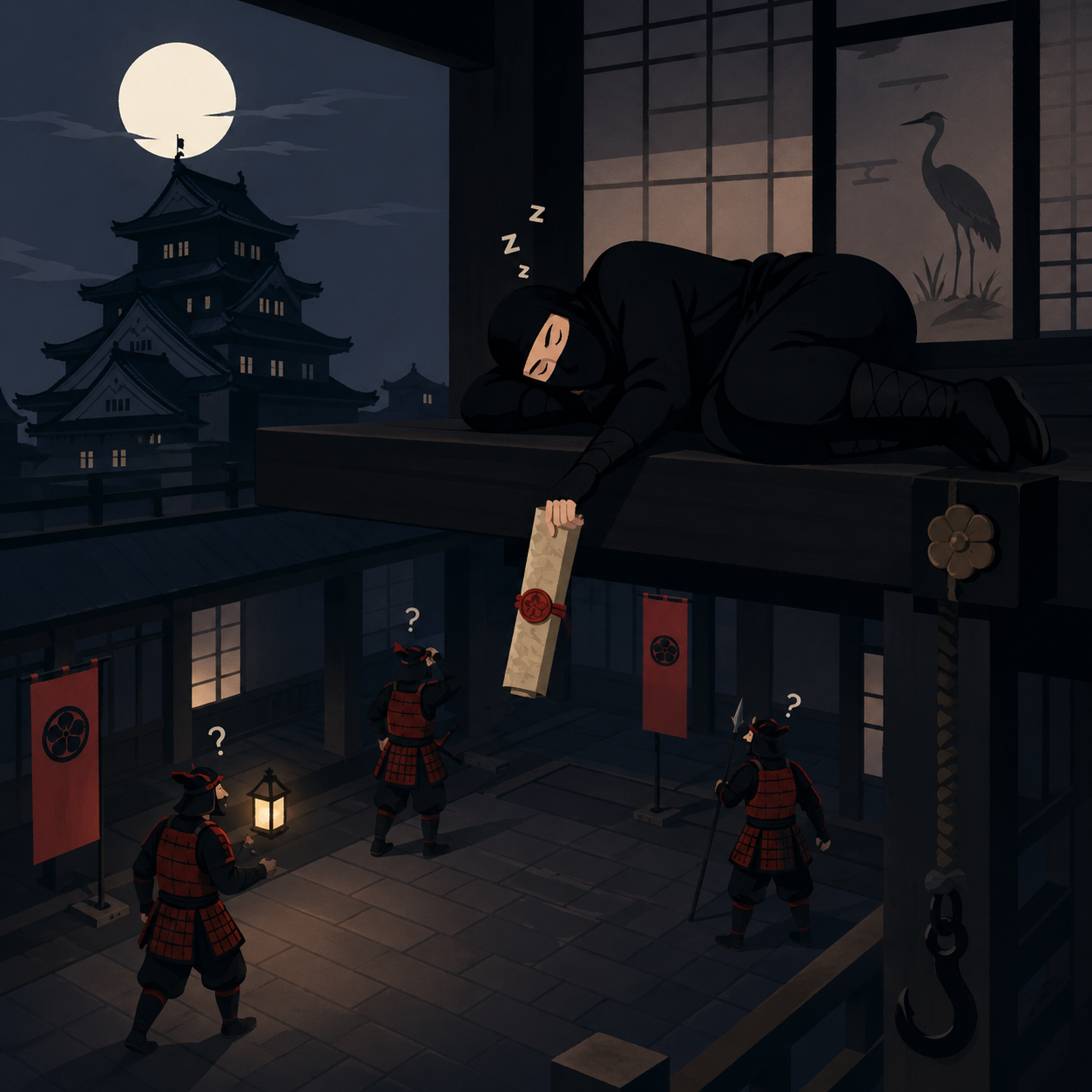
In all the provinces of the Moonlit Empire, where rumor traveled faster than horses and fear arrived before rumor had finished putting on its sandals, there was no shinobi more famous than Kagehiko of the Willow Smoke Clan. Soldiers whispered his name at watch fires and immediately looked over their shoulders.
Courtiers refused to speak it in rooms with open windows.
Generals locked their maps not in cabinets but in iron chests, then locked the keys in different chests, then slept with one eye open, which did nothing to help them because Kagehiko could steal a belt from a man without loosening the buckle.
He could cross a gravel courtyard without shifting a single stone. He could climb a palace wall so smoothly that spiders watched him with professional jealousy. He could stand in a room filled with lamps and still seem to occupy only the places where light had forgotten to go. By the age of twenty-seven, he had ended three wars before they began, rescued seven hostages, replaced twelve forged treaties with genuine ones, stolen the false tooth of a corrupt minister while the minister was still speaking, and once, on a dare, slipped into the Imperial Kitchen to salt the head chef’s tea.
Yet despite this staggering record, despite his legendary discipline and his black mask and his eyes like two careful brushstrokes of midnight ink, Kagehiko had one problem that no amount of training, meditation, or stern lectures from elderly masters could solve.
He fell asleep.
Not occasionally, not politely, and certainly not at convenient times. Sleep seized him like a tax collector: suddenly, firmly, and with no interest in negotiation. One moment he would be crouched on a rooftop, counting patrol steps. The next, he would be curled beside a chimney, breathing softly into his sleeve while guards passed below discussing dumplings. He once fell asleep while suspended upside down from a ceiling beam above a meeting of enemy commanders. He once fell asleep in a hollow tree, woke with three squirrels nesting in his sleeve, and still completed the mission because the squirrels had chewed through the hidden message tube he had been sent to retrieve. Another time, while creeping along the rafters of a tyrant’s audience hall, he dozed, slid through a decorative screen, landed in a banquet cart, and was wheeled straight into the vault chamber disguised as a tray of sweet buns.
This condition might have ended the career of a lesser ninja, but Kagehiko was not lesser. He was, by all known measures, either blessed by the gods, cursed by the gods, or very confusing to them. His sleep never prevented his success. It merely changed the route by which success arrived, usually carrying a tray, knocking over a vase, and apologizing to nobody.
The Willow Smoke Clan lived in a monastery hidden between cliffs where fog gathered each morning like a committee of old ghosts. There the shinobi trained in silence, discipline, balance, patience, disguise, herbal medicine, rope work, misdirection, coded poetry, and the noble art of not sneezing while hiding in hay. Kagehiko had mastered all of these. During the final examination of his youth, students were required to remain motionless in a bamboo grove for six hours while their instructors hunted them with bells, dogs, and insulting remarks about their footwork. Kagehiko vanished so completely that no one found him for two days. When they finally did, he was asleep in the laundry basket of Master Jiro, having somehow tied three instructors together with their own belts in his dreams.
Master Jiro, who had eyebrows so severe they seemed to disapprove of weather, had peered down at him and said, “This is unacceptable.”
Kagehiko had opened one eye. “Did I pass?”
Master Jiro looked at the three bound instructors, one of whom had a sock stuffed in his mouth. “Technically.”
Thus began the legend.
Years later, on the morning our story truly begins, Kagehiko was asleep in a persimmon tree.
He had not intended to be. He had intended to be meditating beneath it, focusing his mind for a mission of national importance. He had folded his legs, placed his hands upon his knees, listened to the rustle of leaves, inhaled deeply, and achieved such perfect serenity that he immediately tilted sideways and rolled up into the lower branches, where his body settled with the unconscious grace of a cat dropped into a basket. Several persimmons rested on his chest. A sparrow inspected him, found him uninteresting, and began cleaning its wing.
Below the tree stood Master Jiro and Lady Emi, the spymaster of the Eastern Court. Lady Emi was dressed in gray traveling robes with a hood pulled low, though her posture alone announced that she had spent many years making powerful men feel they had forgotten something important. She held a lacquered scroll case. Master Jiro held a bamboo stick he used for pointing at things he disliked, which was most things.
“Is he dead?” Lady Emi asked.
“No,” said Master Jiro.
“Is he pretending to be dead?”
“No.”
“Is this a technique?”
Master Jiro looked up at Kagehiko, who snored once, very softly. “In his case, sometimes.”
Lady Emi’s mouth twitched. She had heard the stories, of course. Everyone had. Kagehiko once infiltrated the winter fortress of Lord Banto by falling asleep inside a rolled carpet, which was then carried past six checkpoints and delivered to the lord’s private chamber. He woke when Banto stepped on his ribs, mistook the lord for a pillow, and captured him by clinging in startled confusion. It was ridiculous. It was also effective. Lady Emi had not come to the Willow Smoke Clan because she needed normal.
Master Jiro jabbed the tree with his stick. “Kagehiko.”
No answer.
He jabbed harder. A persimmon fell, bounced off his shoulder, and rolled into the grass.
“Kagehiko.”
The ninja stirred. One arm slipped from the branch and dangled. Then the rest of him followed. He dropped from the tree without waking, twisted halfway, caught a branch with the back of his knee, spun gently, and landed on his feet with a small sigh. His eyes remained closed.
Lady Emi raised one eyebrow.
Master Jiro sighed. “Kagehiko.”
The ninja opened his eyes.
“Ah,” he said, taking in the spymaster, the scroll case, the persimmons at his feet, and the sparrow now scolding him from above. “I was reviewing the mission terrain.”
“There is no mission terrain yet,” said Master Jiro.
“Then I was preparing to review it.”
Lady Emi stepped forward. “I am told you are the finest infiltrator alive.”
Kagehiko bowed. “That is kind of whoever told you.”
“I am also told you once slept through an assassination attempt.”
“Two,” he said. “Unless you count the goat.”
“I do not know about the goat.”
“It is better that way.”
Lady Emi studied him for a long moment. “I need someone to enter Night Heron Castle, pass through its outer defenses, avoid the Crimson Lantern Guard, find the hidden archive beneath the west tower, and retrieve a treaty stolen from the imperial envoy three nights ago. Without it, Lord Kazumori will claim the northern border villages were ceded to him. He will march within a week. Thousands may die.”
Kagehiko’s face changed. The sleepy softness disappeared, replaced by an attentive stillness so complete that even the sparrow stopped scolding. “Night Heron Castle,” he said. “Kazumori’s seat.”
“Yes.”
“Built over marshland, three rings of walls, inner moat fed by underground springs. The west tower rests on old stone foundations from the Heron Shrine. Crimson Lantern Guard numbers?”
“Eighty within the castle. Another two hundred in the surrounding town.”
“Archive entrance?”
“Unknown. The envoy’s clerk died before he could describe it fully. We know only this.” She opened the scroll case and withdrew a narrow strip of paper. “His last message: ‘Under the sleeping bird, where the moon drinks ink.’”
Master Jiro frowned. “Poetic men cause operational delays.”
Kagehiko took the paper. “When must I leave?”
“At once,” said Lady Emi. “You have three nights. After that, Kazumori announces the false border claim before witnesses from three provinces. If he produces the treaty first, we have no leverage.”
Kagehiko folded the paper and tucked it into his sleeve. “I will retrieve it.”
Master Jiro tapped his stick against the ground. “And you will take precautions.”
“I always take precautions.”
“You fell asleep in a persimmon tree.”
“The tree was secure.”
“You drooled on a bird.”
The sparrow chirped sharply, as if confirming this.
Kagehiko looked faintly embarrassed. “I will take tea leaves.”
“You said that before the Banto mission.”
“They worked until the carpet.”
Lady Emi glanced between them. “Is there a risk he may fall asleep inside the castle?”
Master Jiro and Kagehiko answered together.
“Yes.”
“No.”
They looked at each other.
Kagehiko corrected himself. “There is always risk in a mission.”
Master Jiro said, “There is always sleep in this one.”
Lady Emi drew a breath, but she did not withdraw the mission. War was worse than absurdity. She handed Kagehiko a small pouch of silver, a map of the castle town, and a bone whistle carved in the shape of a crane. “If you need extraction, sound this from the east marsh. My agents will hear.”
Kagehiko accepted them. “I will not need extraction.”
“Everyone says that.”
“Then I will try to need it quietly.”
By dusk he had left the monastery. He traveled light: black climbing cord, hooked claws, smoke pellets, needles, lock picks, a short blade, a packet of bitter tea leaves, a folded cloak dyed the color of muddy reeds, and three rice balls wrapped in bamboo leaf. Master Jiro had added, against Kagehiko’s protests, a small wooden rattle tied to his wrist by red string.
“If you fall asleep standing,” the master said, “perhaps this will make noise and wake you.”
“If I am hiding, noise is undesirable.”
“If you are asleep, you are already undesirable.”
Kagehiko had considered arguing, but arguing with Master Jiro was like punching fog that kept notes. So he wore the rattle tucked inside his sleeve, where it clicked softly when he moved too quickly and made him feel like a ceremonial infant.
The road to Night Heron Castle wound through cedar forests and low fields silvered by irrigation water. Kagehiko moved mostly by night, sleeping in short deliberate intervals during the day to reduce the likelihood of involuntary naps. This strategy was sound in theory and insulting in practice, because the more carefully he planned his rest, the more sleep treated his plans as suggestions from a minor official.
On the first night, he reached a roadside shrine dedicated to Hoshiko, goddess of travelers, door hinges, and misplaced chopsticks. He knelt to leave a copper coin, blinked, and woke an hour later behind the shrine with a fox sitting on his chest. The fox had stolen one rice ball and appeared to be considering the second. Kagehiko opened one eye. The fox froze. He froze. For several breaths, they regarded one another as fellow professionals.
“You may have that one,” he whispered.
The fox took the second rice ball and vanished.
Kagehiko found, however, that while he had slept, two highway bandits had crept into the shrine yard and were now hanging by their ankles from a cedar limb, tied together with his climbing cord. He had no memory of doing it. One bandit was weeping. The other said, “Sir, we apologize to your fox.”
Kagehiko retrieved his cord, advised them to seek honest work, and continued on.
On the second night, rain fell, turning the road into black ribbon. Kagehiko approached the castle town disguised as a traveling ink seller. He had chosen the disguise because of the clue: where the moon drinks ink. It seemed prudent to understand ink before finding a moon that drank it. His pack contained small jars of lampblack ink, brushes, and paper; his face was shaded by a wide hat; his black shinobi garments were folded beneath a merchant’s robe. He walked with the slight stoop of a tradesman whose back had negotiated poorly with age.
Night Heron town huddled below the castle walls on raised wooden streets because the marsh breathed beneath it. Lanterns reflected in dark water channels. Frogs croaked from unseen places. Guards stood at the main gate, their armor lacquered red over black, each holding a spear tipped with a tassel of crimson silk. The Crimson Lantern Guard looked decorative from a distance and murderous up close.
A line of travelers waited to enter before curfew. Farmers, two monks, a potter with cracked hands, a woman carrying baskets of eels, and Kagehiko with his ink. The inspection moved slowly. Guards opened sacks, tapped cart wheels, questioned anyone with nervous eyes. Kagehiko made his eyes appropriately tired and mildly offended, which was the natural expression of a merchant near authority.
Then the drowsiness came.
It began as warmth behind his eyes. He shifted his weight, pressed his thumbnail against the inside of his wrist, and quietly chewed three bitter tea leaves. The taste was so foul that his soul tried to leave by the back door. It helped for almost nine breaths.
The line shuffled forward. The eel woman argued about a tax. The potter coughed. A guard waved a lantern near Kagehiko’s face.
“Name.”
“Koma,” said Kagehiko.
“Trade.”
“Ink.”
“Purpose.”
“To sell ink.”
The guard scowled. “Do not be clever.”
Kagehiko nodded solemnly. The lantern flame wavered. The guard’s mouth moved again, asking something about permits, but the words stretched like noodles. Kagehiko felt himself tipping gently forward. He thought, with distant irritation, Not now.
He fell asleep standing.
His forehead dropped onto the guard’s breastplate with a hollow clonk. The wooden rattle in his sleeve clicked once.
The guard stared down at him. The other guard stared too. The eel woman stopped arguing.
“What is this?” said the first guard.
Kagehiko snored.
“Drunk?”
The second guard lifted one of the ink jars, uncorked it, sniffed. “Ink.”
“I know it is ink.”
“Maybe he drinks it.”
“I do not want ink-drunk merchants vomiting in the gatehouse.”
They shoved him toward the side, intending to dump him outside the gate until morning. But because Kagehiko’s sleeping body retained instincts honed by decades of training, when the first guard pushed him, he pivoted with the pressure, slipped under the spear haft, and leaned against the inspection table. The table leg, already weakened by marsh damp, snapped. The table collapsed. Three confiscated knives, two tax ledgers, a pouch of bribe coins, and a sealed message tube rolled into the mud.
The second guard lunged for the message tube. The first guard lunged for the bribe coins. They collided helmets with a crack and staggered into the eel woman, whose baskets overturned. Eels exploded across the gate road like wet living ropes. Horses screamed. Monks leapt onto a cart. A potter dropped six bowls. Guards slipped, cursed, and thrashed as eels found every gap in their armor.
In the confusion, Kagehiko, still asleep, slid down the collapsed table, rolled beneath the lifted gate chain, and came to rest inside Night Heron town beside a stack of firewood. A child passing with a lantern looked at him, looked at the chaos behind him, and whispered, “Mama, the ink man is magic.”
Kagehiko woke to the smell of damp wood and eel.
He sat up. Behind him, the gate was in uproar. Ahead lay the town, open and shadowed. His merchant hat was crooked. One ink jar had leaked down his sleeve. He blinked, assessed the situation, and murmured, “Entry successful.”
He found lodging at a cheap inn called The Bent Reed, where the walls were thin enough for mosquitoes to gossip through. He rented a corner room, paid in copper, and listened until midnight. The innkeeper talked freely while pouring tea. Lord Kazumori had doubled guard shifts. The west tower had seen masons come and go last month. A priest from the old Heron Shrine had been summoned twice and left pale both times. The castle kitchens were hiring temporary help for Kazumori’s announcement feast in three days.
Kagehiko thanked the innkeeper, retreated to his room, and prepared. He spread the castle map on the floor. Outer wall. Inner wall. Kitchen yard. Servants’ passage. West tower. The hidden archive had to be below old shrine foundations. The clue: under the sleeping bird, where the moon drinks ink.
He planned three possible approaches. Over the wall from the marsh. Through the kitchen as a servant. Beneath the town via drainage culverts. Each had risks. The wall was watched. The kitchen was crowded. The culverts were likely trapped or flooded. He studied the map until the candle burned low, then decided on the kitchen approach. He would enter before dawn with delivery wagons, hide until night, locate the west tower, and search for shrine imagery.
Then he folded the map, set a needle alarm near the candle—if the flame burned too low, thread would snap and drop a pebble into a cup—and lay down for exactly two hours.
He woke at noon.
The candle was out. The pebble was in the cup. His needle alarm had worked perfectly, except he had apparently reached out in his sleep, caught the pebble before it struck, placed it gently in the cup, and continued sleeping.
Kagehiko stared at it.
From the courtyard below, the innkeeper shouted, “Ink man! You wanted morning rice?”
Kagehiko closed his eyes. “I wanted many things.”
His delay ruined the delivery wagon plan, but a ninja who requires only one path is merely a burglar in dramatic clothing. He changed tactics. Daylight infiltration was dangerous but possible. He dressed as a kitchen assistant using clothes stolen from a laundry line, tucked his gear into a sack of turnips, and joined a group of laborers carrying supplies up the castle road. No one looked closely at another tired man with vegetables. Castles devoured food, wood, oil, cloth, and labor; one more pair of hands vanished into the appetite.
Inside the outer courtyard, Night Heron Castle proved colder than the town. Its walls were slick with moisture, its stones dark as old tea. Heron statues perched on roof corners, long necks curved, beaks pointing downward like accusations. The castle had been built for defense, but also for unease. Every corridor turned too sharply. Every window seemed too narrow. Water ran in channels under iron grates, whispering beneath the floors.
Kagehiko carried turnips to the kitchen and immediately discovered that castle kitchens were battlefields with better smells. Cooks shouted. Boys plucked ducks. A woman with arms like bridge beams kneaded dough as if punishing it for treason. Steam clouded the rafters. Knives flashed. No one cared who Kagehiko was as long as he moved quickly and did not block the soup.
“Turnips there!” barked the bridge-armed woman.
Kagehiko put the sack down.
“Not there! There!”
He moved it.
“Are you asleep?”
“Not currently.”
“Good. Peel.”
She thrust a knife into his hand and pointed to a mountain of turnips. Kagehiko, assassin of tyrants, terror of corrupt ministers, sat on a stool and peeled vegetables for the enemy. This, too, was infiltration. Humility was a blade. Also, the cook was watching.
For three hours he peeled, listened, and learned. Servants spoke of the west tower in lowered voices. A night guard had seen blue light under the door. A mason had fallen ill after working below it. Lord Kazumori had forbidden anyone to enter without a bronze crane token. The old shrine priest had muttered about “the bird that sleeps with open eyes.” The phrase caught Kagehiko’s attention.
Late afternoon brought another wave of drowsiness. His fingers slowed around a turnip. He stood, hoping movement would help. It did not. Steam filled the kitchen. The rhythmic chop of knives became rain. The dough woman shouted something, but her voice drifted far away.
Kagehiko fell asleep while carrying a tray of peeled turnips.
His body continued walking.
This was known among the Willow Smoke Clan as “the wandering nap,” a phenomenon Master Jiro regarded with horror and physicians regarded with unhelpful curiosity. Kagehiko’s sleeping mind followed recent intention, sometimes literally, sometimes poetically, and sometimes as if guided by a drunk ghost. In this case, his intention had been to leave the kitchen and locate a passage toward the west tower. His sleeping body obeyed with perfect stealth and absolutely no judgment.
He drifted through the kitchen door just as two guards entered, blocked from view by steam. One guard said, “Did you see a kitchen boy with turnips?”
The other looked around. “They all have turnips.”
Kagehiko passed behind them, tray balanced in one hand. He crossed a servants’ hall, turned left, then right, then somehow stepped into a linen closet. There he leaned against shelves, slept for several breaths, and slid backward through a loose panel into a narrow service passage that had not been used in years. Spiders watched him pass. Dust accepted his footprints as if honored.
The passage sloped downward. Kagehiko moved without waking, one hand brushing the wall. Ahead, two men spoke in hushed tones. They wore mason’s aprons and carried chisels. One held a bronze token shaped like a crane.
“I tell you, I heard something below,” said the first mason.
“Rats.”
“Rats do not whisper prayers.”
“In this castle, they might.”
Kagehiko emerged behind them. Still asleep, he placed the tray of turnips on a shelf, reached out as though adjusting a blanket, and gently plucked the bronze crane token from the first mason’s belt. Then he turned, bumped into a hanging broom, and instinctively embraced it like a pillow.
The broom fell. The masons spun.
“Who’s there?”
Kagehiko, asleep, swayed upright with the broom in his arms. The service passage was almost dark. His stolen kitchen clothes were dusty. His hair had come loose from under his cloth cap. He looked less like a ninja and more like a haunted janitor.
The second mason whispered, “It’s the shrine ghost.”
The first mason made a small strangled sound.
Kagehiko murmured in his sleep, “Under the bird…”
The masons screamed and ran.
Their screams drew guards away from the corridor leading to the west tower. Kagehiko released the broom, scratched his cheek, and wandered onward.
He woke in a small antechamber before a bronze-bound door.
For a moment he did not know where he was. Then he saw the heron carved above the door: a long-necked bird standing on one leg, head tucked beneath its wing, asleep. Its eye, however, was open, a small disk of polished black stone set in the carving. Beneath the bird was a circular depression in the door, precisely the size of the bronze crane token he found in his hand.
Kagehiko looked at the token. “Thank you, me.”
He set the token in the depression. The black eye of the sleeping heron caught the last light from a narrow window. Something clicked. The bronze door opened inward, breathing out cold air and the smell of old water.
Beyond lay a stairway descending into darkness.
Kagehiko changed into his black shinobi clothes in the antechamber, hid the kitchen disguise behind a loose stone, secured his tools, and went down. The stairs were older than the castle, their edges worn by centuries. The walls bore carvings of herons, moons, reeds, and waves. At the bottom, the passage opened into a shrine chamber carved from black stone. A shallow pool filled the center, perfectly still. In its surface floated the reflection of the moon, though no moon could be seen overhead; the chamber had no windows. Around the pool stood shelves of scrolls and lacquered boxes. At the far end rested a stone statue of a sleeping heron, head beneath wing, one eye open with a black gem.
“The sleeping bird,” Kagehiko whispered. He looked at the pool. “Where the moon drinks ink.”
The water was black.
Not dirty. Black like ink. The reflected moon trembled though the pool did not move.
He knelt at the edge and studied the shelves. There were hundreds of scrolls. The stolen treaty could be anywhere. Worse, the chamber almost certainly had traps. Old shrines loved symbolism, and symbolism loved killing thieves.
Kagehiko tested the floor with a reed whisk. No darts. He held a thread over the pool. No draft. He sprinkled powdered shell near the shelves. No hidden pressure plates visible. He approached the nearest scroll case.
A voice said, “I wondered who would come.”
Kagehiko froze.
From behind the heron statue stepped a woman in red lacquered armor, helmet under one arm, hair tied high. She was tall, narrow-eyed, and carried twin short swords. Captain Sayuri of the Crimson Lantern Guard. Kagehiko knew her by reputation. She had hunted smugglers through winter marshes, broken a rebel siege by swimming beneath a bridge with oil flasks, and once caught an assassin by noticing that one shadow in a lantern hall was breathing.
“You are not a kitchen boy,” she said.
“I am many things,” Kagehiko replied.
“Not for long.”
She drew both swords.
Kagehiko raised his hands slightly, palms empty. “The treaty Lord Kazumori stole will bring war.”
“Lord Kazumori protects his lands.”
“With forged claims.”
“You speak as if courts do not forge truth every day.”
“Truth is not improved by more forgeries.”
Sayuri’s expression did not change, but something in her eyes sharpened. “You are Kagehiko.”
He bowed. “Captain.”
“I expected someone taller.”
“I expected the archive unguarded. We are both disappointed.”
She attacked.
Sayuri was fast. Not tournament fast, not showy fast, but battlefield fast, each movement efficient and meant to end conversation permanently. Kagehiko retreated around the black pool, drawing his short blade only to deflect, not strike. Steel rang softly in the shrine. He could not risk noise. She knew this and pressed him hard, forcing him toward the shelves.
He ducked beneath a slash, rolled, flicked a smoke pellet. Sayuri kicked it midair before it burst, sending it into the pool. Black water swallowed it with a hiss. She smiled faintly.
“Your tricks are famous.”
“Then allow me to try obscure ones.”
He threw three needles at a hanging lamp chain. The lamp dropped. Sayuri cut it aside. Oil splashed across the stone. Kagehiko used the moment to leap onto a shelf, spring off, and land behind the heron statue. There, carved into the statue’s base, was a narrow slot shaped like a scroll. He noticed it in the same instant Sayuri noticed him noticing it.
They moved together.
She lunged. He twisted. Her blade sliced the cloth at his shoulder. He flung his climbing cord around the statue’s neck, swung low, and kicked the bronze token from the door mechanism. Somewhere above, the archive door began to close.
Sayuri cursed and turned toward the stairs. Kagehiko used that moment to press the black gem eye of the heron statue. Nothing happened. He pressed harder. Still nothing. Then he remembered the clue: where the moon drinks ink.
The pool.
The moon’s reflection floated in the black water, though impossible. He looked up, saw the statue’s open eye angled toward the pool. The eye was not a button. It was a lens.
Sayuri reached the stairs and slammed a hand against the closing door, holding it with effort. “You will trap us both.”
“Only briefly,” Kagehiko said, though he had no evidence.
He dipped a brush from his ink seller’s kit into the pool. The black water clung like ink. He painted a circle over the reflected moon.
The shrine groaned.
The pool began to drain, spiraling downward, carrying the painted moon with it. Stone shelves shifted. One section behind the statue opened, revealing a small alcove with a lacquered chest.
Sayuri abandoned the door and ran at him.
Kagehiko reached the chest first. It had no lock. Inside lay five scrolls bound with different cords. He scanned them quickly. Land surveys. Tax ledgers. Private letters. And one treaty, sealed with the imperial chrysanthemum in blue wax, its cord cut and retied.
Sayuri’s blade touched his throat.
“Hand it to me,” she said.
Kagehiko held the scroll in one hand. “You know what he will do with this.”
“I know my duty.”
“Duty to Kazumori?”
“To order.”
“War is not order.”
“Neither is theft.”
He tilted his head slightly. “Then arrest your lord.”
For the first time, anger broke through her discipline. “You think I do not know what he is? You think everyone who serves a rotten man is blind? Some of us stand close enough to keep worse men from taking our place.”
Kagehiko believed her. That made the blade at his throat more unfortunate.
Above, the bronze door slammed shut. The sound echoed down the stairwell.
Sayuri’s eyes flicked upward. In that heartbeat, Kagehiko moved. He dropped backward, letting her blade slice the air where his neck had been, and threw the treaty straight up. Sayuri’s gaze followed it. Kagehiko kicked the edge of the chest. The lid snapped into her wrist. One sword fell. He rolled, caught the treaty, and sprinted toward the stairs.
He made it six steps before sleep hit him like a temple bell.
No, he thought. No, no, no.
His knees softened.
Behind him, Sayuri recovered her sword. “Is this another trick?”
Kagehiko clutched the treaty against his chest, blinking hard. “I wish.”
The stairs wavered. His body, exhausted from travel, stress, missed sleep, and a duel in a haunted archive, betrayed him with magnificent timing. He slid sideways and wedged himself into a narrow recess in the stair wall, where a small statue niche held an offering bowl. His eyes closed.
Sayuri approached cautiously.
Kagehiko snored.
She stared. “Impossible.”
He slumped deeper into the niche. The treaty slipped from his hand, rolled down one step, and came to rest against the offering bowl. Sayuri bent to take it.
The step beneath her foot sank.
The old shrine, which had waited centuries for someone to ignore the offering bowl, responded with enthusiasm. The stairway folded. Not collapsed—folded, each step tilting into a smooth ramp slick with sudden black water from hidden channels. Sayuri slid downward with a shout. Kagehiko, asleep in the niche, remained untouched. The offering bowl tipped, bounced, and struck his knee. His sleeping body reacted by curling around the treaty and rolling in the opposite direction, up the ramp, as water surged beneath him.
He slid upward.
This was not physically reasonable, but the ramp had shifted like a seesaw under Sayuri’s weight, and the rush of water struck at such an angle that Kagehiko, wrapped around the scroll like a child around a toy, was propelled up the stairwell, through a side drainage chute, and into a vertical shaft used centuries ago for incense smoke. He rose in darkness, bumped off three walls, passed through a rotted wooden grate, and landed in a laundry cart full of damp towels in the west tower servants’ room.
He did not wake.
Two guards burst in moments later, having heard the shrine mechanism. One carried a lantern. The other carried a spear and a half-eaten dumpling.
“What was that?”
“Earthquake?”
“In one tower?”
They saw the laundry cart. Kagehiko lay buried under towels, only one foot visible.
The first guard lifted the towel. Kagehiko’s sleeping hand shot out, grabbed the guard’s wrist, and pulled. The guard toppled into the cart. Kagehiko rolled over him, still asleep, and came out the other side wrapped in a sheet like a ghost. The second guard dropped his dumpling.
“Ancestor preserve us!”
Kagehiko drifted forward under the sheet. The wooden rattle in his sleeve clicked.
The guard screamed, swung his spear wildly, and struck the lantern from his own companion’s hand. Oil spilled. Flame caught the edge of a towel. The laundry woman, arriving with a basket, saw smoke, saw what appeared to be a ghost carrying a treaty, and began beating both guards with wet linen while shouting, “Not in my tower!”
Kagehiko wandered through the door.
He woke in a corridor full of smoke.
For a trained infiltrator, waking in smoke with an imperial treaty tucked under one arm and a sheet over one’s head is not ideal, but it is informative. He heard bells. Fire bells. Alarm bells. Men shouting. Somewhere below, Captain Sayuri was probably climbing out of a shrine trap and considering murder with renewed focus.
Kagehiko tore off the sheet and ran.
The castle had transformed. Servants rushed with buckets. Guards ran toward the west tower. Kagehiko ran with them until he saw a turn, then vanished into a side passage. Twice he had to flatten himself against beams as patrols thundered past. Once he ducked into a room where Lord Kazumori himself stood with three advisers, all staring at maps.
Kazumori was broader than Kagehiko expected, dressed in dark blue silk, his beard trimmed to a point sharp enough to sign decrees. He held a cup of wine and looked annoyed rather than alarmed.
“Find the intruder,” Kazumori said. “If the treaty leaves this castle, Captain Sayuri will answer for it.”
One adviser bowed. “My lord, the false copy is prepared. Even without—”
Kazumori struck him across the face with the wine cup. “Do not say false where walls may hear.”
Kagehiko, pressed above them in the ceiling beams, memorized the statement. Useful, but not enough. He needed escape.
Then his eyelids drooped.
He bit his tongue. Pain flashed bright. The drowsiness retreated, then returned stronger, offended. Below, Kazumori continued giving orders. Kagehiko’s fingers loosened on the beam.
This was, in professional terms, disastrous.
He fell asleep and dropped directly onto Lord Kazumori.
The impact drove the lord into his own map table. Advisers shouted. Wine flew. Kagehiko, asleep, clung instinctively to the nearest object, which happened to be Kazumori’s formal beard. Kazumori howled. The table collapsed under both of them. Maps slid everywhere. One candle tipped onto the false treaty copy, which caught fire. An adviser lunged to save it, slipped on spilled wine, and crashed through a paper screen into the hall.
Guards outside saw smoke, a burning treaty, their lord wrestling with a black-clad figure who appeared to be napping on his chest, and three advisers yelling contradictory orders. The first guard shouted, “Assassin!” The second shouted, “Fire!” The third shouted, “Why is he asleep?”
Kagehiko woke to Kazumori punching his shoulder.
“Ah,” Kagehiko said. “Lord Kazumori.”
“Get off me!”
Kagehiko looked at the burning false treaty, the terrified advisers, the guards in the hall, and the real treaty still tucked safely inside his vest. He smiled under his mask. “Thank you for confirming the forgery.”
“What?”
Kagehiko threw a smoke pellet into the candle flame.
This one worked.
The room vanished in white smoke. Kagehiko rolled away, swept up a half-burned scrap of the false treaty as evidence, and dove through the broken paper screen. Guards stabbed into smoke, striking furniture and each other. Kazumori shouted for the gates to be sealed. Kagehiko sprinted down the hall, turned through the servants’ corridor, climbed a support pillar, and slipped into the rafters above a covered walkway.
He had to reach the east marsh. Lady Emi’s agents could extract him if necessary. The outer gates would be closed, the walls watched. Fire chaos helped, but the castle was awake now, every guard hunting.
He moved above them, shadow to shadow, until he reached the roof of the eastern storehouse. From there he could see the marsh beyond the wall, gleaming under moonlight. Between him and freedom lay the inner courtyard, the outer wall, two watch platforms, and Captain Sayuri.
She stood on the roof ridge ahead, armor wet, hair loose, face streaked with black shrine water. She looked furious, but not wild. Her swords were drawn. Behind her, the moon hung over a carved heron finial, pale and watchful.
“You are difficult to arrest,” she said.
“You are difficult to discourage.”
“Give me the treaty.”
“No.”
She looked toward the courtyard, where soldiers searched with lanterns. “Kazumori will burn villages to hide this humiliation.”
“Then help me stop him.”
“You have evidence?”
Kagehiko drew the treaty slightly from his vest, then showed the charred scrap. “The real treaty, the false copy, and advisers who heard him call it false.”
“Advisers obey fear.”
“So do guards.”
Sayuri’s grip tightened. “You think I can simply turn on my lord in the middle of his castle?”
“No,” said Kagehiko. “I think you can choose which duty survives tonight.”
For a moment, only the fire bells spoke.
Then from the courtyard came Kazumori’s voice, magnified by rage. “Captain Sayuri! Bring me his head! If the treaty leaves these walls, your family loses its name!”
Sayuri closed her eyes briefly.
Kagehiko waited. He had no weapon raised. It was either trust or die tired.
Sayuri opened her eyes. “There is a drainage chain on the east wall. It lowers the refuse gate into the marsh. Too small for armored men. Not too small for you.”
Kagehiko bowed. “Captain.”
“Do not thank me. Run.”
Below, guards noticed them. A shout rose. Arrows snapped upward. Kagehiko and Sayuri moved at once, but not against each other. She turned and cut down two arrows midflight. Kagehiko sprinted along the ridge, leapt to the storehouse roof, slid down tiles, and dropped into a hay cart. He rolled out the far side before the guards saw him land.
The east wall refuse gate was hidden behind stables, where the smell alone discouraged curiosity. Kagehiko found the drainage chain, thick with rust, feeding through an iron wheel. Too loud to lower by force. He set his shoulder to it anyway. It groaned. Guards rounded the stable corner.
“There!”
Kagehiko pulled. The chain stuck. He pulled harder. Nothing.
Drowsiness flickered at the edge of his vision.
He laughed once, softly. “You cannot be serious.”
Sleep answered by dropping a curtain over the world.
His hands slipped from the chain, but as he collapsed, his foot caught in a loop. His weight yanked the chain downward. The iron wheel spun. The refuse gate dropped open with a wet boom. Kagehiko slid across the muck-slick stones, through the low opening, and out into the marsh channel just as three spears struck the wall where he had been.
Cold water woke him instantly.
He surfaced among reeds, sputtering. Behind him, guards shouted but could not fit through the gate in armor. Arrows hissed into the water. Kagehiko sank beneath the surface, swam through mud and roots, and emerged behind a bank of reeds fifty paces away. He crawled through the marsh, treaty held above the water in an oilskin pouch, while frogs complained about the disturbance.
At the edge of the east marsh, he raised Lady Emi’s bone whistle and blew.
No sound came that human ears could hear. But across the water, a lantern blinked once, then twice. A narrow boat slid from the reeds, poled by a woman in a fisherman’s hat. Lady Emi sat in the stern, dry as a judgment.
Kagehiko climbed aboard and collapsed onto the planks.
“You have it?” she asked.
He held up the pouch.
“Evidence?”
He held up the charred scrap.
“Complications?”
The castle behind them rang with bells, smoke rising from the west tower, men shouting, eels somehow still being discussed at the main gate.
“One or two,” said Kagehiko.
Lady Emi looked at his wet hair, torn sleeve, muddy face, and the small wooden rattle still tied to his wrist. “Did you fall asleep?”
Kagehiko considered lying. Then he considered that the boat contained a spymaster. “Strategically.”
The boat woman snorted.
They poled through the marsh until Night Heron Castle dwindled into darkness. Near dawn, they reached a safe house disguised as a reed cutter’s hut. There, Lady Emi opened the oilskin pouch and confirmed the imperial seal. The treaty was intact. The charred scrap bore enough of Kazumori’s forged language to prove intent, and Kagehiko’s account would guide agents toward witnesses. But the greatest surprise came at sunrise, when a rider arrived at the hut under a white flag.
It was Captain Sayuri.
She came alone, unarmored, carrying a sealed statement signed by six officers of the Crimson Lantern Guard and two of Kazumori’s advisers, who had apparently decided that fear of Kazumori was less immediate than fear of imperial investigators, shrine ghosts, burning laundries, and a sleeping ninja falling from the ceiling. Sayuri had arrested Lord Kazumori at dawn after he attempted to flee through the treasury passage dressed as a monk. The disguise had failed because he refused to remove his jeweled boots.
Lady Emi read the statement, then looked up. “You understand what this means for you?”
Sayuri stood straight. “Yes.”
“It may mean trial.”
“Yes.”
“It may also mean command.”
Sayuri’s expression flickered. “That would be inconvenient.”
“Most duties are.”
Kagehiko, wrapped in a blanket near the hearth, lifted a cup of tea. “For what it is worth, Captain, I recommend her.”
Lady Emi glanced at him. “You recommend everyone who does not kill you.”
“I find it encourages the practice.”
Sayuri looked at him for a long moment. “You fell asleep during our duel.”
“Yes.”
“And still escaped.”
“Yes.”
“And dropped onto Kazumori.”
“Also yes.”
She seemed to struggle with several possible replies before settling on, “Your clan trains strangely.”
Kagehiko nodded. “Our standards are mysterious.”
By the time they returned to the capital, the story had already outrun them. It crossed bridges, rode merchant carts, slipped into taverns, and arrived in increasingly decorated forms. In one version, Kagehiko had transformed into mist and haunted the west tower. In another, he had summoned sacred eels to destroy the gatehouse. In a third, he had defeated Lord Kazumori in single combat while asleep, which was unfair only because it was almost true. The laundry woman became a folk hero in the castle town. The masons resigned and opened a broom shop. The fox from the roadside shrine, though uninvolved in later events, acquired a minor cult.
At the Imperial Court, the recovered treaty prevented Kazumori’s claim. His forged copy, charred though it was, exposed the scheme. His advisers testified. Captain Sayuri’s statement carried weight, and so did the fact that much of the Crimson Lantern Guard chose loyalty to the realm over loyalty to a lord who threatened families whenever paperwork disappointed him. Kazumori was stripped of title and sent to a monastery where, according to rumor, he was made responsible for cleaning eel baskets.
Kagehiko received formal thanks in a private chamber because public ceremonies made him nervous and, more importantly, sleepy. The imperial minister bowed and presented him with a lacquered box containing gold, a silk sash, and a poem praising his “unbroken vigilance.” Lady Emi coughed into her sleeve at that line.
Master Jiro, who had traveled from the Willow Smoke monastery for the debriefing, read the poem, looked at Kagehiko, and said, “Unbroken vigilance.”
Kagehiko said, “Poetry allows flexibility.”
“You entered the town by causing an eel riot.”
“Unintentionally.”
“You found the archive while asleep.”
“Efficiently.”
“You escaped a trapped shrine because you were napping in a wall niche.”
“Safely.”
“You subdued Lord Kazumori by falling on him.”
“Decisively.”
Master Jiro stared at him for so long that a lesser man would have confessed to additional crimes. Finally, the old master turned to Lady Emi. “You see my difficulty.”
Lady Emi smiled. “I see your asset.”
“Asset?”
“Enemies can predict discipline. They can study methods, bribe informants, build countermeasures. No one can plan for him.”
Kagehiko bowed modestly. “I also cannot plan for me.”
“Exactly,” said Lady Emi.
Master Jiro looked pained. “This is not a doctrine.”
“It may become one.”
“Absolutely not.”
But the Willow Smoke Clan was never quite the same after that. Young students, hearing the tale, began asking whether unconscious improvisation could be considered an advanced technique. Master Jiro responded by making them stand barefoot in cold streams reciting lock-picking principles until they regretted curiosity. Still, the story remained. At night, around small hidden fires, older shinobi told younger ones about the Napping Ninja, who breached Night Heron Castle with ink jars, eels, turnips, towels, and a complete lack of appropriate timing.
Kagehiko himself returned to the monastery and tried to resume ordinary discipline. He trained at dawn, practiced blade forms at noon, studied maps in the evening, and took carefully measured naps under supervision, which was as humiliating as it sounds. The clan physician brewed teas strong enough to make flowers wilt. Master Jiro devised new exercises involving bells, cold stones, and surprise questions about historical treaties. None cured him. Some made him irritable. One made him briefly able to smell colors, which everyone agreed was not useful.
Yet his fame grew. Requests arrived from distant courts.
A pearl merchant needed a stolen ledger recovered from pirates. Kagehiko infiltrated their ship by hiding in a barrel of pickled radish, fell asleep, rolled during a storm into the captain’s cabin, and woke with the ledger stuck to his face.
A mountain abbot needed proof that a rival temple had been replacing sacred incense with cheap sawdust. Kagehiko fell asleep in the incense storeroom, sneezed so violently that the hidden wall panel opened, revealing the sawdust sacks.
A governor’s daughter had been kidnapped by bandits. Kagehiko tracked them to a cave, fell asleep outside the entrance, and snored in such a strange echoing rhythm that the bandits believed a demon lived within the rocks and fled, leaving the girl to wake him by poking his forehead with a stick.
Each success made Master Jiro more severe and Lady Emi more amused. Eventually, the spymaster began sending mission scrolls addressed not to Kagehiko of the Willow Smoke Clan, but to Kagehiko, Specialist in Unanticipated Outcomes. Master Jiro burned the first one. Kagehiko saved the second.
But despite the jokes, despite the songs sung badly in taverns, despite children pretending to fall asleep on friends and calling it “the Kagehiko strike,” those who worked beside him knew the truth was not merely ridiculous. Every mission cost him. He feared the sleep. He trained against it. He carried shame quietly, tucked deeper than any blade. A ninja survived by control, and his body kept stealing control at the worst moments. People laughed because the endings were funny. Kagehiko laughed too, because laughter was easier to carry than dread.
One autumn evening, months after Night Heron Castle, he sat again beneath the persimmon tree where Lady Emi had found him. The leaves were gold. The air smelled of rain. He had a mission scroll unopened beside him, a cup of bitter tea in both hands, and dark circles beneath his eyes.
Captain Sayuri, now commander of the reformed Heron Guard, had come to the monastery to discuss border security with Master Jiro. On her way out, she found Kagehiko staring at the mountains.
“You are awake,” she said.
“For the moment.”
She sat beside him without asking permission, which he respected. For a while they watched fog gather in the valley.
“I heard the children in town sing about you,” she said.
He winced. “Which song?”
“The one where you defeat fifty men by rolling downhill in a rice sack.”
“That was six men and a laundry basket.”
“I thought so.”
He sipped tea. “Songs simplify.”
“They admire you.”
“They admire luck.”
“No,” Sayuri said. “They admire survival that does not look like anyone else’s.”
Kagehiko glanced at her.
She continued, “At Night Heron, I thought discipline meant never breaking form. You broke every form I knew. You were also the only person in that castle who did not bend around Kazumori’s fear.”
“I fell asleep during our duel.”
“And still did what you came to do.”
“That is not a recommended method.”
“Neither is serving a corrupt lord until a sleeping man tells you to arrest him.”
He smiled faintly. “We are both cautionary tales.”
“Perhaps.” She stood. “Or perhaps the world is too strange for only one kind of strength.”
After she left, Kagehiko remained beneath the tree until the sky darkened. Master Jiro found him there later, the mission scroll still unopened.
“You are avoiding the scroll,” the master said.
“I am considering it.”
“You have been considering it for three hours.”
“It is a complex scroll.”
“It is tied shut.”
Kagehiko sighed and picked it up. “Do you ever wonder whether Lady Emi chooses me because I am skilled, or because disasters near me arrange themselves into solutions?”
Master Jiro lowered himself onto the grass with the careful irritation of an old man whose knees had submitted formal complaints. “Both.”
“That is not comforting.”
“Comfort is for mattresses.”
Kagehiko waited.
Master Jiro looked toward the valley. “When you were a boy, I thought your condition would make the path impossible. I was wrong.”
“You rarely admit that.”
“I dislike giving it novelty.”
Kagehiko smiled.
The old master continued, “You are not great because you sleep. Do not let fools tell you that. Sleep endangers you. It endangers missions. It is not a gift wrapped by heaven. But you are great because when you wake, you continue. Because before you sleep, you prepare. Because even your dreaming body has been trained by years of discipline. Luck visits you often, yes. But luck finds doors only because you spend your waking hours learning locks.”
Kagehiko looked down at the unopened scroll.
Master Jiro stood. “Also, you are infuriating.”
“There it is.”
“Open the scroll.”
Kagehiko did.
The mission concerned a stolen statue, a jealous duke, and a banquet at which no weapons were permitted but all desserts were to be inspected for poison. Kagehiko read it twice. Then he looked at Master Jiro.
“I may need to disguise myself as a pastry chef.”
“No.”
“A servant?”
“No.”
“A decorative screen?”
Master Jiro closed his eyes. “I am already tired.”
Kagehiko tucked the scroll into his sleeve and rose. The persimmon tree rustled overhead. Somewhere in its branches, perhaps descended from the same offended sparrow, a bird chirped sharply at him.
He bowed to Master Jiro. “I will depart before dawn.”
“You will sleep before then.”
“Yes.”
“Deliberately?”
“That is my intention.”
Master Jiro grunted. “Intentions are frightened animals around you.”
Kagehiko laughed, and this time the laugh held little shame. He walked back toward the monastery, where lamps glowed behind paper windows and young students practiced silent steps in the courtyard. One boy stumbled, caught himself, and glanced around in embarrassment. Kagehiko paused beside him.
“Again,” he said gently.
The boy bowed. “Master Kagehiko, is it true you once defeated Lord Kazumori while dreaming?”
Kagehiko considered the question with appropriate seriousness. “No.”
The boy’s face fell.
“I was only lightly asleep.”
The boy grinned.
Kagehiko continued toward his room. Behind him, the students returned to practice, stepping more carefully now, though one of them attempted to close his eyes while walking and immediately collided with a water bucket. Master Jiro’s shout shook leaves from the tree.
That night, Kagehiko prepared for the next mission. He sharpened his blade, packed his tools, checked his cord, replaced his smoke pellets, and tied the ridiculous wooden rattle to his wrist. He brewed bitter tea and set three alarms: a pebble cup, a candle thread, and a small bell attached to his ankle. Then, because he had learned something from surviving himself all these years, he placed his bedroll in the center of the room, far from windows, shelves, weapons, ink, turnips, laundry baskets, secret doors, unstable tables, and anything that might be mistaken for a strategic opportunity by his unconscious mind.
He lay down.
For several breaths, he watched moonlight move across the ceiling. Tomorrow there would be danger. There always was. There would be locked doors, suspicious guards, perhaps poison pastries, perhaps worse. There would likely be an inopportune nap. There might be embarrassment. There might be songs.
His eyelids grew heavy.
Kagehiko smiled into the dark.
In another province, a jealous duke slept peacefully, unaware that the most unpredictable ninja in the empire would soon arrive at his banquet. In the Willow Smoke monastery, Master Jiro woke suddenly from a nightmare involving cream cakes and falling chandeliers, sat upright, and muttered, “Absolutely not,” though no one was there to hear him. In the rafters above Kagehiko’s room, a mouse crept along a beam, paused, and decided wisely to leave.
The moon crossed the window.
The Napping Ninja slept.
For now.