Post-Apocalyptic Postman
When the pudding fell, Harold Spindle was asleep in his uniform.
This was not unusual. Harold had worn the blue-gray coat of the Royal Postal Service every working day for twenty-seven years, and sometimes on Sundays when he forgot it was Sunday. The coat had brass buttons, a rain flap, and a deep inside pocket in which Harold kept emergency postage stamps, a small tin of peppermint lozenges, and a spoon.
The spoon had originally been for lunch. Over time it had become for stirring tea, scraping mud from boot heels, rescuing jammed envelopes from letterboxes, and, once, defending himself from a goose. Harold believed a postman should be prepared for anything, though even he would later admit that “anything” had not seemed likely to include twelve trillion tons of vanilla pudding descending from the sky at three minutes past two in the morning.
He woke because of the sound.
It was not thunder, nor rain, nor hail. It was a soft, enormous blorp.
Harold sat up in bed.
Blorp, said the roof.
Blurp, said the chimney.
Plap-plap-plap-plap, said the window.
Harold put on his spectacles, though everything beyond the glass was a pale yellow smear. He swung his feet onto the floor and discovered, with mild irritation, that pudding had already made its way under the door and was creeping across the boards in a glossy, determined layer.
“Oh,” said Harold.
That was all. Harold was not a dramatic man.
He stood, buttoned his coat, took his cap from the bedpost, and went downstairs. The pudding was ankle-deep in the hall. It was warm, but not hot. It smelled of vanilla and nutmeg and something faintly festive, like a bakery that had lost control of itself.
In the kitchen, the radio sat on the counter beneath a mound of pudding that had squeezed through a crack in the ceiling. Harold wiped it clean with a dish towel and turned the knob. Static crackled. Then a voice emerged, thick with disbelief.
“This is the Emergency Broadcast Service. Citizens are advised to remain indoors unless absolutely necessary. Repeating: a global pudding event has occurred. Experts are currently describing it as gentle, edible, and, quote, ‘extremely inconvenient.’ Do not attempt to swim in deep custard. Do not panic. Do not eat pudding of unknown depth. Roads are impassable in most districts. Railway services are suspended due to wobble. The postal service is—”
The radio gave a wet pop and died.
Harold stared at it.
“The postal service is what?” he asked.
The radio did not answer.
He looked at the clock. Six fifteen. Sorting began at six thirty.
Harold took his lunch tin, checked that the spoon was in his pocket, and opened the front door.
A slow wave of pudding nudged his boots.
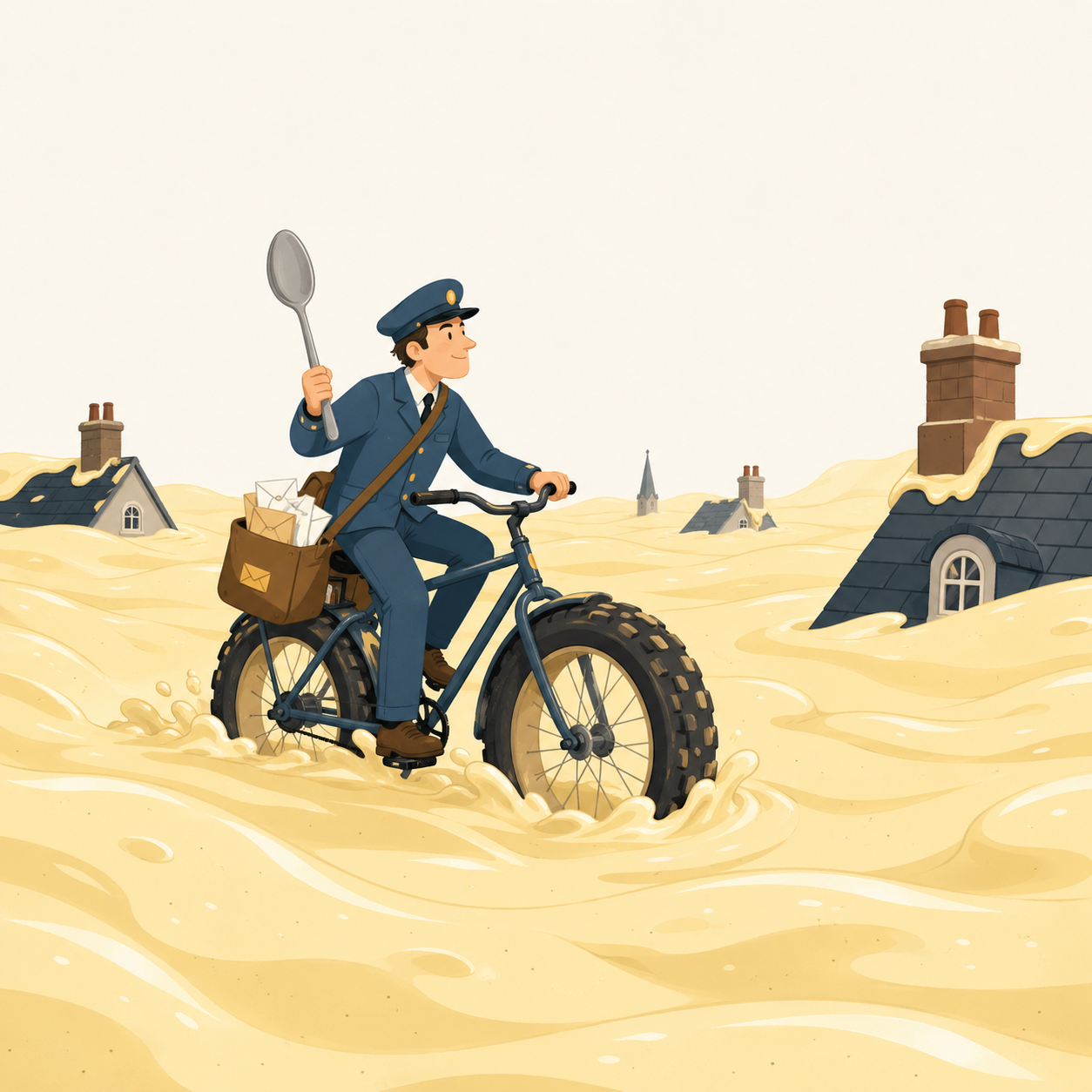
The street had vanished. So had the pavement, the garden walls, the painted curb, and Mrs. Whitely’s gnomes, although one pointed red hat poked out near the hydrangeas. The world was smooth and shining, a custard-colored plain stretching from doorstep to doorstep. Chimneys stuck up like islands. Trees rose from it with their trunks buried halfway. The lampposts wore pudding around their waists. A cat sat on the roof of a parked car and looked offended.
Across the road, Mr. Buntle opened an upstairs window.
“Harold!” he called. “Have you seen this?”
“Yes,” said Harold.
“What is it?”
“Pudding.”
“I know that, but why?”
Harold considered this. “I don’t believe I’ve been informed.”
Mr. Buntle leaned farther out. “Where are you going?”
“To work.”
“To work? Harold, the world has ended!”
Harold looked up and down the street. The world, in his opinion, had not ended. It had merely become difficult to walk upon.
“I have people’s post,” he said.
Mr. Buntle blinked. “But it’s pudding.”
“So I shall take my bicycle.”
“You can’t ride a bicycle through pudding!”
Harold glanced toward the shed at the side of his house. “Not a standard bicycle, no.”
Mr. Buntle watched as Harold waded to the shed. The pudding came nearly to his knees in the lane, and each step made a comic squelch. Harold unlocked the shed, opened the door against a soft yellow drift, and revealed his bicycle.
It was an old black postal bicycle with a front basket, rear panniers, bell, lamp, and a small brass badge that read No. 14. But it had been modified.
Harold had been a practical man long before the apocalypse. The town of Little Crumbly was low-lying and prone to floods, mud, runaway dough from the bakery during the Great Yeast Incident, and one memorable winter in which the mayor had insisted on salting the roads with powdered gravy. Harold had therefore fitted his bicycle with wide, ribbed, rubber-coated tires, each as fat as a loaf of bread. The tires had deep paddle grooves, sealed spokes, and a varnish of his own invention made from beeswax, linseed oil, and something sold to him by a traveling salesman as “otter reluctance.”
He had called them pudding-proof tires only as a joke.
Now, as he wheeled No. 14 into the lane, he felt a small flicker of pride.
Mr. Buntle watched from his window. “You knew?”
“No,” said Harold, mounting the bicycle. “But it is always best to keep one’s options open.”
He pushed down on the pedal.
The front tire rose over the pudding. The back tire churned, wobbled, found grip, and then the bicycle moved. Slowly, yes. With a sound like a hippo tiptoeing through porridge, certainly. But it moved.
Harold rang his bell.
Ting-ting.
A ripple spread through the pudding-covered street.
He cycled toward the sorting office.
Little Crumbly had become a town of roofs, upper windows, church spires, and startled faces. People leaned out with mugs in their hands, wearing dressing gowns and baffled expressions. A boy on Number Seven was attempting to lower a bucket on a string into the pudding. His mother pulled him back by the pajama collar. At the corner shop, old Mrs. Patel stood on the flat roof beneath a beach umbrella, calmly writing “PUDDING SOLD OUT” on a chalkboard.
“Morning, Harold,” she called.
“Morning, Mrs. Patel.”
“Bit slippery today.”
“So I’ve noticed.”
“You want a jar of cherries? Might improve the commute.”
“Kind of you, but I’m on duty.”
He pedaled on.
The main square had taken the worst of it. Pudding rose nearly to the second step of the town hall. The statue of Sir Oswald Crumbly, founder of Little Crumbly and inventor of the folding scone, was visible only from the waist up. Pudding clung to his bronze moustache. Someone had placed a raspberry on his helmet.
At the post office, the front door opened inward and therefore could not be opened at all, because several tons of pudding leaned against it with placid confidence. Harold dismounted and assessed the building. The sorting office windows were above the pudding line. The fire escape at the back led to the roof. The roof led to a skylight. The skylight led to the storage loft. The storage loft led to a ladder beside the parcels cage.
Harold nodded.
He removed his spoon.
A lesser postman might have turned back. A lesser postman might have declared the day unpostable. A lesser postman might have stayed home and eaten a cautious portion of apocalypse with tinned peaches. Harold Spindle was not a lesser postman. He was a man who had once delivered a postcard addressed only to “Auntie June, the house with the loud dog,” and had found it in under forty minutes.
He leaned his bicycle against a drainpipe, climbed the fire escape, crossed the roof, scraped pudding from the skylight with his spoon, and lowered himself into the loft.
Inside, the sorting office smelled of paper, ink, damp canvas, and pudding trying to get in. Thin yellow fingers had pushed through the mail slot and were spreading across the floor. The sorting tables stood high enough to remain dry. The mailbags hung from hooks like sleeping bats. The clock read six forty-eight.
“Late,” muttered Harold.
He took the day’s incoming sacks from their rack. The last van must have arrived before the pudding, he thought. There were three full bags for Little Crumbly and the surrounding lanes, plus a special red pouch containing registered letters, legal documents, and birthday cards with money inside.
He sorted quickly.
Household bills into one tray. Personal letters into another. Parcels onto the high shelf. Postcards, circulars, council notices, seed catalogues, knitting magazines, apology notes, official envelopes, wedding invitations, one mysterious package shaped like a duck, and seven letters addressed in green ink to persons who had not lived in the district for a decade.
By eight o’clock, Harold had filled his panniers. He wrapped the mailbags in oilcloth, tied them tight, and slung the registered pouch across his chest. Then he paused at the staff noticeboard.
There, pinned crookedly beside a poster about dog safety, was the Postal Oath. It had been there for years, curling at the edges.
Neither rain nor gloom nor incorrectly numbered cottages shall keep us from our appointed rounds, it read.
Someone had once added in pencil: nor geese.
Harold took the pencil and wrote beneath it: nor pudding.
Then he climbed back onto the roof, lowered the bags by rope, mounted No. 14, and began his round.
The first deliveries were simple. People leaned from windows with laundry baskets, fishing nets, and cooking tongs. Harold rolled beneath them, and they lowered containers. He placed letters inside, saluted, and went on. Mrs. Greaves at Number Twelve received a postcard from Brighton, though Brighton, Harold suspected, was now beneath custard as well. Mr. Tombleby received a pension notice and asked if Harold could deliver a message to his sister two streets over.
“If it is properly addressed and stamped,” said Harold.
Mr. Tombleby disappeared from the window and returned with an envelope, a stamp, and a gravy boat attached to a broom handle.
By nine thirty, Harold had completed Crumpet Lane, Ladle Street, and half of Marmalade Terrace. His legs ached from pedaling through pudding, but No. 14 behaved beautifully. The pudding-proof tires rolled and churned. The front basket collected splashes. The bell grew sticky but still produced a dignified ting.
Then he reached Wobble Bridge.
Wobble Bridge crossed the little River Snip, although the river itself was no longer visible. Normally the bridge was stone, narrow, and perfectly safe except during market days when goats argued upon it. Now it was buried under a mound of pudding that quivered from bank to bank like a dessert with nerves.
A signpost stuck out at an angle.
BRIDGE CLOSED IF WOBBLING.
Harold dismounted.
The bridge wobbled.
He looked left. He looked right. The river valley had filled with pudding to an unknown depth. A flock of ducks sat on the surface, drifting slowly as if deeply unsure whether they were swimming or being served.
Harold tested the bridge with his spoon. The pudding jiggled. Somewhere beneath it, stone held firm. Probably.
On the far side lay the north route: Orchard Row, Button Hill, the old library, and, most importantly, the retirement home. Harold had thirteen letters, four magazines, and one parcel of boiled sweets for the residents of Primrose Rest. He also had a pink envelope addressed to Miss Ethel Plum, who received letters every Thursday from her grandson in the navy. Harold knew this because she waited by the window every Thursday at ten fifteen.
It was now ten ten.
He remounted the bicycle.
The front tire touched the bridge pudding. The mound trembled. Harold pedaled gently. No. 14 climbed. Pudding slithered down both sides in slow folds. Beneath the tires, the buried stone path curved upward, then flattened.
Halfway across, the bridge made a sound.
Gloop.
Harold stopped.
The pudding ahead rose suddenly, forming a bulge the size of a wardrobe. It shivered, swelled, and split. Out from within emerged a cow.
The cow blinked at Harold.
Harold blinked at the cow.
The cow had apparently been standing in the river meadow when the pudding fell, and had since traveled under the surface, chewing her way through the apocalypse. Her horns were draped in custard. A postal circular advertising chimney repair stuck to her forehead.
“Good morning,” said Harold.
The cow said, “Mrrrp,” which was not quite a moo because her mouth was full.
She stepped forward. The bridge wobbled dramatically. Harold squeezed the brake.
“Carefully,” he told her.
The cow considered him, then licked the handlebar.
“No, thank you.”
The cow licked the bell.
Ting, said the bell, sadly.
This seemed to satisfy her. She turned, slid down the side of the pudding mound, and disappeared with a serene plop into what had once been the south bank.
Harold waited until the wobbling settled, then continued. He reached the far side at ten fourteen.
At Primrose Rest, twenty-three elderly residents were gathered on the upper balcony wearing hats, shawls, and expressions of great interest. Someone had hung bunting. Someone else had written WELCOME POSTMAN in lipstick on a bedsheet.
“Harold!” cried Miss Ethel Plum, small and birdlike in a purple cardigan. “You made it!”
“I did say Thursday,” Harold replied.
He passed up the mail in a wicker basket lowered on a pulley normally used for bringing in potted geraniums. Miss Plum clutched the pink envelope to her chest.
“It’s from Arthur,” she said to everyone.
Everyone already knew, but they applauded anyway.
Mr. Coggs, who had been a railway guard for forty years and missed no opportunity to inspect timetables, leaned over the rail. “Any word on trains?”
“I believe they are suspended due to wobble.”
“Typical,” said Mr. Coggs. “One wobble and the whole system gives up.”
Miss Plum opened her letter with a hairpin. Harold did not pry, but he saw her smile grow slowly across her face, and that was worth the bridge.
He was about to leave when Nurse Beadle called, “Harold, there’s a message from the mayor! He’s trapped in the town hall with the emergency committee. They need volunteers.”
“I am on my round,” Harold said.
“They specifically asked for anyone mobile.”
Harold looked at the remaining mailbags. He still had deliveries for Button Hill, the library, and the far cottages beyond the cricket field. But the mayor, ridiculous as he often was, did represent civic order, and civic order mattered in an apocalypse, even a custard-based one.
“Very well,” said Harold. “I shall pass by after Orchard Row.”
Nurse Beadle frowned. “After?”
“Mrs. Finch is expecting her seed catalogue.”
“But Harold, the mayor—”
“Has waited this long,” said Harold. “Mrs. Finch has been trying to grow prize pumpkins since February.”
He rang his bell, thanked them, and rode on.
Orchard Row was difficult. The apple trees had become pudding islands, each trunk surrounded by a moat of dessert. The branches hung low with last autumn’s forgotten fruit, now glazed in vanilla. Harold ducked under limbs and pedaled between submerged garden gates. At Number Three, Mr. and Mrs. Finch were marooned on their porch roof with a teapot and three cushions.
“Seed catalogue,” said Harold, holding it up.
Mrs. Finch gasped as if he had presented her with a royal decree. “Bless you, Harold.”
“I cannot guarantee spring planting conditions.”
“Nonsense,” she said. “Pudding is only compost that hasn’t made up its mind.”
Mr. Finch lowered a saucepan on a rope. Harold placed the catalogue inside. As Mr. Finch hauled it up, the rope slipped. The saucepan swung, hit the gutter, bounced, flipped, and sent the catalogue sailing into the air.
Harold reacted instantly. He drew his spoon, leaned from the bicycle, and caught the catalogue against the spoon bowl just before it landed in the pudding.
Mrs. Finch shrieked with delight.
“Marvelous!” cried Mr. Finch. “Like cricket!”
Harold tucked the catalogue securely into a folded newspaper and tried again. This time it reached the roof.
By late morning, word had spread. Harold Spindle was delivering the mail. People shouted from chimneys and dormers. Children cheered. Dogs barked from upstairs windows, confused by their inability to chase him. Someone played a trumpet, badly. Harold accepted three additional stamped letters, one grocery list, and a biscuit wrapped in wax paper. He refused to transport an unstamped love note because, apocalypse or not, there were standards.
Near the old library, the pudding grew deeper. The library stood at the bottom of a dip, and only the top half of the building remained visible. Miss Quill, the librarian, was sitting on the roof beside a stack of books protected under umbrellas.
“Harold!” she called. “I thought you’d come.”
“I have the interlibrary loan notices.”
“Wonderful. Completely useless, but wonderful.”
He delivered them via a fishing net. She sent down a bundle of overdue reminders in return.
“Do you expect people to return books today?” Harold asked.
“Not today,” said Miss Quill. “But civilization depends on consequences.”
Harold could not argue with that.
As he turned toward the town hall, the first real danger appeared.
At first he thought it was a hill of pudding sliding across the square. Then the hill shuddered and rose. It had two lumps like shoulders, a sagging middle, and a rounded head into which someone’s bicycle helmet had become embedded. Two currants formed eyes. A cherry sat where the nose should be.
It was a pudding man.
Not a man made deliberately of pudding, like something at a children’s party, but a man-shaped wobble that had perhaps been created by the mixing of heat, custard, static electricity, and the general silliness of the apocalypse. It stood twelve feet tall and moved with slow, uncertain steps, leaving splats behind it.
The town hall balcony was crowded with officials. Mayor Puddifoot, whose name had become painfully appropriate, waved both arms.
“Spindle! Spindle! Over here!”
The pudding man turned toward Harold.
Harold stopped No. 14.
The pudding man leaned down. Its currant eyes wobbled. It smelled strongly of vanilla.
“Morning,” said Harold.
The pudding man lifted one enormous arm.
On instinct, Harold held up a council tax bill addressed to 4 Buttercup Close.
The pudding man paused.
Harold did not know whether pudding men understood mail. But in his experience, most creatures recognized importance when presented with an envelope.
The pudding man poked the bill with one blobby finger. The paper stuck to it.
“That is not for you,” said Harold firmly.
The pudding man made a mournful bloooooop.
“I’m sure you would like a letter,” Harold said. “Many people would. But you cannot simply take someone else’s.”
The creature lowered its arm. The bill slid free and fell into Harold’s basket, only slightly damp.
Mayor Puddifoot shouted, “Do something!”
“I am doing something,” Harold called back. “I am maintaining postal integrity.”
The pudding man suddenly sat down.
The square shook. A wave of pudding rolled outward. Harold braced his feet. No. 14 tilted, skidded, and nearly toppled. The wave slapped the town hall steps, surged past Sir Oswald’s raspberry-topped statue, and carried Harold sideways toward the fountain.
He pedaled hard. The pudding-proof tires churned. His front wheel struck something buried—perhaps a bench, perhaps a tuba—and the bicycle lurched. The registered pouch swung loose. A handful of letters spilled from the front basket and landed on the pudding surface, drifting away like pale boats.
Harold’s heart gave a sharp thump.
He dismounted into waist-deep pudding.
The letters floated apart. One spun toward a drainpipe. Another slid toward the sitting pudding man. A third began sinking slowly, the ink already blurring.
Harold took his spoon.
With quick, precise movements, he scooped the nearest letter, flicked it into his cap, grabbed the second between two fingers, and lunged for the third. The pudding sucked at his boots. He stretched farther. His fingertips brushed the envelope. It sank another inch.
A long pole appeared beside him.
“Use this!” shouted someone.
It was Mayor Puddifoot, leaning from the balcony with the ceremonial town mace, a ridiculous golden staff topped with a carved scone.
Harold hooked the envelope against the mace and lifted it free.
“Thank you, Mayor.”
“Quite,” said the mayor. “Never liked that mace.”
Harold rescued all six letters, wiped them with his handkerchief, and placed them inside the driest pouch. He then looked at the pudding man, who sat in the square with a sorrowful slump.
The creature’s cherry nose had slid down to its chest.
Harold felt unexpectedly sorry for it.
He took a blank postcard from his bag. Postal regulations allowed the sale of postcards during rounds. He wrote carefully:
To: The Large Pudding Gentleman, Town Square, Little Crumbly.
Message: Welcome. Please do not interfere with the mail.
From: Harold Spindle, Postman.
He affixed a stamp, cancelled it with his portable mark, and held it out.
The pudding man stared.
Harold placed the postcard against the creature’s chest. It stuck there. The currant eyes widened. A tremble passed through its whole body, not dangerous this time, but pleased. The cherry nose slid back upward, or perhaps another cherry surfaced.
The pudding man gave a small, happy blurp.
“Good,” said Harold. “Carry on.”
The mayor insisted Harold come inside. Getting inside required climbing a rope ladder from the town hall balcony while two councilors argued about whether rope ladders had been approved under emergency access regulations. Harold left No. 14 propped against Sir Oswald’s visible elbow and carried the mailbags up with him.
The emergency committee had set up in the council chamber. The mayor sat at the head of the table wearing his chain of office over pajamas. Around him were the fire chief, the school headmistress, Mrs. Patel, Miss Quill by radio, Nurse Beadle by loudhailer, and three citizens who appeared to have joined because they were trapped there anyway.
Maps covered the table, although the maps showed roads and the town now contained mostly pudding.
“We have a crisis,” said Mayor Puddifoot.
“Yes,” said Harold.
“We must coordinate supplies, check on vulnerable residents, establish safe routes, and determine whether the pudding is custard, blancmange, or technically dessert foam.”
“Pudding,” said Mrs. Patel.
“Quite,” said the mayor. “We need communication. Telephones are unreliable. The internet has gone sticky. Radios work only when not full of pudding. We require a courier system.”
Everyone looked at Harold.
Harold looked down at his remaining mail.
“I have sixteen letters left, two magazines, a parcel for the old mill, and a registered document for Mrs. Abigail Teaspoon at the hill cottage.”
“Exactly,” said the mayor. “You’re the only one moving reliably.”
“I am moving slowly.”
“Reliably slowly.”
The fire chief leaned forward. “We need messages taken to the school roof, the bakery, the water tower, and the farms. We need to know who’s safe. We need to tell people not to light fires under the pudding.”
“Have they been doing that?” asked Harold.
“One man tried to make crème brûlée of his driveway.”
“Unwise.”
The headmistress placed a bundle of papers before him. “These are emergency notices. Can you deliver them?”
Harold examined them. They were folded, addressed by district, and stamped with the town seal. Not proper postage, but civic emergency post had precedent, particularly during floods, blizzards, and the unfortunate ferret election of 1983.
“I will deliver them,” he said, “in addition to the mail.”
A relieved murmur filled the room.
“But I will require waxed bags, string, a fresh cloth, a map of pudding depths, and any available cherries.”
“Cherries?” asked the mayor.
“For diplomacy.”
Mrs. Patel nodded as if this were obvious. “I’ll get the cherries.”
Within twenty minutes, Harold was back on No. 14 with twice the cargo, four jars of cherries, emergency notices, a whistle, and a council armband reading OFFICIAL PUDDING RESPONSE. He found it too large and tied it around the handlebar.
His next destination was the school.
The children of Little Crumbly Primary had been on an overnight astronomy camp in the assembly hall when the pudding fell. They were now stranded on the roof, having learned more about atmospheric dessert than stars. Headmistress Prim had returned via town hall and wanted Harold to deliver instructions to Mr. Japes, the substitute teacher in charge.
The road to the school passed the bakery. Here the apocalypse had become complicated. Pudding had entered the ovens, mixed with flour, yeast, jam, and possibly several experimental pastries. The result was a slow-breathing mass of sticky dough-pudding that rose from the bakery windows and burped cinnamon.
Mr. Crust, the baker, stood on the roof in a floury apron.
“Harold!” he shouted. “Don’t come too close! It’s alive!”
The dough-pudding bulged.
A tendril of sweet dough stretched toward Harold’s front wheel.
Harold stopped just out of reach.
“I have a notice for you,” he said.
“Never mind that! It’s eating the baguettes!”
“Is anyone injured?”
“Only my pride.”
The tendril slapped the pudding surface, searching.
Harold opened one jar of cherries. He placed three on his spoon and flicked them toward the bakery window.
The dough-pudding froze.
Then the tendril changed direction, scooped up the cherries, and withdrew. A pleased yeasty sigh came from inside the bakery.
Mr. Crust stared. “How did you know?”
“I did not,” said Harold. “But most things like cherries.”
He delivered the notice by throwing it wrapped around a rolling pin. Mr. Crust caught it and saluted with a baguette.
The school roof was crowded with children, sleeping bags, telescopes, and one rabbit in a cage. The moment Harold appeared at the gate, they cheered so loudly the pudding rippled.
“Postman Harold!”
“Did you fight a monster?”
“Can pudding get homework?”
“Can we eat the playground?”
Mr. Japes, a thin man with large ears and a sweater vest, looked as if he had aged eight years since breakfast. Harold passed up the emergency notices and three letters addressed to school staff.
“Headmistress Prim says to keep the children on the roof, ration snacks, and absolutely no sliding down the pudding banks.”
Mr. Japes turned pale. “They’ve been asking about that.”
A girl with pigtails leaned over the roof edge. “Mr. Spindle, is it true you have magic tires?”
“No,” said Harold. “They are rubber, wax, and sensible maintenance.”
“That’s what magic is,” said the girl.
Harold considered this and decided not to argue.
One small boy raised his hand. “Can you deliver something to my mum?”
“If it is addressed and stamped.”
The boy produced an envelope made from lined exercise paper. It was addressed, in large uneven letters, to MUM AT HOME, THE BLUE DOOR, LOVE SAM. A stamp had been drawn in the corner with a crayon. It featured Harold himself on his bicycle.
“This is not a valid stamp,” Harold said.
The boy’s face fell.
Harold looked at the roof full of children, at the trembling world, at the drawn stamp showing his own nose much larger than it truly was.
“However,” he said, “under emergency artistic postage provisions, it may be accepted.”
Mr. Japes whispered, “Are there emergency artistic postage provisions?”
“There are now,” said Harold.
By afternoon, the sun had warmed the pudding. The surface became shinier, softer, and more treacherous. Harold’s wheels left deep tracks that filled behind him. His trousers were soaked. His gloves were sticky. His cap smelled like custard. Still, he rode.
He delivered the boy’s letter to the blue door, or rather to the blue attic window, where Sam’s mother cried so hard she dropped a slipper into the pudding. He delivered medical instructions to Nurse Beadle, a crate label to the water tower, two love letters accidentally posted before the apocalypse and now urgently appreciated, and a magazine called Advanced Ferret Keeping to a man stuck on a greenhouse roof with no ferrets but a lot of spare time.
At the cricket field, he encountered the Spooners.
The Spooners were not people. They were actual spoons.
Thousands of them.
They had gathered from kitchens across the town, swept up by pudding currents, and now floated together in the shallow bowl of the cricket field. Teaspoons, soup spoons, serving spoons, ladles, grapefruit spoons, one silver christening spoon, and a suspiciously large number of souvenir spoons from seaside resorts bobbed in a glittering swarm.
Harold slowed.
The spoons turned toward him.
This was alarming because spoons did not usually turn toward anything.
His own spoon, in his pocket, gave a little twitch.
“Oh,” said Harold.
The spoon swarm began moving across the pudding, tinkling softly. They flowed around No. 14’s tires, nudged the spokes, tapped the pedals, and gathered before Harold like a crowd awaiting a speech.
Harold took out his spoon.
The swarm went still.
He held it up. “I am on postal business.”
The spoons tinkled.
“I cannot take you all with me.”
The spoons sagged.
Harold felt this was becoming one of those days in which a man must make decisions not covered by training.
“I can take three volunteers.”
The field erupted in tiny metallic clatters.
Three spoons leapt—or perhaps were pushed—onto his front basket. One was a teaspoon with a bent handle. One was a stout soup spoon. One was a long sundae spoon, elegant and ambitious.
“Very well,” said Harold. “Welcome aboard.”
The rest of the spoons parted, making a shining path across the cricket field.
With the help of his new passengers, Harold crossed the field faster than expected. The spoons paddled in the pudding beside the tires, clearing thicker clumps and flinging aside lumps of sponge cake that had appeared from nowhere. The sundae spoon proved especially useful for fishing letters from deep pockets. The soup spoon bailed pudding from Harold’s shoes. The teaspoon mostly rang the bell, but morale was important.
Beyond the cricket field stood Button Hill, which was steep, exposed, and now coated in pudding like a cake left out in the rain. At the top, the old mill turned slowly in a custard breeze. Harold had the duck-shaped parcel for Mr. Willow there, plus emergency notices for the hill cottages and the registered document for Mrs. Abigail Teaspoon.
Button Hill defeated him twice.
The first time, No. 14 climbed ten yards before sliding backward into a hedge. The hedge, being full of pudding, accepted him without complaint. The second time, he zigzagged halfway up before a concealed garden roller sent his front wheel sideways. He and the bicycle rotated gently, slid down the hill, and arrived at the bottom facing the wrong way.
Harold stood, dripping.
The teaspoon rang the bell.
Ting.
“Yes, thank you,” said Harold.
He studied the hill. The pudding surface was too smooth. The tires needed purchase. He opened the last jar of cherries and placed them in a line up the slope, pressing each one into the pudding. It seemed absurd. But the cherries made bumps, the bumps made texture, and texture made possibility.
He mounted again.
The tires gripped the first cherry, then the second. No. 14 lurched upward. The soup spoon dug at the pudding like an oar. The sundae spoon hooked passing shrubs. Harold pedaled until his knees burned. Halfway up, the pudding began to slide downhill in a broad sheet, carrying them with it.
“Hold fast,” Harold told the spoons.
They held fast, having no fingers but considerable spirit.
He leaned forward, pedaled harder, and shouted, which surprised him because he was not generally a shouting man.
“Postal delivery!”
The bicycle surged. Tires churned. Cherries popped beneath the treads. Pudding sprayed. Harold burst over the top of Button Hill and rolled onto the flat ground by the mill, where he came to a stop beside Mr. Willow, who was sitting on the roof with a teacup.
Mr. Willow was a woodcarver, a widower, and the sort of man who ordered mysterious parcels from catalogues that smelled of sawdust. He looked at the duck-shaped package and nodded.
“Thought that might arrive today.”
“Sign here, please.”
Harold raised the delivery book on the sundae spoon. Mr. Willow signed with a pencil tied to a fishing rod.
“Any idea what’s in it?” Harold asked, which he ordinarily would not have done, but the day had loosened something in him.
“Duck call,” said Mr. Willow.
“For calling ducks?”
“No. For calling something away from ducks.”
Before Harold could ask more, the pudding behind the mill bulged. Three ducks shot past quacking furiously. Behind them rose something long, pale, and wobbling. It had a neck like a swan, the body of a pudding roll, and a head shaped unfortunately like a spoon.
Mr. Willow opened the parcel, took out a carved wooden whistle, and blew.
The sound was low and solemn.
The creature stopped chasing the ducks at once. It turned, listened, and drifted dreamily toward the millpond, which was now more of a millpudding.
“Works, then,” said Mr. Willow.
“Good,” said Harold.
At the far end of the hill lane stood Teaspoon Cottage. It was small, white, and nearly untouched by pudding because it sat on the highest ground for miles. Smoke rose from the chimney. Flowers bloomed in window boxes. A brass letterbox shone in the door.
For the first time all day, Harold could make an ordinary delivery.
He dismounted, took the registered document, walked up the path, and knocked.
Mrs. Abigail Teaspoon opened the door.
She was a tall woman in a yellow cardigan, with silver hair, sharp eyes, and the calm air of someone who had expected the apocalypse and set out extra napkins. Behind her, shelves lined the walls. On every shelf were spoons. Wooden spoons, silver spoons, tiny spoons, soup ladles, ceremonial spoons, measuring spoons, and one enormous spoon mounted above the mantel like a sword.
Harold’s three volunteer spoons trembled in the basket.
“Mrs. Teaspoon,” he said. “Registered post.”
“Ah,” she said. “At last.”
She signed the book without surprise.
“Do you know what this is?” she asked, holding up the envelope.
“No, madam.”
“It is the final notice from the International Dessert Observatory.”
Harold waited.
Mrs. Teaspoon opened it, read, and sighed. “As I suspected. Their warning arrived after the event.”
“That happens,” said Harold.
She invited him in for tea. Harold hesitated, looking at his bicycle, the sinking sun, and the remaining emergency route. Mrs. Teaspoon noticed.
“Ten minutes,” she said. “Even civilization allows tea.”
Inside, the cottage was warm and dry. Harold sat at a table covered in a checked cloth. Mrs. Teaspoon poured tea and placed before him a plate of plain crackers.
“No pudding?” he asked.
“I believe we have enough outside.”
She read the letter aloud in a crisp voice. It explained that a passing comet, officially designated Comet PUD-17 and informally known as The Silly One, had brushed Earth’s upper atmosphere. Due to a rare interaction between cosmic dust, industrial dessert vapor, and a worldwide surplus of powdered custard, atmospheric condensation had occurred. The result: planetary pudding fall. The Observatory expected the pudding to remain stable for several days, then gradually collapse into harmless sweet rain, followed by a brief but intense period of stickiness.
“Several days,” Harold said.
“Yes.”
“I’ll need more wax.”
Mrs. Teaspoon smiled. “You’ll need more postmen.”
Harold looked out the window. From the hilltop, he could see Little Crumbly spread below, half-submerged and golden in the afternoon light. Smoke curled from chimneys. People moved on roofs. The pudding man sat peacefully in the square, the postcard still stuck to his chest. In the distance, the schoolchildren waved blankets. The world had not ended. It had become ridiculous and difficult and in need of delivery.
“I am the postman,” Harold said.
“You are one postman,” Mrs. Teaspoon replied. “There is a difference.”
She stood and went to the mantel. From beneath the enormous mounted spoon, she took a wooden box. Inside were old brass badges, each bearing the winged envelope of the postal service.
“My father was a postmaster,” she said. “During the flood of ’62, he deputized half the village. Milkman, butcher, piano tuner, one very responsible child. They carried messages by boat, ladder, and pig trough. The rules survived.”
Harold picked up a badge.
Deputy Post.
He imagined Mr. Crust throwing notices from the bakery roof. Miss Quill managing records. Nurse Beadle organizing medical messages. The schoolchildren writing letters. Mrs. Patel distributing supplies. Even the mayor, if kept away from the mace, might be useful.
Harold put the badge in his pocket.
“Thank you,” he said.
Mrs. Teaspoon also gave him a jar of pickled onions, explaining that if cherries were diplomacy, onions were deterrence. Harold did not ask deterrence against what.
The ride down Button Hill was faster than the ride up and considerably louder. Harold used the brakes, the spoon volunteers used themselves as rudders, and No. 14 skidded in a long graceful curve that ended in a haystack pudding drift near the cricket field. The teaspoon rang the bell the entire way.
Evening approached. The pudding cooled and thickened. Harold’s round became harder, but the town had changed. People were no longer merely stranded; they were organizing. Washing lines stretched between rooftops, carrying baskets of supplies. Children had invented roof-to-roof message kites. The fire brigade had mounted paddles to a ladder and declared it a boat. Mrs. Patel’s shop roof had become a distribution point, with tins, candles, and jars arranged in careful rows. The pudding man in the square had acquired three more postcards and a hat.
Harold delivered the first deputy badges at the town hall.
Mayor Puddifoot puffed out his chest. “I shall coordinate the Auxiliary Postal Pudding Service.”
“You shall coordinate from the table,” said Harold. “Mrs. Patel will handle supplies. Miss Quill will keep the register. Nurse Beadle will prioritize medical notes. Mr. Crust will manage bakery district messages. The schoolchildren may draw emergency stamps.”
The mayor opened his mouth, then closed it. “Yes. Sensible.”
Harold handed him a stack of forms. “And no one carries private letters without a mark and a route number.”
“Even now?”
“Especially now.”
By sunset, Little Crumbly had a postal network.
It was messy, improvised, and fragrant. Messages traveled in jam jars, saucepans, biscuit tins, toy boats, and one hollowed-out baguette. The retired railway guard at Primrose Rest created a timetable and shouted departures from the balcony. Miss Quill recorded every item in a ledger. The schoolchildren designed stamps featuring bicycles, spoons, cows, and heroic puddings. Mrs. Finch offered to test whether seed packets could be floated safely in teacups. Mr. Willow carved more duck calls, in case of further dessert fauna.
And Harold kept riding.
He rode after dark with a lamp strapped to his cap. The lamp beam turned the pudding silver. Stars appeared overhead, clear and innocent, as if they had not recently assisted with global dessert. He carried one last pouch of urgent messages: a note from a daughter to her father on the water tower, a prescription request, a list of safe houses, and a birthday card for a girl named Lucy who had turned eight on the day the sky became pudding.
Lucy lived in a red-brick house by the canal. The canal had vanished entirely, and the house was accessible only by a narrow ridge of thick pudding supported by a submerged fence. Harold considered the risk. Then he looked at the birthday card. It had been mailed three days earlier by Lucy’s grandmother. It was decorated with balloons and had a suspicious coin-shaped bump inside.
He started across.
The ridge wobbled under the wheels. On either side, pudding dipped into dark troughs. The spoon volunteers were silent now, tense in the basket. Halfway across, something moved beneath the surface.
Harold stopped.
The pudding rose in several places. Round shapes emerged. Then eyes. Then snouts.
Pigs.
Six pigs surfaced from the submerged canal path, coated in pudding and delighted beyond measure. They had escaped from Farmer Brindle’s cart and had evidently found the apocalypse to their liking. They grunted, snuffled, and began eating the ridge.
“No,” said Harold.
The pigs ignored him.
“This is an official route.”
The pigs ate faster.
Harold reached for the pickled onions.
He opened the jar.
The smell struck the air like a trumpet.
The pigs froze. Six snouts lifted. Six expressions changed from joy to betrayal. As one, they turned and paddled away into the pudding, leaving ripples and offended grunts.
“Thank you, Mrs. Teaspoon,” Harold murmured.
He reached Lucy’s house.
Her family had gathered at an upstairs window around a candle. Lucy herself wore a paper crown made from wallpaper. When Harold held up the birthday card, her mouth formed a perfect O.
“For me?”
“For Miss Lucy Bell, aged eight, red-brick house by the canal,” said Harold. “Happy birthday.”
Her father lowered a mixing bowl on a belt. Harold placed the card inside. When Lucy opened it, a pound coin fell into her hand. She shouted with joy as though money still mattered more than miracles.
“Thank you, Postman Harold!”
“You are welcome.”
“Do you want cake?”
Harold looked at the slice being lowered in the bowl. It was slightly squashed but dry. He had not eaten since morning except for the biscuit, crackers, and a small amount of unavoidable pudding.
“Yes,” he said. “Thank you.”
He ate the cake standing beside his bicycle under the stars, while Lucy waved from the window and the pudding lapped softly against the submerged garden gate.
When Harold returned to the town square, the emergency committee had lit lanterns. People called reports from rooftops. Miss Quill’s ledger was filling. Mr. Coggs’s timetable had become so complex that it included a line for spoon-assisted traffic. The pudding man slept beside the statue, gently bubbling. Someone had given Sir Oswald another raspberry.
Harold parked No. 14 by the post office and climbed to the roof. He was tired in places he had not known could become tired. His boots were full of custard. His gloves could stand upright by themselves. His spoon was bent. But the mailbags were empty.
Every letter from the morning round had been delivered.
Every registered item had been signed for.
Every emergency notice had gone out.
Harold sat on the roof edge and looked over Little Crumbly.
Mrs. Patel climbed up beside him with two mugs of tea.
“Thought you could use this.”
“Thank you.”
They drank in silence for a moment. The tea tasted faintly of smoke and triumph.
“Do you think the rest of the world is like this?” Mrs. Patel asked.
“The broadcast said global.”
“Poor world.”
“Yes.”
“What happens tomorrow?”
Harold looked at the post office skylight. Below it, in the sorting room, more mail would be waiting. Perhaps not a normal amount. Perhaps letters from before the pudding, reports from nearby towns, messages written in panic or hope, postcards from roofs, apologies, requests, recipes, warnings, jokes. Perhaps people would write more now, not less. When roads disappeared and wires failed, a letter became a rope thrown across uncertainty.
“Tomorrow,” said Harold, “we sort.”
Mrs. Patel laughed softly. “Of course we do.”
At dawn, the town woke to find that Harold had already begun.
He had slept for three hours on the sorting office table, using an empty mailbag as a blanket and his cap as a pillow. At five forty-five, he rose, washed his face in rainwater collected from the roof, cleaned his spoon, and inspected No. 14. The tires were still sound, though encrusted with pudding skin. The volunteer spoons had rested in the basket; by morning, the teaspoon had attracted two cousins.
The second day of the pudding apocalypse was not easier, but it was better organized.
Deputy Post Mrs. Patel established a stamp exchange: one official stamp, one emergency stamp, or one useful good deed per message. Miss Quill opened the roof library and issued books by fishing pole. The schoolchildren produced hundreds of crayon stamps, most of which featured Harold looking much more heroic than he felt. The mayor practiced giving orders and improved considerably once someone gave him a clipboard.
Harold trained the deputies.
“Never assume pudding depth,” he told them.
They nodded.
“Keep letters above waist height.”
More nodding.
“Do not trust a smooth surface near pigs.”
Several people wrote this down.
“If approached by a pudding creature, offer acknowledgment before cherries.”
The mayor raised his hand. “Why acknowledgment?”
“Everyone likes to be addressed properly.”
By noon, Little Crumbly had routes. By evening, it had news from neighboring villages. Upper Scone had formed a raft club. Lower Scone had eaten too much pudding and requested antacids. The town of Brisket-on-Flan had declared itself independent but still wished to receive parcels. A farm reported that sheep could walk on thick pudding if they did not think about it too hard.
Messages moved. People laughed. The panic thinned.
On the third day, the pudding began to rain upward.
This was not predicted in the Observatory letter, but the apocalypse had never shown much respect for schedules. At first, little droplets rose from the surface and drifted skyward like golden bubbles. Then whole wisps lifted from the streets, curling into the air. The pudding level dropped inch by inch. Roofs became second floors. Cars reappeared, wearing custard hats. Garden walls returned. The river remembered it was a river and flowed away in a sweet, confused rush.
By the fourth morning, the roads were visible beneath a sticky glaze. By the fifth, people came down from roofs and balconies, stepping carefully, laughing at their own footprints. Children built pudding forts in gutters. Dogs rediscovered running and immediately regretted it. The pudding man in the square shrank slowly, not sadly, but peacefully, until all that remained was a custard puddle, a cherry, and the postcard Harold had written.
Harold picked up the postcard. The ink had held.
He placed it in the town archive under Miss Quill’s supervision.
Weeks later, when the world beyond Little Crumbly had begun to recover, newspapers arrived with headlines such as PLANET SURVIVES DESSERT EVENT and SCIENTISTS BAFFLED BUT FULL. There were photographs of famous monuments half-submerged, interviews with chefs, debates in Parliament, recipes no one wanted, and letters to editors complaining that the pudding had been too sweet in the south and insufficiently thick in the north.
But in Little Crumbly, people remembered something else.
They remembered the bell.
Ting-ting through the custard dawn.
They remembered Harold Spindle on No. 14, pedaling through a world gone soft and silly, his coat buttoned, his cap straight, his spoon ready. They remembered letters lifted to windows, birthday cards crossing impossible paths, notices carried past pudding beasts, and a pink envelope delivered at ten fourteen to a woman who had been waiting.
The town council voted to honor him with a statue. Harold objected strongly. Statues, he said, attracted pigeons and unrealistic expectations. They compromised by installing a new sign above the post office door:
LITTLE CRUMBLY POST OFFICE
DELIVERING IN ALL CONDITIONS
RAIN, GLOOM, GEESE, AND PUDDING
The spoon volunteers were given a drawer in the sorting office. Sometimes, when the room was quiet, they arranged themselves into helpful piles. The teaspoon took charge of the bell.
Mrs. Teaspoon became honorary postmistress for emergency preparedness. Mrs. Patel stocked waxed bags year-round. Mr. Willow carved a new handle for Harold’s bent spoon. Miss Quill wrote a pamphlet titled Custard-Based Civic Continuity: Lessons from Little Crumbly, which no one borrowed until she added a chapter about pigs.
And Harold?
Harold continued his route.
The roads dried. The pudding-proof tires remained on No. 14, because one never knew. The world became ordinary again, or as ordinary as a world could be after discovering that the sky was capable of dessert. People returned to work. Bills returned to being unwelcome. Parcels went missing and were found. Dogs chased. Geese threatened. Rain fell as rain.
But something had changed.
More people wrote letters.
They wrote to sisters two streets away and sons overseas, to old friends and new neighbors, to the mayor with suggestions, to the library with thanks, to children on other roofs in other towns. They wrote because they had learned that a letter was not merely paper. It was proof that someone had thought of you across the wobble.
Harold delivered them all.
Every morning, he unlocked the post office, sorted the trays, loaded the bags, checked his spoon, and wheeled No. 14 into the street. Sometimes children followed him for a block, ringing imaginary bells. Sometimes adults waved from windows with a warmth that embarrassed him. Sometimes, when he passed the square, he glanced at the spot where the pudding man had sat.
One Thursday months later, Miss Ethel Plum waited by the window at Primrose Rest. Harold arrived at ten fifteen exactly.
“Letter from Arthur?” she asked.
“Two,” said Harold.
She smiled. “You spoil me.”
“No,” said Harold. “I deliver.”
He placed the pink envelopes in her hands. The sun shone. The street smelled faintly, very faintly, of vanilla whenever it rained. No. 14 leaned against the gate, its wide tires clean but ready. In Harold’s pocket, the spoon rested beside the stamps.
The world, Harold knew, was strange. It could become foolish overnight. It could wobble beneath you, swallow roads, bury plans, and turn cows into surfacing mysteries. It could send pudding from the heavens and expect everyone to stop.
But somewhere, always, there was a letter.
And as long as there was a letter, Harold Spindle intended to deliver it.