Penguin Parade Mix-Up
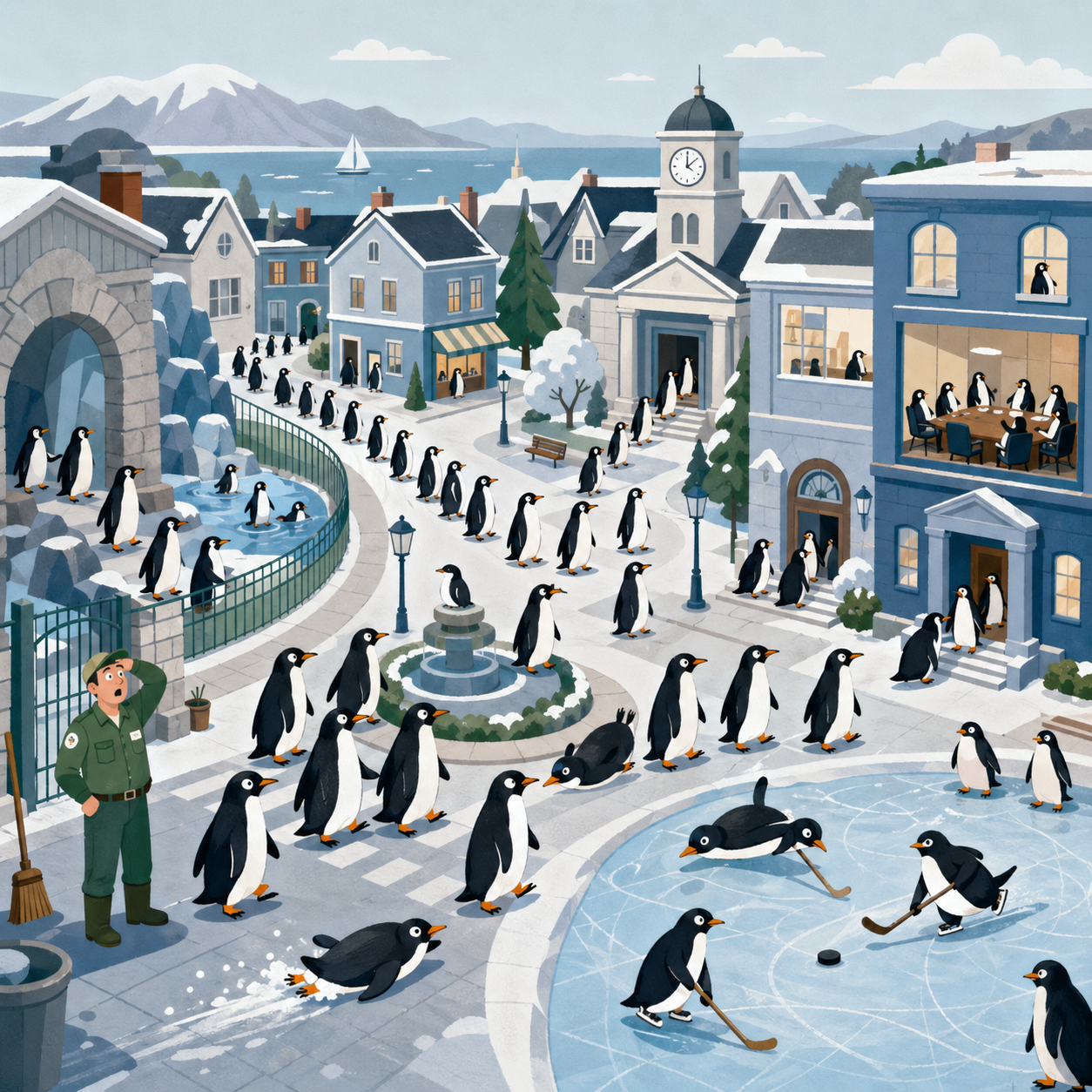
When Martin Plover, head zookeeper of the modest Bellweather Town Zoo, placed the order for ten penguins, he was wearing his reading glasses on top of his head and peering through his spare pair, which had a crack across the left lens. That was the first problem.
The second problem was that the zoo’s new ordering system had recently been upgraded, which meant that every animal request now went through a polished online form with drop-down menus, confirmation boxes, and a cheerful spinning penguin icon whenever the page was loading. Martin hated the system. He preferred the old way, which involved a telephone, a clipboard, and a supplier named Lars who called everyone “chief” and always knew what Martin meant.
But Lars had retired to grow cucumbers in a greenhouse, and the Bellweather Town Zoo had to move with the times.
So Martin sat in his office late on a Tuesday afternoon, rain tapping at the window, and filled out the form as carefully as he could.
Species: Little blue penguin.
Quantity: 10.
Delivery date: Friday.
Special handling instructions: Please ensure birds are comfortable, cool, and calm.
He clicked submit. The screen froze. The cheerful spinning penguin spun. Martin sighed, took off one pair of glasses, put on the other, and leaned forward. The page returned with a little warning box that said: Order could not be processed. Please confirm quantity.
Martin, already thinking about the leaky roof over the meerkat house and the mayor’s visit next week, squinted at the box. In the quantity field, something strange had happened. The cursor blinked after the number 10. Perhaps, he thought, the system wanted him to type the number again. He clicked. His hand brushed the zero key. Then, because the keyboard at the zoo office stuck unless pressed firmly, he hit it twice more.
Quantity: 1000.
He did not notice. He clicked confirm.
The spinning penguin spun merrily once again.
Order confirmed.
Martin smiled, shut down the computer, and went home feeling that, despite modern technology, he had triumphed.
On Friday morning, Bellweather woke beneath a sky as pale as a fish belly. The town was not large, but it was proud of its tidiness. It had a central square with a clock tower, three bakeries that argued about who had invented the cinnamon walnut bun, a library shaped like an old train station, and a town hall with brass doors polished every Monday by the same man who complained that no one appreciated brass anymore. It also had the zoo, which sat at the edge of town near the pine woods and the little river.
At six-thirty, Martin arrived carrying a thermos of coffee and a folder labeled PENGUIN ARRIVAL. He had arranged everything perfectly. The small penguin habitat had been scrubbed clean. The pool had been cooled. Ten name tags had been printed in case donors wanted to sponsor the birds. A local school class was scheduled to visit at eleven. The mayor was due at noon for a photograph. The gift shop had ordered sixty penguin pencils and a box of plush toys.
Martin unlocked the main gate, humming.
At seven, he heard the first truck.
By seven-ten, he heard the second.
By seven-twenty, there were twelve refrigerated trucks lined up outside the zoo, their engines rumbling like a thunderstorm. Each one had a picture of a penguin on the side and the words POLAR & MARINE LIVE TRANSPORT in blue letters.
Martin stood at the gate with his coffee halfway to his mouth.
The first driver climbed down, carrying a clipboard.
“Morning,” she said. “Delivery for Bellweather Town Zoo.”
“Yes,” said Martin slowly. “Ten penguins.”
The driver checked the clipboard. “One thousand penguins.”
Martin laughed, because sometimes the only reasonable thing to do in the face of disaster is make the sound that belongs to a joke.
The driver did not laugh.
Martin lowered his coffee. “I’m sorry?”
“One thousand penguins,” she repeated. “Little blues. Healthy, inspected, temperature controlled. Took three teams to load them. Where do you want them?”
Martin’s mouth opened. No words came out.
A penguin chirped from inside the truck.
Then another.
Then, from the combined refrigerated depths of twelve vehicles, came a chorus of squeaks, trills, squawks, and impatient flipper-slaps that sounded as though an orchestra of rubber ducks was tuning up.
Martin looked at the clipboard. He looked at the trucks. He looked back at the clipboard. He found his signature on the order form, clean and official.
“Oh,” he said.
The driver waited.
Martin put one hand on the gate to steady himself. “Could you hold on for just a moment?”
He walked into the zoo office, shut the door, and screamed silently into the folder labeled PENGUIN ARRIVAL.
Within half an hour, the zoo staff had gathered in a panic around the staff room table. There was Martin, pale and trembling. There was Priya, the veterinarian, who had already begun making lists. There was Glen, keeper of large mammals, who kept whispering, “A thousand?” as if the number might shrink if he repeated it softly enough. There was Nora from education, who had arrived wearing penguin earrings in honor of the expected ten and was now staring at them in betrayal. There was Hugh from maintenance, who said nothing but began sharpening a pencil with grim purpose.
“We cannot keep a thousand penguins,” Martin said.
“No,” said Priya. “Not in the penguin habitat.”
“Not in the zoo,” said Glen.
“Not in Bellweather,” said Nora.
From outside came a rising cry as the drivers began unloading the first crates into the service yard. The sound was cheerful, eager, and multiplying.
Martin rubbed his face. “We need emergency space. Shade. Cooling. Water. Barriers. Food.”
“How much food?” asked Hugh.
Priya looked at her list. “A little blue penguin eats about its share of fish daily. Times one thousand. We need a fish supply immediately.”
“Call Harrow’s Seafood,” said Martin.
“Harrow’s Seafood is one shop,” said Glen. “They panic when four people order cod.”
“Call every seafood shop within fifty miles.”
“I’ll call the aquarium in Port Brindle,” said Priya. “Maybe they can take some.”
“And I’ll call the mayor,” said Martin, which was perhaps the bravest thing anyone said that morning.
Mayor Agnes Thistle was in the middle of judging the annual Bellweather Window Box Competition when Martin reached her. She was standing outside Mrs. Hemley’s house, deciding whether geraniums arranged in the shape of a smile counted as civic excellence or emotional manipulation.
“One thousand?” the mayor said into her phone.
Mrs. Hemley leaned closer.
“Yes,” said Martin. “There has been a clerical error.”
“A clerical error is when someone misspells ‘Wednesday’ on the town newsletter.”
“This is a larger clerical error.”
Behind Martin, a penguin waddled past the office door.
The mayor closed her eyes. She had been mayor for fourteen years. She had handled floods, budget disputes, a mysterious plague of garden gnomes, and the year the marching band learned only one song. She had never handled a thousand penguins.
“Are they dangerous?” she asked.
“No.”
“Are they ill?”
“No, perfectly healthy.”
“Are they loud?”
A penguin knocked over a bucket outside. Several others applauded with their flippers.
“Somewhat,” Martin said.
Mayor Thistle opened her eyes. “I’m coming.”
By noon, the zoo had become the center of a crisis unlike anything Bellweather had ever seen. Penguins filled the service yard, the staff parking lot, the picnic lawn, and the shaded walkway near the reptile house. The flamingos, scandalized by the sudden appearance of so many formally dressed strangers, retreated to the far side of their pond and refused to look at anyone. The goats in the petting area treated the penguins with cautious respect until one brave goat sniffed a penguin and was pecked sharply on the nose. After that, the goats surrendered the lower hay trough.
The school group arrived at eleven as planned. Nora met them at the gate, breathless.
“Children,” she said, “today’s lesson has changed.”
The children looked past her and saw what appeared to be a living black-and-white river moving through the zoo.
One boy raised his hand. “Is this more penguins than usual?”
“Yes,” said Nora.
“Can we name them?”
“No,” said Nora, then saw thirty disappointed faces. “You may name eleven of them.”
By early afternoon, the local news van had arrived. The headline on the Bellweather Bulletin website changed from MAYOR PRAISES SPRING FLOWERS to ZOO RECEIVES 1,000 PENGUINS BY MISTAKE. By three o’clock, people were gathering along the zoo fence to watch. By four, the first penguin escaped.
Its name, according to a child who had been allowed to name one of the eleven, was Pickle.
Pickle discovered that the temporary barrier behind the gift shop had a gap just wide enough for a determined penguin with nothing else scheduled. He squeezed through, crossed the delivery lane, and emerged onto Maple Street, where he encountered Mrs. Alvarez walking home with groceries.
Mrs. Alvarez was eighty-two, feared by door-to-door salesmen, and known for making soup strong enough to cure sadness. She looked down at Pickle. Pickle looked up at her.
“Well,” she said. “You’re not a pigeon.”
Pickle chirped.
Mrs. Alvarez opened her shopping bag, removed a small tin of sardines, and said, “Don’t tell anyone I spoil visitors.”
That was how the first penguin entered Bellweather proper.
By sunset, there were twenty-seven penguins in town.
No one knew how they were getting out. Hugh inspected the barriers twice and found no gaps. Then he discovered that the penguins were not escaping through one large opening but through many tiny opportunities: under a loose flap of canvas, behind a stacked crate, between two bins, through a drainage channel, and once, astonishingly, by forming a small pushing crowd until a gate latch popped open. They were not malicious. They simply possessed the collective curiosity of toddlers and the persistence of dripping water.
At seven that evening, Mayor Thistle called an emergency meeting at town hall.
The meeting lasted six minutes before the penguins arrived.
At first there were only three, waddling in through the open brass doors just as the mayor was saying, “We must remain calm.” They crossed the polished floor, slipped slightly, regained their balance, and proceeded toward the council table with solemn purpose. One climbed onto Councilman Bixby’s briefcase. Another inspected the microphone. The third found a wastebasket and announced its approval by sitting in it.
Then came more.
Penguins flowed through the doorway in a steady, bobbing line. They moved between chairs, under tables, around ankles. A few slid on their bellies across the polished floor and seemed delighted by the speed. Soon the emergency meeting had become less a meeting than a negotiation with a crowd of birds who had discovered municipal architecture.
Councilwoman Darnell tried to continue. “The first issue is containment—”
A penguin leapt onto the table and slid into the stack of printed agendas, scattering them like leaves.
“The first issue,” said the mayor, removing a penguin from her lap with practiced dignity, “is that town hall now requires mats.”
Everyone agreed.
That night, Bellweather changed.
The ice rink, which usually closed in spring and became a storage hall for folding chairs, was reopened. The town’s old refrigerated flower warehouse was cleared. The fish market placed emergency orders. The bakery donated unsold bread until Priya firmly explained that penguins should not be fed cinnamon walnut buns no matter how politely they stared. Volunteers brought kiddie pools, tarps, fans, bags of ice, and folding fences. The high school’s science department lent temperature sensors. The butcher offered freezer space, then withdrew the offer after realizing he did not want a thousand penguins associated with his sausages.
By midnight, three hundred penguins had been moved to the ice rink. Two hundred were in the zoo’s shaded back lots. One hundred and fifty were in the flower warehouse. The rest were, in theory, somewhere within a controlled perimeter.
In reality, Bellweather slept poorly to the sound of tiny feet.
The next morning, penguins were everywhere.
There were penguins outside the bank, arranged in a line so neat that customers simply joined behind them. There were penguins in the library, where they gathered in the travel section and stared at books about Antarctica. There were penguins in the post office, tapping their beaks against parcels. One penguin rode the slow elevator in the medical building for forty minutes because nobody had the heart to remove it. Another stood outside the dentist’s office and frightened patients who thought it was judging their flossing habits.
At Bellweather Primary School, Principal Kline arrived to find forty penguins in the playground.
Children pressed their faces to classroom windows.
“We are not going outside,” said Ms. Farrow, the third-grade teacher.
“Why not?” asked a girl named Tessa.
“Because the playground is full of penguins.”
Tessa considered this. “That sounds like the best reason to go outside.”
By nine, the school day had been rewritten. Math involved counting penguins in groups of ten. Science involved discussing habitats, food chains, and why classroom radiators were now turned off. Art involved drawing penguins, which had already been the plan for several children and was now compulsory by enthusiasm. Reading time was interrupted when a penguin waddled into Class 2B and settled beneath the bookshelf labeled Friendship Stories.
The children named it Professor Wobble.
Professor Wobble became the school’s unofficial mascot by lunch.
At Bellweather Financial Services, a quarterly board meeting began at ten sharp and derailed at ten-oh-three when two penguins entered the conference room through an automatic door that had opened for an intern carrying coffee. They crossed the carpet, hopped onto the low credenza, and observed the presentation on regional investment strategies.
The managing director, Mr. Talbot, attempted to ignore them.
“As you can see from the projections,” he said, pointing to a graph, “our second-quarter outlook depends heavily on maintaining customer confidence.”
One penguin slid down the polished conference table, bumped gently into a bowl of mints, and stopped in front of the chief accountant.
The accountant looked at the penguin. The penguin looked at the accountant.
“Customer confidence appears high,” the accountant said.
Someone laughed. Then everyone laughed, except Mr. Talbot, who tried very hard not to and failed.
By noon, photographs of penguins in board meetings, classrooms, shops, and public benches had spread far beyond Bellweather. Reporters began arriving from nearby cities. A travel blogger posted a video titled I FOUND THE TOWN WHERE PENGUINS GO TO WORK, and it received more views in two hours than the Bellweather tourism board had achieved in its entire history.
Mayor Thistle saw both opportunity and disaster standing in the same pair of webbed feet.
“We must be organized,” she declared at the second emergency meeting, which was held outdoors because town hall still smelled faintly of fish. “Bellweather cannot become a free-for-all penguin carnival.”
A penguin standing near the mayor sneezed.
“However,” she continued, “we also cannot pretend this is not happening.”
The town formed committees. Bellweather loved committees. There was a Penguin Safety Committee, a Penguin Feeding Committee, a Penguin Traffic Committee, a Penguin Education Committee, and, after pressure from local businesses, a Penguin Tourism Opportunities Working Group. Hugh was appointed Director of Temporary Penguin Infrastructure, a title he accepted on the condition that no one put it on a mug. Priya became the unquestioned authority on penguin health, which meant she spent most of her time telling people not to feed them things. Nora organized school visits to the ice rink. Martin apologized to everyone so often that the mayor finally told him to save his strength.
The first real adaptation came at crosswalks.
Penguins, it turned out, respected lines but not schedules. If one penguin began crossing a road, others often followed, and then more followed them, and soon traffic stopped while eighty penguins waddled across with the seriousness of a royal procession. At first drivers honked. Then they learned that honking did nothing except make the penguins pause and look offended.
So the town painted temporary penguin crossings in blue and white stripes. Volunteers in reflective vests guided flocks across busy streets. Children made signs that read SLOW: FORMAL BIRDS CROSSING and GIVE WADDLE ROOM.
The second adaptation came at shops.
Every business placed a shallow tray of clean water outside, partly for the penguins and partly to discourage them from entering. This worked for the hardware store, the pharmacy, and the shoe shop. It did not work for the fish market, which had to install a second door, a third door, and finally a polite but firm system involving two volunteers, a rope barrier, and a sign reading CUSTOMERS ONLY, NO EXCEPTIONS, YES THAT MEANS PENGUINS.
The third adaptation came at homes.
Residents learned to check under porches, inside garden sheds, behind bins, and once, in the case of Mr. and Mrs. Bellamy, inside a laundry basket full of towels. Penguins liked towels. They liked anything soft, shady, and inconvenient. They particularly liked basements, especially if the basements were cool and belonged to people who had recently purchased fish.
By the end of the first week, no one in Bellweather could walk anywhere without encountering at least one penguin.
At first, people complained.
“My tulips have been trampled,” said Mrs. Hemley.
“My cat refuses to come downstairs,” said the librarian.
“One of them stole my sandwich,” said Councilman Bixby.
“It did not steal your sandwich,” Priya said. “It investigated your sandwich.”
“It investigated it into its mouth.”
But the complaints began to change. Mrs. Hemley discovered that tourists were taking photographs of penguins among her geraniums and leaving coins in her charity jar. The librarian discovered that children who had never cared for nonfiction were suddenly borrowing books about marine birds. Councilman Bixby discovered that the penguin who had investigated his sandwich was now following him to work each morning, and after three days he began bringing an extra tin of approved fish pieces under Priya’s supervision.
The penguin was named Briefcase.
Briefcase became very popular in town hall.
The zoo, meanwhile, worked frantically to find long-term homes for the birds. Aquariums, coastal sanctuaries, wildlife parks, and rehabilitation centers were contacted. Some could take twenty. Some could take fifty. One facility could take a hundred but not for six weeks. Transport permits had to be arranged. Health checks had to be performed. Funds had to be found.
“Until then,” Mayor Thistle said at a press conference, “Bellweather will provide safe temporary care.”
A reporter asked, “Is it true the penguins are attending school?”
The mayor paused. “They are present at school.”
“Is it true one joined a board meeting?”
“It observed a board meeting.”
“Is it true the town is forming an ice-hockey league for them?”
The mayor blinked. “A what?”
That was how she learned about Toby Marsh.
Toby was seventeen, captain of the Bellweather High hockey team, and the sort of person who could look at chaos and see a tournament bracket. The ice rink, now home to hundreds of penguins, still had a smooth central sheet of ice that the birds loved. They slid across it constantly, chasing one another, chasing shadows, chasing nothing at all. The hockey team had volunteered to help clean and distribute fish, but during breaks they began skating slowly while penguins zipped around them like living pucks.
One afternoon, Toby dropped a rubber practice puck onto the ice.
A penguin nudged it.
Another penguin chased it.
A third penguin slid into it, sending it skittering toward the goal.
The goalie, who had been leaning on his stick, watched the puck slide between his skates.
Toby stared.
“Did we just get scored on by a penguin?” asked his teammate Lila.
“Yes,” said Toby. “And with better teamwork than our last game.”
By the next day, the team had created Penguin Hockey, though Priya insisted on changes before anyone was allowed to call it that. The puck had to be soft. No sticks near penguins. No chasing them. No forcing them to participate. If a penguin happened to slide with the puck, that was enrichment. If it chose to leave, that was its right as a penguin and a temporary guest of the town.
The rules evolved quickly. Human players wore skates and could only guide the soft puck with wide foam paddles. Penguins could touch the puck however they liked. Goals counted only if the puck crossed the line without being carried by a human. Each team had three humans and however many penguins decided to join. Matches lasted ten minutes, unless the penguins lost interest, in which case the match ended immediately and everyone applauded.
The first official game drew half the town.
Someone named the teams the Bellweather Blizzards and the Waddling Wonders. The penguins ignored both names. The crowd did not.
Mayor Thistle dropped the ceremonial puck. A penguin immediately sat on it.
The crowd cheered.
A second puck was introduced. Two penguins chased it, slid past it, collided gently with Toby, and spun in slow circles. Lila guided the puck toward the goal. Briefcase, who had somehow left town hall and arrived at the rink, nudged it sideways with his chest. Another penguin shot forward on its belly and knocked it cleanly into the net.
The crowd erupted.
The goalie raised both arms. “I was screened by six penguins!”
By the end of the match, no one knew the score, but everyone agreed the penguins had won.
Penguin Hockey became the pride of Bellweather in exactly three days.
The tourism board printed flyers. The high school band played chilly versions of fight songs. The bakeries, seeing opportunity, entered into a temporary truce and jointly produced penguin-shaped biscuits approved for human consumption only. The ice rink sold out every exhibition match, with proceeds going to penguin care and eventual relocation. A local radio announcer began calling games with unnecessary seriousness.
“And here comes Pickle on the left flank, excellent slide speed, strong belly form, he approaches the puck, ignores the puck, continues past the puck, and yes, he has chosen to inspect the blue line. A bold strategic decision.”
Children collected trading cards featuring penguins who had distinguished themselves by personality rather than athletic skill. Professor Wobble’s card listed “Reading Level: Advanced.” Briefcase’s listed “Occupation: Civic Advisor.” Pickle’s listed “Known For: Escape Artistry.” A penguin named Duchess earned fame by refusing to move unless the crowd chanted her name.
Not everyone was delighted. Mr. Talbot from Bellweather Financial Services worried that the town was losing focus.
“We cannot base civic identity on accidental penguins,” he told the mayor.
Mayor Thistle looked out her office window at three tourists photographing a penguin beside the statue of the town founder. The penguin had somehow acquired a tiny knitted scarf.
“I agree,” she said. “We should base civic identity on resilience, hospitality, and excellent temporary management of accidental penguins.”
Mr. Talbot frowned. “That sounds like the same thing.”
“It sounds better in grant applications.”
And indeed, money began to arrive. Donations came from amused strangers, bird lovers, hockey fans, and former Bellweather residents who had not thought about the town in years. A refrigeration company donated portable cooling units. A fish distributor offered reduced prices in exchange for being named Official Fish Partner of the Great Penguin Parade, a phrase that had begun as a joke and then appeared on banners across town.
The parade itself was Nora’s idea.
It happened because the penguins at the ice rink needed to be moved in rotating groups to the zoo and warehouse for health checks and habitat cleaning. At first the transfers were chaotic, requiring crates and vans and much flipper-based disagreement. Then Hugh noticed that, if guided gently with barriers and patient volunteers, the penguins would waddle together along a cleared route.
“They like moving as a group,” he said.
“Can we make it safe?” asked Priya.
“Yes, if we close the streets and keep people back.”
“Can we make it calm?”
“Yes.”
“Can we make sure no one tries to touch them?”
Hugh looked toward the town. “We can threaten them with you.”
Priya nodded. “Good.”
The first organized transfer took place early on a Sunday morning. The route ran from the ice rink down Alder Street, across the square, and toward the zoo. Volunteers lined the path. Police redirected traffic. Residents came out with coffee, cameras, and children wrapped in blankets. The penguins emerged from the rink in a dense, murmuring crowd, their little bodies bobbing, their feet pattering softly on the damp pavement.
For once, Bellweather fell quiet.
There was something funny about the sight, yes. A thousand penguins made it impossible not to smile. But there was also something strangely grand about them: the steady movement, the collective purpose, the shine of their backs in the morning light. They passed the bakery, the library, the brass doors of town hall, the statue of the founder, and Mrs. Hemley’s geraniums. They waddled past people who, one week earlier, had thought a delayed bus was a major disruption. Now those same people stood with gloved hands and soft voices, protecting a river of birds that had arrived by mistake and somehow become their responsibility.
A little boy whispered, “It’s like a parade.”
His mother said, “It is a parade.”
The name stuck.
The Great Penguin Parade became a daily event, though not always at the same time and never purely for show. Its purpose remained practical: moving penguins safely. But people gathered anyway. Shops adjusted opening hours. The school brought classes to watch from behind barriers. Office workers scheduled meetings around it. Mr. Talbot, despite his objections, moved one board meeting fifteen minutes later because “avian traffic is expected in the square.”
The penguins continued to reshape Bellweather.
The library started Penguin Story Hour, which involved children reading aloud while a few calm penguins stood nearby wondering why humans made so many noises at paper. The hospital added a penguin viewing window for patients who could not go outside. The senior center adopted a daily “waddle watch,” during which residents rated the dignity of passing penguins on a scale from one to ten. No penguin ever scored below seven.
At the school, Professor Wobble’s visits improved attendance so dramatically that Principal Kline wrote a formal letter to the mayor requesting “continued educational penguin engagement where appropriate.” Priya wrote back with a list of seventeen conditions. The principal accepted all of them.
At Bellweather Financial Services, the penguins’ accidental boardroom appearance inspired a marketing campaign about “adapting to unexpected conditions.” Briefcase appeared in the advertisement, standing beside Councilman Bixby’s shoe. The campaign was successful enough that Mr. Talbot sent a donation to the zoo and pretended it had been his idea.
At home, Martin Plover struggled.
Everyone knew the mistake had been his. No one said it cruelly, but Bellweather was a town where news traveled faster than weather. At first Martin could not walk through the square without hearing whispers. There goes the penguin man. A thousand instead of ten. Imagine.
He tried to laugh with them. He made jokes. He gave interviews in which he accepted full responsibility. But each night he returned to his small house near the river exhausted, smelling of fish, and wondering if he had ruined the zoo, the town, and his own career with one careless click.
On the tenth night, he found a penguin in his kitchen.
It was Pickle, of course.
Pickle stood beside the refrigerator as if waiting for service.
Martin stared at him. “How did you get in?”
Pickle chirped.
“The back door was locked.”
Pickle looked toward the cat flap.
“I don’t have a cat.”
Pickle looked back at Martin.
Martin sank into a chair and laughed until his eyes watered. Pickle waddled closer and pecked gently at his shoelace.
“You know,” Martin said, “this is all your fault in a way.”
Pickle tilted his head.
“No, you’re right. It is mostly mine.”
He sat with the penguin in the quiet kitchen, the refrigerator humming, the town beyond his window altered in ways he could never have predicted. He expected to feel only shame. Instead, for the first time since the trucks arrived, he felt something like wonder.
The next morning, Martin stood before the town council and proposed a full plan.
Not a frantic plan. Not a temporary panic list. A real plan.
Over the next three months, penguins would be transferred in carefully managed groups to approved facilities. Until then, Bellweather would operate three temporary habitat zones: the zoo, the ice rink, and the flower warehouse. The Great Penguin Parade would continue as a controlled movement route. Schools and businesses could participate through supervised programs. Tourism revenue would go into a transparent Penguin Care Fund. A long-term educational exhibit would remain at the zoo for the original ten penguins Martin had meant to order, assuming, he added carefully, that ten could be identified from the thousand.
The council listened.
Mayor Thistle asked, “Can we afford it?”
Martin handed out the budget.
Councilman Bixby adjusted his glasses. Briefcase, standing beside his chair, also appeared to examine the papers.
“With donations and ticket revenue,” Martin said, “yes. Barely. If we are careful.”
Priya stood. “The health protocols are sound.”
Hugh stood. “The infrastructure is ugly but functional.”
Nora stood. “The educational value is enormous.”
Mr. Talbot stood, surprising everyone. “The economic benefit is measurable.”
Mrs. Hemley stood from the public benches. “My geranium charity jar has raised four hundred pounds.”
There was a pause.
Mayor Thistle smiled. “All in favor?”
Every hand went up.
Councilman Bixby raised Briefcase’s flipper, too.
The plan worked because Bellweather made it work.
There were mishaps, of course. A penguin interrupted a wedding by waddling down the aisle ahead of the bride, which the bride later admitted improved the ceremony. Six penguins invaded a yoga class and were better at stillness than most of the participants. One got into the radio station and became briefly famous for squawking during the weather report. A group of penguins discovered the automatic doors at the supermarket and caused a twenty-minute delay in the frozen foods aisle, where they stood in apparent approval.
There were hard days, too. Keeping so many birds healthy was exhausting. Volunteers burned out. Fish deliveries were late. Cooling units failed. Once, during an unexpected warm spell, the town worked through the night moving penguins into refrigerated spaces, carrying ice, setting up fans, and misting shaded areas. People who had argued about parking spaces stood shoulder to shoulder passing crates of fish. Teenagers hauled hoses. Retirees folded towels. The mayor directed traffic in a raincoat over her pajamas. Martin, Priya, Hugh, and Nora did not sleep for thirty hours.
When the heat broke and every penguin was accounted for, the town square filled with people too tired to cheer. They simply sat on benches, curbs, and steps while penguins murmured around them.
Mrs. Alvarez passed out soup from a huge pot.
Martin accepted a cup with shaking hands.
“You look terrible,” she said.
“Thank you.”
“I mean it kindly.”
“I know.”
She watched a penguin slide under a bench. “You made a mistake.”
“Yes.”
“A spectacular one.”
“Yes.”
“But you stayed.”
Martin looked at her.
Mrs. Alvarez shrugged. “People make mistakes and run from them all the time. You made one and ordered fish.”
Martin laughed softly.
After that, he began sleeping better.
As weeks passed, the first groups of penguins left Bellweather for permanent homes. The departures were bittersweet in a way nobody had expected. On the morning the first fifty were loaded into transport crates, children arrived with drawings. The hockey team stood in a line. Mayor Thistle gave a speech that was only three minutes long because Priya said speeches stressed the birds and because everyone knew the mayor would cry if she continued.
Pickle was not in the first group. Nobody was able to catch him that morning.
“Are we certain Pickle exists in only one body?” Hugh asked after the third failed attempt.
“No,” said Martin. “But science suggests yes.”
Each departure made the town a little quieter. The flower warehouse emptied first. The ice rink population shrank from hundreds to dozens. Penguin Hockey changed from chaotic spectacle to something almost organized. The Waddling Wonders won the final charity match when Duchess, after nine minutes of refusing to move, suddenly slid the puck into the goal and then left the ice to thunderous applause.
By then, Bellweather had changed in lasting ways. The school kept its habitat curriculum. The library’s nonfiction loans remained high. The town installed permanent animal-safe crossing signs near the zoo. Businesses that had once competed for customers now shared festival planning meetings. The three rival bakeries continued their truce long enough to create the official Bellweather Waddle Bun, which was just a cinnamon walnut bun with two chocolate eyes, but everyone agreed diplomacy had its limits.
Tourists kept coming even after most of the penguins left, drawn by the story of the town that had accidentally become a penguin capital. The zoo’s visitor numbers tripled. The town hall brass doors bore tiny scratch marks near the bottom from the first chaotic meeting, and Mayor Thistle refused to have them polished out.
“Historical record,” she said.
Three months after the trucks arrived, only ten penguins remained.
Not just any ten. After much debate, careful health evaluation, and public consultation that became more emotional than anyone anticipated, the zoo kept Pickle, Professor Wobble, Briefcase, Duchess, and six others chosen for compatibility, health, and the fact that they had not shown strong preferences for escaping into private kitchens.
The new penguin habitat opened in early summer. It was far larger than Martin’s original plan, with a cooled indoor area, a shaded outdoor pool, educational signs, underwater viewing glass, and a small ice slope that children immediately declared the best thing in the zoo. Above the entrance hung a sign: THE GREAT PENGUIN PARADE EXHIBIT.
On opening day, the whole town came.
Martin stood at the gate in a clean uniform. He had prepared remarks on conservation, animal care, community cooperation, and the importance of checking digital forms before clicking confirm. He carried the speech folded in his pocket.
Mayor Thistle introduced him.
Martin stepped forward and looked at the crowd: children holding plush penguins, business owners wearing penguin pins, volunteers who had spent months carrying fish and ice, hockey players, teachers, reporters, Mrs. Alvarez, Mrs. Hemley, Mr. Talbot, Councilman Bixby, and hundreds of people who had learned, together, how to make room for the unexpected.
Behind him, Pickle stood on the ice slope, watching.
Martin took out his speech. Then he folded it again.
“Three months ago,” he said, “I ordered ten penguins.”
The crowd laughed.
“I received one thousand.”
The crowd laughed louder.
“I thought it was the worst mistake of my life. There were several hours when I thought it might be the last mistake of my professional life. I still recommend very strongly that no one repeat it.”
More laughter.
“But because of that mistake, I saw this town do something extraordinary. You changed your roads. You changed your classrooms. You changed your businesses, your schedules, your meetings, and in some cases your basements. You helped care for animals that were never supposed to be yours. You protected them, fed them, learned from them, and occasionally lost boardroom authority to them.”
Mr. Talbot nodded solemnly.
Martin’s voice softened. “Most of the penguins have gone on to good homes. These ten will stay with us, not as a reminder of error, though they are certainly that, but as a reminder of what can happen when people respond to a mistake with patience, humor, and a truly unreasonable amount of fish.”
The crowd applauded.
Mayor Thistle cut the ribbon. The penguin habitat opened. Children rushed to the glass. Cameras flashed. Professor Wobble inspected a painted sign. Duchess accepted admiration from a rock. Briefcase stood beside Councilman Bixby for a photograph. Pickle waited until everyone was distracted, then slid down the ice slope, shot across the smooth floor, and landed gently against Martin’s boot.
Martin looked down.
“Hello, Pickle.”
Pickle chirped.
“No,” Martin said. “You may not come home with me again.”
Pickle pecked his shoelace.
The first official Great Penguin Parade Festival was held the following winter, on the anniversary of the mistaken delivery. By then the story had settled into town legend, which meant it was already being exaggerated. Some claimed there had been two thousand penguins. Some insisted a penguin had been elected deputy mayor. One child told visitors that the hockey team had lost to penguins by ninety goals, which Toby Marsh did not deny because it sold more festival programs.
The festival began at dawn with a ceremonial waddle from the zoo to the square—not with a thousand penguins, but with the ten permanent residents moving safely in a short supervised route while the town watched from behind barriers. The parade was slower now, smaller, and much easier to manage. Yet when the penguins passed the bakery, the library, town hall, and Mrs. Hemley’s winter planters, the same hush returned.
Bellweather remembered.
After the parade came the hockey match. Humans played badly on purpose, though not much worse than usual. Penguins participated when interested. Duchess scored once, possibly by accident, and the crowd behaved as if she had won a championship. The school choir sang a song called “Waddle Home,” written by Ms. Farrow’s class, with lyrics that did not quite rhyme but made Priya cry anyway.
That evening, snow began to fall. It was rare for Bellweather to get proper snow, the kind that softened rooftops and turned streetlamps golden. People lingered in the square under strings of lights. The statue of the founder wore a penguin scarf. The brass doors of town hall glowed warmly. Vendors sold soup, cocoa, and Waddle Buns. Children slid on patches of ice while parents pretended not to encourage them.
Martin stood near the fountain, watching the town.
Mayor Thistle joined him, holding two cups of cocoa. She handed him one.
“Do you ever miss the quiet?” she asked.
“The zoo was never quiet.”
“You know what I mean.”
Martin watched Pickle, safely behind a low barrier with Priya nearby, stare at a snowflake as if it had insulted him.
“Sometimes,” he said. “But not as much as I thought I would.”
The mayor sipped her cocoa. “I received a proposal today.”
“That sounds dangerous.”
“For a permanent winter festival. Penguin education, conservation fundraising, hockey, parade, local businesses. Sensible scale.”
“Sensible scale,” Martin repeated. “My new favorite phrase.”
“I thought you’d like it.”
Across the square, Mr. Talbot was explaining investment risk to Briefcase. Mrs. Alvarez was feeding soup to volunteers. Hugh was adjusting a barrier that did not need adjusting. Nora was surrounded by children asking whether penguins dreamed. Priya was telling someone, firmly, that cocoa was not for birds. The town moved around the penguins now with practiced ease, not as if they were a disruption, but as if they were part of the pattern Bellweather had discovered in itself.
A little girl near the barrier waved at Pickle.
Pickle turned, took three dignified steps, slipped on a dusting of snow, landed on his belly, and slid forward.
The girl squealed with delight.
Soon other children were laughing. Adults joined in. The sound rose into the cold evening, bright and unplanned. Pickle stood, shook himself, and looked deeply satisfied, as though all applause was both expected and deserved.
Martin smiled.
He had once believed a zoo was a place where people kept animals safely apart from ordinary life, contained behind fences, explained on signs, visited on weekends. He still believed in safety, and fences, and signs with accurate information. More than ever, he believed in careful planning. But he had learned that animals, even temporary ones, had a way of revealing a town to itself. A thousand penguins had shown Bellweather its impatience, its generosity, its silliness, its discipline, its ability to become better organized only after becoming completely overwhelmed.
And they had shown Martin something too.
He would always be the man who ordered one thousand penguins by mistake. There was no escaping that. His grandchildren, if he ever had any, would probably hear about it in school. His retirement party would certainly involve a cake shaped like a penguin and far too many jokes about zeros. But he no longer heard the title as an accusation. Sometimes a mistake was a crack in the wall through which something absurd and wonderful came marching.
The snow thickened. The crowd began moving toward the rink for the final hockey exhibition of the evening. Volunteers guided the ten penguins into their cooled transport cart, where they settled together in a soft chorus of chirps and shuffles.
Pickle was the last to enter.
He paused at the ramp and looked back at Martin.
“Go on,” Martin said.
Pickle chirped once, then waddled inside.
The cart rolled slowly through the square, escorted by keepers and watched by townspeople. Children waved. Shopkeepers stepped out of doorways. The mayor walked beside the route, smiling. For a moment, in the glow of winter lights, the little procession seemed to contain all the others that had come before it: the first chaotic flood through the zoo gates, the solemn crossings at dawn, the schoolyard visits, the boardroom invasions, the hockey slides, the great river of black and white that had taught Bellweather to stop traffic and make room.
Someone in the crowd began to clap in rhythm with the penguins’ steps.
Pat-pat. Clap-clap.
Pat-pat. Clap-clap.
Soon the whole square joined in, not loud enough to frighten the birds, just loud enough to become a heartbeat.
Martin walked with them, cocoa warming his hands, snow settling on his shoulders. He passed the town hall doors with their tiny scratches. He passed the bakery windows filled with penguin buns. He passed children who would grow up remembering the year their town became famous for doing the right thing after a ridiculous mistake.
At the corner, Mrs. Alvarez called out, “Martin!”
He turned.
She raised her cup. “Next time, order elephants.”
The crowd laughed.
Martin groaned, but he was laughing too.
“No,” he called back. “Next time, I’m ordering seeds.”
“Careful,” said Mayor Thistle beside him. “You’ll get a forest.”
Martin looked at the penguins, at the town, at the snow falling over everything like a blessing and a joke.
“Well,” he said, “at least we know how to adapt.”
The penguin cart continued toward the rink, the people followed, and Bellweather, which had once been a tidy little town where very little happened without a permit, stepped cheerfully into another cold, bright evening shaped forever by the great mistake that had waddled in and stayed.