Werewolf Weight Watchers
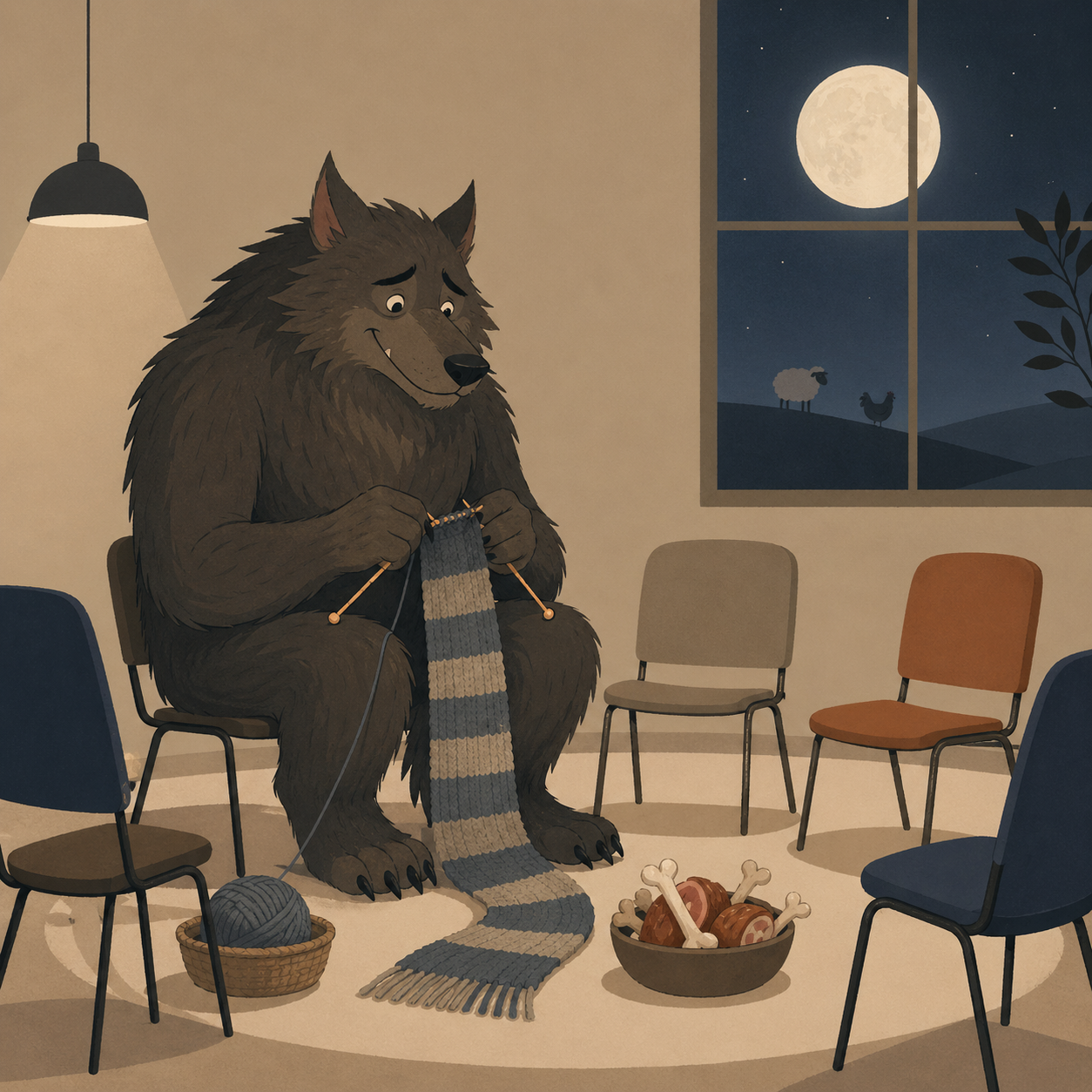
Every full moon, Harold Fenwick woke up somewhere regrettable.
Once it had been the village duck pond, naked except for a ring of pondweed around his neck and three furious ducks standing on his chest like magistrates. Another time he had come to himself on the roof of the butcher’s shop, hugging the chimney, with a string of sausages tied around his waist like a festive belt. He still did not know whether he had put them there, stolen them there, or been dressed in them by someone with a strong sense of irony.
But the morning that changed his life began in a field.
Harold woke with his face pressed into damp grass and his mouth tasting of wool.
For a few seconds he lay still, hoping the world would rearrange itself into something less incriminating. Birds sang. A cow lowed in the next pasture. Somewhere close by, a rooster attempted to crow and sounded as if it had seen things no rooster should ever see.
Harold opened one eye.
Sheep bones.
Chicken feathers.
More sheep bones.
A dented feed bucket.
One of his own shoes.
A small hand-painted sign that said: WELCOME TO HONEYSUCKLE FARM. PLEASE DO NOT CHASE THE LIVESTOCK.
Harold groaned.
He was a large man even when he was not a wolf, broad in the shoulders, soft around the middle, with a tidy brown mustache and the defeated expression of a schoolmaster who has just discovered glue in the piano. He worked as the village postmaster, which meant people saw him every day and liked him because he was polite, remembered birthdays, and never read postcards unless they were written in exceptionally large handwriting.
They did not know that once a month he turned into a seven-foot wolf with glowing amber eyes, claws like pruning shears, and the self-control of a toddler in a cake shop.
At least, Harold hoped they did not know.
He sat up and inspected the damage.
The field looked as though a pillow factory had exploded inside a mutton restaurant. Feathers clung to the hedgerow. Wool tufts drifted lazily in the breeze. There were hoofprints, pawprints, and one long skid mark where Harold, or rather Harold’s wolf, had apparently tried to change direction at high speed and lost the argument with gravity.
“No,” Harold whispered. “No, no, no.”
A lamb bleated from behind the stone wall.
Harold froze.
The lamb peered at him through a gap, unharmed but judgmental.
“Good morning,” Harold said weakly.
The lamb chewed.
Harold looked down at himself. He was, as usual after the full moon, very naked. A chicken feather was stuck to his belly. He plucked it off with dignity, or as much dignity as a naked man in a crime scene full of sheep remains could manage.
From the farmhouse came a shout.
“WHO’S OUT THERE?”
Harold scrambled to his feet. His joints protested. His stomach rumbled. His conscience screamed. He grabbed his shoe, the feed bucket, and the welcome sign by mistake, then bolted for the hedge.
“COME BACK HERE!”
Farmer Bilby, a red-faced man with the lungs of a brass band, appeared at the gate in his nightshirt holding a pitchfork. Harold threw himself through the hedge, collecting scratches on areas he preferred not to mention, and ran across the neighboring field with the feed bucket clanging against his knee.
By the time he reached the lane behind the church, he was gasping. He slipped into the old cemetery, retrieved the emergency clothes he kept hidden behind Reverend Bell’s tool shed, and dressed with trembling fingers. The shirt was too small, because it was from two moons ago, and the trousers had been chewed at the hem, presumably by himself.
Harold walked home before anyone else was awake, carrying the feed bucket under one arm like a businessman with a briefcase. He tried to look casual. Casual men, he knew, did not usually have chicken feathers in their hair or scratch marks on their buttocks, but he did his best.
At home, he stood before the bathroom mirror.
His hair stuck out in every direction. There was mud on his cheek. A bit of wool was caught in his mustache.
“You are thirty-eight years old,” he told his reflection. “You own a kettle. You pay taxes. You alphabetize parcels. This cannot continue.”
His reflection looked unconvinced.
Harold bathed, dressed properly, and ate breakfast. Then he ate a second breakfast, because the wolf always left him ravenous. Then he ate half a loaf of bread, two boiled eggs, three pickled onions, a jar of marmalade, and the corner of a tea towel before realizing what he was doing.
He spat out the tea towel.
“This,” he said, “is a problem.”
At nine o’clock, he opened the post office as usual. The bell over the door jingled. Mrs. Pottle came in to post a birthday card to her sister in Bath. She leaned over the counter and sniffed.
“Morning, Harold. You smell smoky.”
“Do I?”
“And a bit like a barn.”
“New soap,” said Harold.
“Hm. Rural Lavender?”
“Exactly.”
She narrowed her eyes. “Did you hear about Bilby’s farm?”
Harold’s hand tightened around the stamp pad. “No.”
“Terrible business. Lost six sheep and half his chickens. Says it was a beast.”
“A beast?”
“Huge thing, he says. Fur, teeth, yellow eyes. Could’ve been a wolf.”
“We don’t have wolves here,” Harold said too quickly.
“No,” said Mrs. Pottle. “That’s what makes it unusual.”
She bought three stamps and a packet of barley sweets, then left with another suspicious sniff.
All morning, Harold weighed parcels and swallowed guilt. At noon, Farmer Bilby stormed in with a sack over his shoulder and vengeance in his eyebrows.
“Morning, Harold.”
“Morning, Mr. Bilby.”
“Need to send these letters.”
“To whom?”
“The council, the constable, and the newspaper. I’m offering a reward for the beast.”
Harold’s mouth went dry. “Reward?”
“Five pounds.”
“That seems modest for a dangerous beast.”
“Fine. Seven pounds.”
Harold stamped the letters with the heavy certainty of a man sealing his own doom.
“And another thing,” Bilby said, lowering his voice. “I found something in the field.”
Harold stopped breathing.
Bilby reached into the sack.
Harold prepared himself to deny everything. Claw marks? Fur? His other shoe? A handwritten note saying: Dear Farmer Bilby, Sorry about the sheep, best wishes, Harold?
Bilby pulled out a splintered wooden sign.
“Beast tore down my welcome sign,” he said. “Can you believe that? No respect.”
Harold stared. “How awful.”
“World’s gone mad. Animals these days.”
“Yes,” said Harold. “Animals.”
By closing time, Harold had made a decision. He could not keep waking up in agricultural disasters. He could not keep eating livestock. He could not afford endless apology hampers delivered anonymously to farms after every full moon. Most of all, he could not keep pretending the problem was mysterious, unavoidable, or someone else’s fault.
He needed help.
That evening, as he walked home, he saw a poster pinned to the community hall noticeboard.
NEW YEAR, NEW YOU!
THURSDAY EVENINGS
WEIGHT WATCHERS & WELLNESS CIRCLE
Friendly support, practical advice, no judgment.
First meeting free.
Tea provided.
Harold stopped.
He stared at the words no judgment.
The poster showed a smiling woman holding a measuring tape. Behind her were drawings of carrots, apples, and a cheerful bowl of soup. None of the drawings had bones. None had feathers. None appeared to have been hunted under moonlight.
Harold glanced up and down the lane, then tore off the little paper tab at the bottom with the meeting time.
Thursday, 7 p.m.
It was Monday.
The next full moon was in four weeks.
He folded the tab and placed it in his wallet beside a picture of his late mother and an emergency note that said: IF FOUND NAKED, CLAIM SLEEPWALKING.
On Thursday evening, Harold stood outside the community hall wearing his best cardigan. He had combed his hair, trimmed his mustache, and eaten a sensible dinner of vegetable stew. He had also eaten four sausages afterward in a panic, but he was trying to focus on the stew.
Through the frosted windows came the murmur of voices and the clink of teacups. Harold almost turned back. What could he possibly say?
Hello, my name is Harold, and when the moon is round I eat anything with hooves.
No.
Hello, my name is Harold, and my relationship with protein is complicated.
Better, but not much.
He took a breath and went in.
The hall smelled of floor polish, weak tea, and hope. A circle of chairs had been arranged near the stage. On a table sat a kettle, mugs, a plate of oat biscuits, and a bowl of carrot sticks no one had touched.
There were eight people already seated.
Mrs. Pottle was there, which nearly made Harold flee. She looked him up and down.
“Harold! Didn’t expect to see you.”
“No,” he said. “Nor did I.”
A cheerful woman with silver hair and enormous earrings hurried over. “Welcome! I’m Marjorie Plum, group leader. You must be new.”
“Harold Fenwick.”
“Lovely. Take a name sticker.”
Harold wrote HAROLD in careful letters and stuck it to his cardigan.
“And what brings you here, Harold?” asked Marjorie.
He glanced at Mrs. Pottle.
“Cravings,” he said.
Marjorie beamed. “You’re among friends.”
He sat between a nervous young man named Colin, who worked at the bakery and had icing sugar on his cuffs, and a widow named Mrs. Hargreaves, who smelled faintly of peppermint and looked as if she could wrestle a cupboard.
The meeting began with everyone sharing their weekly victories.
Colin had walked past a tray of custard tarts without licking any of them. Everyone applauded.
Mrs. Hargreaves had replaced her evening biscuits with knitting. Everyone applauded.
Mr. Lunt, the retired undertaker, had lost two pounds by eating soup before meals. Everyone applauded, though Mr. Lunt looked disappointed that more weight had not left him out of professional respect.
Then Marjorie turned to Harold.
“And you, Harold? What would you like to achieve?”
Harold cleared his throat. “I’d like to stop waking up full of regret.”
The circle nodded sympathetically.
“I think many of us understand that,” Marjorie said.
“Sometimes,” Harold continued, gaining confidence, “I lose control. Mostly at night. I tell myself I’ll be sensible, but then something comes over me. I smell food, and before I know it, I’ve eaten far too much.”
“Sweet or savory?” asked Colin.
“Alive,” Harold said, then coughed. “I mean, savory.”
Marjorie tilted her head. “Do you notice any triggers?”
Harold stared at the floor. “The moon.”
There was a pause.
Mrs. Pottle clicked her tongue. “Evenings are worst for me too.”
“Yes,” Harold said gratefully. “Evenings.”
Marjorie picked up a notebook. “That’s helpful. We’ll work on strategies. Planning, portion control, mindful eating, replacing old habits with new ones.”
Harold pictured himself under the full moon, seven feet tall, slavering, trying to mindfully eat one portion of chicken.
“How large is a portion?” he asked.
“A palm-sized serving of lean protein.”
Harold looked at his hands. His normal hands were large. His wolf hands were enormous.
“Whose palm?” he asked.
“Yours, generally.”
Harold made a note. ASK: WHETHER CLAWS COUNT.
For the next hour, Marjorie spoke about balanced meals, hunger cues, and emotional eating. Harold listened harder than he had listened to anything in his life. He took pamphlets. He accepted a weekly tracker. He circled words like accountability and moderation with fierce determination.
At the end, Marjorie handed him a small booklet.
“Remember,” she said, “no one is perfect. Progress matters.”
Harold swallowed. “Even if progress means eating only two sheep instead of six?”
She laughed, thinking he had made a joke. “Exactly! Well, metaphorically.”
“Metaphorically,” said Harold.
He went home inspired.
For the next week, Harold was a model of discipline. He ate porridge with sliced apple for breakfast. He packed salads for lunch. He walked around the village twice every evening. He measured cheese with kitchen scales, which saddened him deeply. He replaced biscuits with carrot sticks, though he found carrot sticks morally objectionable.
He bought a calendar and marked the next full moon with a red circle. Beneath it he wrote: PLAN AHEAD.
His plan had several parts.
First, he would eat a large but healthy dinner before moonrise: lentils, potatoes, roasted vegetables, and a sensible portion of chicken.
Second, he would lock himself in the cellar.
Third, he would chain the cellar door.
Fourth, he would leave out approved snacks: cooked turkey slices, boiled eggs, cottage cheese, and celery.
Fifth, he would wear his old gardening clothes, so at least he might wake up clothed.
He felt proud.
At the next meeting, he shared his plan in general terms.
“I’ve identified my danger night,” he said. “I intend to prepare snacks and remove myself from temptation.”
“Excellent!” said Marjorie.
“Will there be tarts?” asked Colin.
“Not for me,” Harold said firmly.
Mrs. Hargreaves nodded. “You need a hobby during cravings. I knit.”
“I don’t think I can knit during mine.”
“Nonsense. Anyone can knit.”
“My hands become unsuitable.”
“Arthritis?”
“Something like that.”
Mrs. Hargreaves patted his knee. “Use thicker needles.”
Harold bought the thickest knitting needles in the shop.
On the night of the full moon, Harold prepared like a man fortifying a castle. He placed a bowl of cottage cheese on the cellar floor. He arranged turkey slices on a plate. He wrote a note to himself: YOU ARE HAROLD. YOU DO NOT NEED TO EAT A GOAT.
He descended into the cellar at sunset, locked the door from the inside, wrapped a chain around the banister, and sat on a crate. Moonlight slipped through the tiny cellar window.
The change began as it always did: an itch under the skin, a shiver in the bones, a stretching of teeth. Harold gripped the knitting needles.
“Mindful,” he whispered. “Moderation. Palm-sized protein.”
His spine arched.
Hair burst along his arms.
His cardigan ripped.
The last human thought he had was: I should have bought low-fat cottage cheese.
At dawn, Harold woke on the cellar floor.
He was naked.
The chain was broken.
The cellar door hung from one hinge.
The turkey slices were untouched.
The cottage cheese bowl had been flung against the wall with apparent contempt.
The celery had been arranged on the floor to spell NO.
Harold sat up. In his lap was a half-finished knitted scarf.
That was encouraging.
Less encouraging was the goat standing beside the coal bin, staring at him.
Harold stared back.
The goat chewed.
There were no bones. No blood. No feathers. Just a live goat, annoyed but intact, wearing Harold’s gardening trousers around its horns.
Harold covered himself with the knitted scarf.
“Good morning,” he said.
The goat sneezed.
He spent the next hour coaxing it out of the cellar, apologizing to it, and trying to determine whose goat it was. A small brass tag on its collar read: DAPHNE. PROPERTY OF MRS. HARGREAVES.
Harold returned Daphne in a wheelbarrow before breakfast. Mrs. Hargreaves opened her door in a dressing gown.
“Harold?”
“I found your goat.”
“In a wheelbarrow?”
“Yes.”
“Wearing trousers?”
“Yes.”
Daphne bleated.
Mrs. Hargreaves looked from the goat to Harold, whose hair was full of cobwebs and whose shoes did not match.
“Are those my knitting needles in your pocket?”
Harold looked down. One enormous wooden needle protruded from his coat.
“I can explain,” he said.
“Good,” said Mrs. Hargreaves. “Come in. I’ll make tea.”
To Harold’s surprise, she did not call the constable. She made tea, placed Daphne in the kitchen, and waited.
Harold tried a partial truth.
“I have unusual sleepwalking episodes.”
Mrs. Hargreaves sipped her tea. “Do you?”
“Yes. Very unusual.”
“Do they involve howling?”
Harold gripped his cup.
“And digging?” she continued. “And carrying goats through bathroom windows?”
“Bathroom windows?”
“She was sleeping in the pantry.”
“Oh.”
Mrs. Hargreaves leaned back. “My late husband Albert had episodes too.”
“Sleepwalking?”
“Werebadger.”
Harold spilled tea down his shirt.
“Werebadger?” he whispered.
“Every full moon. Dug up the vicar’s flowerbeds. Terrible for worms. Lovely man otherwise.”
Harold could only stare.
Mrs. Hargreaves smiled. “You’re not as subtle as you think, dear. At group, when you asked whether bones counted as fiber, I had suspicions.”
Harold buried his face in his hands.
“I’m trying to change,” he said. “I joined the group because I can’t keep eating livestock. It’s expensive and, frankly, rude.”
“That’s good. Recognition is important.”
“I broke my cellar.”
“You need better containment.”
“I tried snacks.”
“What kind?”
“Turkey slices. Cottage cheese. Celery.”
Mrs. Hargreaves made a face. “For a werewolf?”
“I was following the booklet.”
“Booklets are written for people whose cravings don’t have fangs.” She reached across the table and patted his hand. “You need realistic substitutions.”
“Such as?”
“Soup bones from the butcher. Pigs’ ears. A side of beef if you can afford it. Things that satisfy the beast without involving Farmer Bilby’s retirement plan.”
Harold felt hope stir. “That’s allowed?”
“Harold, dieting is not punishment. It’s planning. You wouldn’t feed a dragon lettuce and expect gratitude.”
He thought of the celery message on the cellar floor.
“No,” he said. “I suppose not.”
The next Thursday, Harold returned to the Wellness Circle with renewed purpose and a faint goat smell.
Marjorie asked about his week.
“My plan worked partially,” Harold said. “I avoided sheep.”
The group applauded.
“I did abduct a goat,” he added.
They laughed again.
“Not eating it is a huge victory,” said Marjorie, who still thought he was speaking in metaphors.
Mrs. Hargreaves gave him a sharp approving nod.
Harold began developing what he called his Lunar Food Strategy. The name made it sound respectable. It involved visiting Mr. Crimp, the butcher, every month and buying bones, offcuts, and large quantities of meat nobody else wanted.
Mr. Crimp was delighted.
“Having a party?” he asked the first time Harold ordered three sacks of bones, two ox hearts, and a pig’s head.
“Private function.”
“Dog?”
“In a manner of speaking.”
Harold also reinforced the cellar with iron bars, padded the walls, and installed a feeding chute. Mrs. Hargreaves lent him Albert’s old moon restraints, though she warned him they had been designed for someone much shorter and more inclined to dig.
At meetings, Harold learned to keep a food diary. This was difficult.
Monday: porridge, apple, salad, stew.
Tuesday: eggs, toast, roast vegetables, lentils.
Full moon: twelve pounds beef bones, two ox hearts, pig’s head, unknown quantity of cellar broom.
He showed Mrs. Hargreaves privately.
“Broom’s not ideal,” she said.
“High fiber?”
“Splinters.”
He crossed out broom and wrote: AVOID.
The next full moon went better. Harold woke in the cellar with a beef bone under one arm and no evidence of livestock theft. He had scratched rude shapes into the wall, eaten one boot, and somehow braided his tail hair into a rope, but overall it felt like progress.
He arrived at the Wellness Circle glowing with pride.
“I stayed within my planned environment,” he announced.
Marjorie clapped. “Wonderful!”
“I consumed only what I prepared.”
“Excellent!”
“And one boot.”
“A slip is not a failure.”
Colin raised his hand. “Was the boot sweet or savory?”
“Leather.”
“Ah.”
By the third month, Harold had lost nine pounds, gained confidence, and repaired his relationship with the local livestock to a cautious distance. Farmer Bilby still set traps around his fields, but Harold now delivered apology turnips anonymously instead of money. He was not sure why turnips, but they seemed wholesome.
Unfortunately, success made him careless.
The April full moon arrived on a warm evening smelling of rain and blossom. Harold had prepared his cellar as usual: bones, meat, water barrel, reinforced door, inspirational note. He had eaten a balanced dinner. He had taken his measurements. He had even put on trousers he did not mind losing.
Then Mrs. Pottle came to the post office five minutes before closing.
“Harold, dear, can you help me with this parcel? It must go tonight.”
The parcel was enormous and badly tied.
“Of course,” Harold said, though moonrise was less than an hour away.
The address was smudged. The label had to be rewritten. Mrs. Pottle had forgotten the postal code. Then she remembered it, then doubted herself, then remembered a different one. By the time Harold locked the post office, the moon was already climbing pale and round above the rooftops.
He ran.
Halfway home, he smelled something.
Chicken.
Not just chicken. Roast chicken. Golden skin, dripping fat, herbs, garlic, salt. It drifted from the open kitchen window of the Blue Badger Inn, wrapped around his head, and pulled.
Harold stopped in the lane.
“No,” he said.
The smell grew claws.
From inside the inn came laughter, clinking glasses, and the voice of Mr. Crimp saying, “Another platter for table four!”
Harold’s stomach growled. His bones ached.
“Home,” he ordered himself.
His feet moved toward the inn.
“Cellar,” he insisted.
His hands sprouted hair.
“Oh dear.”
He staggered behind a rain barrel as the change seized him. His shirt tore down the back. His shoes split. His jaw pushed forward. He tried to think of Marjorie’s advice.
Pause. Breathe. Ask yourself: am I truly hungry?
The answer from every cell in his transforming body was YES AND ALSO CHICKEN.
The wolf leapt through the inn’s kitchen window.
What followed became village legend.
The kitchen staff saw a huge hairy shape land in the sink, skid across the wet floor, and crash into a tower of clean plates. The cook hit it with a ladle. The pot boy screamed. The wolf, wearing the remains of Harold’s sensible trousers, rose with a colander on its head and a chicken in its mouth.
It did not attack anyone.
This mattered later.
It only stole chickens.
Seven roasted chickens vanished from the kitchen. One ham disappeared. A bowl of gravy was drunk like soup. The wolf tried to leave through the pantry, found a wheel of cheese, reconsidered its priorities, and attempted to carry the cheese and three chickens at once.
Then Marjorie Plum entered through the back door.
She had been dining with her sister and had come to compliment the cook.
She saw the wolf.
The wolf saw Marjorie.
The kitchen froze.
Marjorie looked at the chicken legs sticking out of the wolf’s jaws, the cheese wheel under one paw, and the gravy dripping from its whiskers.
“Harold Fenwick,” she said, “is that you?”
The wolf blinked.
No one had ever addressed it by name.
Marjorie planted her hands on her hips. “Put that down.”
The wolf growled faintly, but without conviction.
“Put. It. Down.”
The wolf lowered the cheese.
“And the chicken.”
The wolf slowly opened its mouth. A chicken slid onto the floor.
“Thank you.”
The cook whispered, “Mrs. Plum, do you know this beast?”
Marjorie did not look away from the wolf. “He’s in my Thursday group.”
The wolf whined.
Marjorie softened. “Oh, Harold.”
The wolf’s ears drooped.
“Come with me.”
To everyone’s astonishment, the wolf followed her out the back door, through the yard, and into the alley. Marjorie walked as if escorting a naughty child from a sweetshop. The wolf padded behind her, licking gravy from its snout.
She took him to the community hall.
At some point, Mrs. Hargreaves appeared with a bag of butcher bones and Albert’s old restraints. Colin arrived carrying a tray of emergency bread rolls. Mr. Lunt came because he had heard screaming and always liked to be prepared.
Together, they got Harold into the hall’s storage cupboard, which was windowless, sturdy, and full of folding chairs. Marjorie gave firm instructions through the door.
“You may eat what Mrs. Hargreaves provides. You may not eat furniture. You may not eat Colin. You may not eat the choir robes.”
The wolf huffed.
“I mean it.”
Morning found Harold curled beneath a stack of bunting, naked except for a tablecloth, with a beef bone in one hand and a hymn book under his head.
Marjorie sat outside the cupboard on a chair, reading a magazine.
He opened the door an inch.
“Mrs. Plum?”
She looked up over her glasses. “Good morning.”
“I can explain.”
“I should hope so.”
He pulled the tablecloth tighter. “I’m a werewolf.”
“Yes, Harold.”
“I didn’t want to alarm the group.”
“Too late.”
He winced. “Does everyone know?”
“Everyone in the kitchen, most of the inn, myself, Mrs. Hargreaves, Colin, Mr. Lunt, and possibly the choir, depending on whether they believe what they heard through the wall.”
Harold closed his eyes.
“I’m sorry.”
Marjorie folded her magazine. “Why didn’t you tell me?”
“Because you run a respectable wellness circle, and I am a monthly barnyard catastrophe.”
“Harold, our motto is no judgment.”
“I thought there might be a limit.”
“There is. You ate the Blue Badger’s Easter ham.”
“I’ll pay for it.”
“You will also apologize.”
“To whom?”
“The cook, the innkeeper, and the ham if necessary.”
Harold nodded miserably.
Marjorie sighed, then smiled. “But you did respond to your name.”
“I did?”
“You put down the chicken.”
Harold brightened a little. “That’s progress.”
“It is. However, your current plan is incomplete.”
“I know.”
“We need the whole group involved.”
Harold stared. “The whole group?”
“Yes.”
“No.”
“Harold.”
“I cannot stand before everyone and say, ‘Hello, I am the beast eating your livestock.’”
“You already stood before them and said your cravings were triggered by the moon.”
“That was subtle.”
“It was not.”
At the next meeting, Harold sat in the circle wishing the floor would swallow him. The atmosphere was strange but not hostile. Colin looked fascinated. Mr. Lunt looked professionally disappointed that Harold was alive. Mrs. Pottle kept sniffing the air.
Marjorie stood.
“Before we begin, Harold has something to share.”
Harold rose. His knees knocked.
“My name is Harold Fenwick.”
“Hello, Harold,” said the group automatically.
“I am”—he swallowed—“a werewolf.”
Silence.
Then Colin raised his hand. “Is that why you asked whether moonlight had calories?”
“Yes.”
Mrs. Pottle leaned forward. “And Bilby’s sheep?”
Harold looked at his shoes. “Yes.”
“The chickens?”
“Yes.”
“My missing laundry in February?”
Harold frowned. “What kind of laundry?”
“Three nightdresses and a towel with swans.”
“I don’t think so.”
Mrs. Hargreaves said, “That was the wind, Ada.”
“It was not. The towel came back damp.”
Harold cleared his throat. “I’m very sorry for the sheep, the chickens, the inn kitchen, the ham, the cheese, and any fear I have caused. I joined this group because I need help. I don’t want to hurt anyone. I don’t want to be a monster.”
Mrs. Hargreaves clicked her needles. “You’re not a monster. You’re a man with a condition and poor meal planning.”
Colin nodded solemnly. “And strong jaws.”
Marjorie said, “The question is whether we, as a group, can support Harold’s wellness goals while maintaining community safety.”
Mr. Lunt raised a finger. “Are we covered by insurance?”
“Probably not.”
“Then I suggest minutes be taken.”
And so Werewolf Weight Watchers truly began.
The name started as a joke from Colin and then stuck. Officially, the sign outside still read Wellness Circle, but inside they developed a full lunar support program.
Marjorie created charts. Mrs. Hargreaves designed restraint-friendly knitting exercises. Colin invented high-protein, low-chaos moon biscuits made from oats, eggs, liver, and regret. Mr. Lunt drew up emergency procedures in beautiful funeral stationery. Mrs. Pottle became lookout, partly because she liked gossip and partly because no one in the village could watch a street corner with more suspicion.
They met every Thursday and one special night per month. Harold’s progress became everyone’s project.
There were setbacks.
In May, the group attempted guided meditation during transformation. Marjorie sat outside the reinforced hall cupboard and read in a soothing voice.
“Imagine a peaceful meadow.”
The wolf burst through the cupboard door.
“Not a meadow with sheep!” Marjorie shouted, too late.
They found him twenty minutes later in the cricket field, chasing the lawn roller. No animals were harmed, though the lawn roller was never the same.
In June, Colin tried to distract the wolf with moon biscuits shaped like rabbits. The wolf ate the biscuits, the tray, Colin’s apron, and three hymn cushions. Colin took notes and improved the recipe.
In July, Mrs. Pottle brought a whistle to use if Harold escaped. Unfortunately, she tested it during the meeting, and Harold, still human, knocked over two chairs, climbed the stage curtains, and hid behind the piano before remembering he was not currently a wolf.
“Instinct,” he said from behind the piano.
“No whistles,” Marjorie ruled.
In August, Harold woke in the hall holding Mr. Lunt’s hat in his teeth. Mr. Lunt accepted the apology but said the hat had been with him through two marriages and a flood and deserved a better end. Harold bought him a new one. Mr. Lunt wore both for a week, one atop the other, out of respect.
Despite setbacks, real change happened.
The village noticed.
Farmer Bilby lost no more sheep. Chickens slept easier. Goats stopped filing complaints, though Daphne still glared at Harold whenever he passed Mrs. Hargreaves’s gate. The Blue Badger Inn added “Fenwick Platter” to the menu: roast chicken, beef ribs, ham, cheese, and an apology pickle. Harold could not decide whether to feel honored or exposed.
His body changed too. He became lighter, stronger, less breathless on walks. His trousers fit better. His face sharpened. Even his wolf form seemed sleeker, less frantic. Where once the wolf had been a storm of hunger, now it became, if not tame, at least negotiable.
Harold learned its rhythms.
The wolf did not like celery but would accept roasted carrots if they were cooked in beef dripping.
The wolf hated cottage cheese but enjoyed Greek yogurt if mixed with liver.
The wolf could be redirected from live prey with a sack of bones, unless the live prey was running, in which case all bets weakened.
The wolf responded to Marjorie’s voice, Mrs. Hargreaves’s whistle-free commands, and, strangely, Colin singing bakery songs.
The wolf loved knitting.
This was discovered in September. Mrs. Hargreaves had left a basket of thick wool near the containment cupboard by accident. In the morning, Harold woke surrounded by an enormous tangled object that looked like a blanket designed by a thunderstorm.
Mrs. Hargreaves inspected it.
“Not bad tension,” she said.
“I made that?”
“Your wolf did.”
“It has thumbs?”
“Apparently enough.”
The group began leaving wool inside during full moons. The wolf produced scarves, blankets, one alarming sock large enough for a pony, and a long tubular item no one could identify until Mr. Lunt suggested it might be a coffin cozy.
Knitting gave the wolf something to do with its paws after eating. This reduced door damage by forty percent, according to Marjorie’s chart.
Harold began to hope he might someday live without shame.
Then October came, and with it the Harvest Fair.
The fair was the grandest village event of the year. There were pumpkin competitions, jam judging, cider pressing, pie stalls, children’s games, and Farmer Bilby’s famous livestock parade. Harold usually avoided it because the smells overwhelmed him even when he was human. That year, however, the Wellness Circle had a booth.
Marjorie wanted to promote healthy habits. Colin wanted to sell moon biscuits, rebranded as “Savory Protein Rounds.” Mrs. Hargreaves wanted to display wolf-knitted blankets without explaining their origin. Mr. Lunt wanted to offer free waist measurements, though people avoided him because he measured with the solemnity of a coffin fitting.
The problem was that the Harvest Fair fell on the same day as the full moon.
“We simply won’t attend after sunset,” Marjorie said.
“I should go home by four,” Harold said.
“Three,” said Mrs. Hargreaves.
“Two,” said Mrs. Pottle.
“Why two?” asked Harold.
“I like a margin.”
The day began beautifully. The sky was crisp and blue. The village green filled with stalls and bunting. Children ran with paper windmills. The air smelled of hay, apples, frying onions, and fifty types of pastry Harold pretended not to notice.
At the Wellness Circle booth, Harold handed out pamphlets with titles like Cravings Are Not Commands and Sensible Portions for a Sensible Life. He wore a clean waistcoat and felt almost normal.
Farmer Bilby approached, leading a prize ram decorated with ribbons.
Harold stiffened.
Bilby eyed him. “Fenwick.”
“Mr. Bilby.”
“I hear you’ve been doing some kind of group.”
“Yes.”
“Health, is it?”
“Yes.”
Bilby grunted. “Good. You look less peaky.”
“Thank you.”
The ram stared at Harold. Harold stared at the ram.
Bilby leaned closer. “Between you and me, I haven’t lost a sheep in months.”
“That’s good.”
“Must’ve scared the beast off.”
“Perhaps it found support.”
“What?”
“Another territory.”
Bilby nodded. “Well, if you see anything suspicious tonight, you tell me.”
“I will.”
The ram sneezed directly onto Harold’s waistcoat.
At noon, Colin entered the baking contest with a low-sugar apple tart. He lost to Mrs. Pottle’s treacle cake, which contained enough sugar to stun bees. Colin took it hard and ate one of his own tarts behind the booth.
“Emotional eating,” Harold said gently.
“I’m emotionally correct,” Colin replied.
By three o’clock, Harold was tired. By four, the smells had sharpened. By five, the setting sun painted the church tower red, and Harold’s skin began to prickle.
“I should go,” he said.
Marjorie nodded. “Go.”
He took one step, and that was when the prize pig escaped.
The pig, a magnificent creature named Sir Francis Bacon, burst from its pen wearing a blue ribbon and the expression of one who had discovered liberty. It bolted across the green, knocking over a cider barrel, smashing through the onion stall, and scattering children like pigeons.
“Catch him!” shouted Farmer Bilby.
People lunged. Sir Francis dodged. He was fast, round, and greased by destiny.
Then he ran past Harold.
Every instinct in Harold woke.
Pig.
Running pig.
Running prize pig.
The moon had not risen yet, but it was close enough that the wolf pressed against his ribs, eager and delighted.
Harold clenched his fists. “No.”
Sir Francis dashed toward the road.
A cart was coming.
Without thinking, Harold ran.
He did not chase the pig to eat it. He chased it to save it. Still, the villagers saw Harold Fenwick, polite postmaster and suspected oddball, sprinting after a pig with the face of a man fighting his own teeth.
“Left!” Marjorie shouted.
“Block the lane!” cried Mrs. Hargreaves.
Colin threw a tray of protein rounds. The pig veered.
Harold leapt, grabbed Sir Francis around the middle, and slid through mud, apples, and crushed onions. The pig squealed. Harold held on. The cart rattled past.
The green erupted in cheers.
Harold lay on his back, covered in mud, hugging an indignant pig.
Farmer Bilby ran over. “You saved him!”
Harold looked at the pig. The pig looked delicious. The first edge of moonlight appeared over the trees.
“Please,” Harold said through clenched teeth, “take him.”
Bilby lifted Sir Francis away. Harold scrambled up.
“I need to leave now.”
But the crowd surrounded him, clapping him on the back, praising him, blocking his path. His ears rang. His skin burned. Hair pushed through his cuffs.
Marjorie saw.
“Make way!” she shouted.
Too late.
The moon rose.
Harold doubled over beside the pumpkin judging table.
The village watched in horror as the mild postmaster grew, twisted, tore, and became the wolf.
For one breath, everything was silent.
The wolf stood among pumpkins, taller than any man, fur bristling, eyes gold. Children stared. Dogs hid. Farmer Bilby clutched his pig. Mrs. Pottle whispered, “I knew the soap wasn’t lavender.”
The wolf lifted its head.
All around it were smells: pork, pies, chickens, fear, sugar, apples, wool, mud, people. The old hunger surged.
Then Marjorie stepped forward.
“Harold.”
The wolf’s ears flicked.
Mrs. Hargreaves joined her, holding a bundle of wool. “Harold, sit.”
The wolf trembled.
Colin held up a sack. “Protein rounds! Extra liver!”
The wolf’s nose twitched.
Mr. Lunt, wearing both hats, opened the emergency plan. “Procedure Harvest Moon, paragraph three: form a calm semicircle.”
“Don’t read it, do it!” Marjorie snapped.
The Wellness Circle moved. Slowly, carefully, they surrounded the wolf, not trapping him, but shielding the crowd. Mrs. Pottle, astonishingly, stepped in front of the children.
“Nothing to see,” she said, though there was clearly a great deal to see. “Move along unless you want to be mentioned in detail to your mothers.”
The wolf looked at Farmer Bilby’s pig.
Farmer Bilby backed away.
Harold, somewhere inside the wolf, remembered the field of bones. He remembered shame. He remembered the goat in trousers. He remembered Marjorie saying no judgment. He remembered applause for small victories. He remembered that progress mattered.
The wolf took one step toward the pig.
Marjorie said, “Put that thought down.”
The wolf stopped.
Colin tossed a protein round. The wolf caught it midair.
Chewed.
Swallowed.
Another. Then another.
Mrs. Hargreaves held out the wool. The wolf sniffed it, sneezed, and took it delicately between two claws.
“Good,” she said. “Knit.”
The wolf growled softly, confused.
“Knit,” she repeated.
The wolf sat.
Right there in the middle of the Harvest Fair, under the full moon, surrounded by pumpkins and terrified villagers, the werewolf began to knit.
No one moved.
His huge claws worked awkwardly at first, then with gathering rhythm. Wool looped. Needles clicked. The beast that had once torn through farms now sat in the mud making what appeared to be a very long scarf.
Colin fed him protein rounds. Marjorie spoke calmly. Mrs. Hargreaves corrected his stitches. Mr. Lunt took notes. Mrs. Pottle controlled the crowd with the power of social consequences.
Farmer Bilby stared, still clutching Sir Francis Bacon.
“That’s the beast?” he said.
Harold’s wolf glanced up, ears lowering.
Bilby looked at the pig, then at the wolf, then at the Wellness Circle standing protectively around him.
“He ate my sheep,” Bilby said.
Marjorie lifted her chin. “He is making amends.”
“He saved my pig.”
“Yes.”
“He’s knitting.”
“Yes.”
Bilby rubbed his face. “I need a cider.”
The wolf finished the scarf sometime after midnight. It was forty feet long and included, somehow, a pattern that looked like small pigs running under moons. Mrs. Hargreaves declared it his best work.
They led him to the community hall without incident.
The next morning, Harold woke on the floor of the storage cupboard, wrapped in the pig-moon scarf. He was human. His head ached. His mouth tasted of liver biscuits. His hands were sore.
Marjorie, Mrs. Hargreaves, Colin, Mr. Lunt, Mrs. Pottle, Farmer Bilby, and half the village were waiting outside.
Harold pulled the scarf up to his chin.
“I suppose everyone knows,” he said.
“Yes,” said Marjorie.
“Did I hurt anyone?”
“No.”
“Did I eat the pig?”
“No,” said Farmer Bilby. “You saved him. Then you knitted at him.”
Harold swallowed. “I’m sorry. For everything.”
Bilby stepped forward. For a moment Harold expected anger. He deserved anger. He had taken sheep, chickens, peace of mind. He had been a nightmare with a mustache.
Bilby removed his cap.
“You owe me six sheep and seventeen chickens,” he said.
“Yes.”
“And one welcome sign.”
“Yes.”
“And possibly emotional damages to Daphne, though she’s not mine.”
Mrs. Hargreaves nodded. “She has suffered.”
Harold looked down. “I’ll repay it all.”
Bilby grunted. “You can start by helping mend my east fence next Saturday. And by keeping whatever arrangement this is going.”
“I will.”
The farmer shifted awkwardly. “Also, that scarf. My wife liked it.”
Harold blinked. “The scarf?”
“Says it would look nice over the mantel at Christmas. With the pigs.”
Mrs. Hargreaves beamed. “Commission work.”
That was how Harold became the village’s most unusual artisan.
By winter, the secret was not secret, but it was managed. Villagers locked livestock barns on full moon nights, not from fear alone but as part of what Marjorie called “community-supported wellness.” Mr. Crimp prepared a monthly Lunar Hamper at a discount. The Blue Badger hosted early full-moon suppers for the Wellness Circle, with Harold seated far from the kitchen. Farmer Bilby accepted repayment in labor, knitted goods, and a promise that if Harold ever felt tempted by sheep again, he would come directly to the farm and split logs until moonset.
Harold did split logs once in December, howling miserably while Bilby timed him.
“Good pace!” Bilby shouted.
The wolf threw a log at a stump and split both.
“Very good pace!”
The Wellness Circle grew. People joined for ordinary reasons and extraordinary ones. A woman from the next village confessed she turned into a fox during eclipses. Mr. Crimp admitted he sleep-ate pork pies, no moon required. Colin continued battling custard tarts. Mrs. Pottle joined officially after pretending for months that she was “only observing.” Even Farmer Bilby attended occasionally, claiming he was there to monitor Harold but staying for the soup discussion.
The group motto changed. Marjorie painted it on a board in neat blue letters:
PROGRESS, NOT PERFECTION.
NO JUDGMENT.
PLEASE LABEL ALL MOON SNACKS.
Harold still had difficult nights.
There were full moons when the wolf paced, snarled, and clawed at the reinforced hall doors until sparks flew. There were mornings when Harold woke ashamed because he had eaten something ridiculous: a cushion, a mop, seven pounds of emergency cheddar, the left sleeve of Marjorie’s coat. There was the unfortunate night he escaped into the churchyard and rearranged every wreath into the shape of a rabbit.
But there were no more bones in fields.
No more feathers in hedges.
No more terrified farmers discovering disaster at dawn.
Each month, Harold learned a little more. Hunger came like weather, fierce and real, but weather could be prepared for. Shame told him he was alone, but every full moon proved otherwise. The wolf was part of him, but not the whole of him. It could be fed without being obeyed, heard without being followed, guided without being hated.
On the anniversary of the morning he woke at Honeysuckle Farm, Harold stood once more in Bilby’s field.
This time he was clothed, holding a hammer, repairing the last section of fence. Lambs grazed nearby. Sir Francis Bacon, now retired from fairs due to fame, dozed in a pen beside the barn. Daphne the goat had come with Mrs. Hargreaves and was eating Harold’s lunch basket.
Harold watched the sheep.
He felt a tug in his chest, not hunger exactly, but memory.
Farmer Bilby leaned on a fence post beside him.
“Full moon tonight,” Bilby said.
“Yes.”
“You ready?”
Harold considered.
In the community hall cellar, there were three sacks of bones, two hams, a tub of liver biscuits, a barrel of water, six bundles of thick wool, and a note from Marjorie that said: YOU ARE HAROLD. YOU HAVE CHOICES. DO NOT EAT THE BUNTING.
Mrs. Hargreaves would be there with knitting needles. Colin would bring fresh protein rounds. Mrs. Pottle would supervise the door and pretend she was not worried. Mr. Lunt would update the emergency forms. Marjorie would say his name if he forgot it.
Harold smiled.
“As ready as I get.”
Bilby nodded. “Good.”
A lamb wandered close to the fence and bleated up at Harold.
Harold crouched. The lamb sniffed his fingers.
“Hello,” Harold said softly.
The lamb nibbled his sleeve.
Bilby raised an eyebrow. “Careful. That one bites.”
Harold laughed, and for once the sound held no fear.
That evening, the Wellness Circle gathered early. The moon rose huge and silver behind the community hall, bright enough to turn the windows white. Harold stood in the reinforced cellar, wearing old clothes and holding his food diary.
Marjorie stood at the top of the stairs.
“How are you feeling?”
“Nervous,” Harold said.
“That’s honest.”
“Hungry.”
“That’s expected.”
“Hopeful.”
Marjorie smiled. “That’s new.”
He looked around the cellar. At the food prepared with care. At the wool waiting in baskets. At the padded walls repaired after last month’s misunderstanding with the water barrel. At the thick door that was not a prison so much as a promise.
Mrs. Hargreaves called down, “I expect at least six feet of scarf tonight. No dropped stitches.”
Colin added, “I changed the biscuit recipe. More liver, less tray.”
Mr. Lunt said, “For legal purposes, I have noted that down.”
Mrs. Pottle shouted, “And no howling after midnight. Some of us enjoy sleep.”
Harold grinned.
Then moonlight touched his face.
The change rose, terrible and familiar. Bones stretched. Teeth sharpened. Fur rushed over skin. Hunger opened like a furnace.
But this time, as Harold fell to his knees and the wolf came forward, he was not falling alone into darkness. Voices surrounded him. Plans surrounded him. Care surrounded him. The wolf lifted its great head and smelled meat, wool, wood, dust, people, trust.
Above all, it heard Marjorie say, “Harold.”
The wolf blinked.
It huffed.
It walked to the meat and ate.
Not politely. Not delicately. The Wellness Circle would never have described the scene as refined. Bones cracked. Liver vanished. A ham met a swift and emotional end. But the food was food meant for him, chosen for him, given without fear. When the hunger softened, the wolf turned to the wool basket, selected a deep bundle of yarn, and began to knit.
Upstairs, the group listened to the clicking needles.
Marjorie poured tea.
Colin took a biscuit from the plate, then put it back with visible effort.
Mrs. Hargreaves nodded approvingly at the rhythm below.
Farmer Bilby, attending his first full-night support session, leaned toward Mrs. Pottle and whispered, “Is it always like this?”
“No,” she whispered back. “Sometimes he eats the mop.”
Below them, the werewolf knitted under the full moon, belly full, paws busy, the village safe around him.
And when Harold woke at dawn, he was in the cellar, wrapped in a warm new scarf, surrounded not by bones stolen in shame, but by bones he had planned for, paid for, and eaten without hurting anyone.
There were feathers nowhere.
There were sheep nowhere.
There was only a note pinned to the scarf in Marjorie’s handwriting.
Well done. Same time next month.
Harold read it twice.
Then he laughed until he cried.