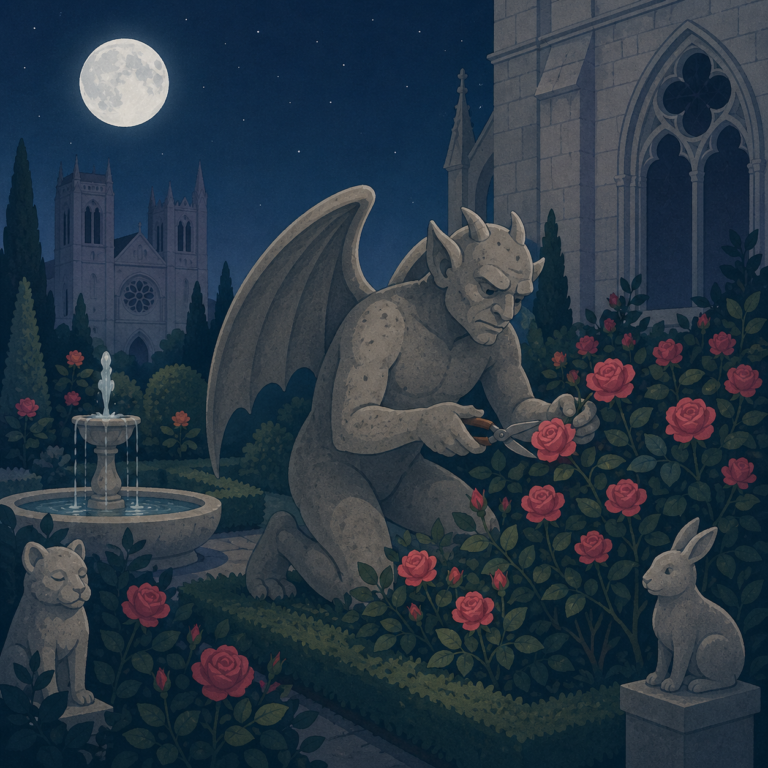
Sir Sneeze-a-Lot

Sir Sneeze-a-Lot was not born with that name. His mother had called him Cedric, after a great-great-grandfather who had supposedly wrestled a river troll, although nobody in the family could agree whether the troll had been defeated, befriended, or merely confused into leaving.
His father had called him “lad,” because his father was the sort of blacksmith who believed names should be saved for horses, swords, and the occasional stubborn mule. The kingdom called him Sir Cedric of Bramblebrook for exactly six months after he was knighted, which was how long it took for the unfortunate truth to become impossible to ignore.
He was allergic to dragons.
Not afraid of dragons, which would have been embarrassing but understandable. Not cursed by dragons, which would have sounded rather grand and tragic. Not even unlucky around dragons, though that was certainly part of it. He was allergic to them in the plainest, most ridiculous way. The moment a dragon came within sneezing distance, Sir Cedric’s nose would twitch, his eyes would water, his helmet would rattle, and a sneeze of such astonishing force would burst out of him that banners shook, goblets toppled, and small woodland creatures reconsidered their life choices.
The first time it happened, nobody understood what was going on.
It had been during the Trial of the Ashen Ridge, the most famous test of bravery in the kingdom of Gallanthia. Every knight who wished to prove themselves had to climb the blackened slopes beyond the eastern woods and confront Emberclaw, a dragon said to be as ancient as the mountain and as cruel as a tax collector with a toothache. The tradition was simple. A knight rode up the ridge, declared their name, shouted something about honor, and returned with either a dragon scale, a tale of heroic combat, or a very good excuse.
Sir Cedric had polished his armor until clouds could see themselves in it. He had sharpened his sword, though not too sharply, because he had no desire to hurt anything that could roast him at twenty paces. He had memorized a speech about courage, duty, and the protection of innocent villages. He had even tied a blue ribbon from his mother around his lance for luck.
At dawn, the whole court watched him depart. King Bartholomew the Broad waved from the castle steps. Queen Mirabel dabbed her eyes with a handkerchief, though she dabbed them at every event, including harvest parades and cheese tastings. The royal trumpeters played “Gallanthia the Glorious,” though one of them sneezed during the second verse, which everyone later agreed had been an omen.
Sir Cedric rode up Ashen Ridge with his chin high and his knees knocking only a little. He found Emberclaw sprawled across a shelf of warm stone, tail curled around a pile of half-melted helmets. The dragon was enormous, red as sunrise through smoke, with gold eyes and horns like polished ivory. Heat shimmered from his scales. Smoke curled from his nostrils. His claws were longer than Cedric’s sword, and his teeth looked like a fence designed by someone with a grudge.
“Who approaches?” rumbled Emberclaw.
Sir Cedric lifted his visor. “I am Sir Cedric of Bramblebrook, knight of Gallanthia, defender of the weak, servant of the crown, and challenger of—”
His nose twitched.
He paused.
Emberclaw narrowed one golden eye. “Challenger of what?”
“Of…” Cedric blinked rapidly. “Of… of… ah…”
His whole face crumpled.
“Ah…”
The dragon raised his head.
“Ahhh…”
Smoke puffed uncertainly from Emberclaw’s nostrils.
“AHHH-CHOOOO!”
The sneeze exploded out of Sir Cedric so violently that his visor slammed shut, his plume shot backward like a frightened squirrel, and his horse, Ploddington, sat down.
Emberclaw flinched.
Sir Cedric tried to recover his dignity. “Forgive me. As I was saying—ah—ahhh—ACHOO! ACHOO! AHHH-CHOO!”
Three more sneezes came, each louder than the last. The final one echoed down the ridge, across the valley, and all the way back to the castle, where the trumpeters stopped playing because they thought someone had fired a cannon.
Emberclaw stared.
Sir Cedric fumbled for his sword, sneezed again, dropped it, bent to pick it up, sneezed into his own breastplate, and made a sound like a church bell falling into a soup pot.
The dragon’s terrible mouth opened.
Cedric braced himself for flame.
Instead, Emberclaw laughed.
It began as a low rumble, then rose into a thunderous roar of amusement that sent pebbles skittering down the mountainside. The dragon laughed so hard that smoke rings puffed from his nostrils and floated above his horns.
“Oh, by the first flame,” Emberclaw wheezed, “what is wrong with you?”
“I believe,” Cedric said through watering eyes, “I may be allergic to your magnificence.”
This made Emberclaw laugh even harder.
By the time Cedric returned to the castle, he carried no scale and had fought no battle. But he did carry a small pouch of dragon tea, made from mountain herbs, because Emberclaw had insisted it might soothe his nose. He also carried Emberclaw’s promise not to scorch the sheep of Ashen Ridge anymore, provided the villagers stopped leaving tin washtubs outside his cave, as the reflections made him think rival dragons were mocking him.
At court, the knights were baffled. The king was delighted that no one had been roasted. The queen asked whether dragons preferred honey in their tea. The villagers cheered because their sheep were safe. Sir Cedric sneezed once into his gauntlet, and someone in the back of the crowd shouted, “Sir Sneeze-a-Lot!”
The name stuck faster than a goblin in a jam cupboard.
Sir Cedric tried to object at first. “A knight should have a noble title,” he told his friend, Dame Rosalind, who was polishing her axe in the courtyard.
“Sir Sneeze-a-Lot is noble,” she said. “Memorable, too. Nobody forgets a man who can startle a dragon with his nose.”
“I did not startle him.”
“You made him laugh until he promised peace. That is more than Sir Gravemore managed. He came back without eyebrows.”
Sir Cedric had no answer to that.
Within weeks, songs spread through the taverns. Some were flattering, most were not, and all included the word “achoo” more often than Cedric would have preferred. Children followed him in the streets, pretending to sneeze and fall over. Bakers gave him extra handkerchiefs with his buns. Old women recommended remedies involving onions, nettles, moonwater, or standing upside down under a pear tree. Nothing worked.
Meanwhile, Gallanthia began to change.
For generations, dragon confrontations had been the measure of knighthood. Young knights had sought glory by riding toward fire and returning scorched, if they returned at all. Dragons, in turn, had grown used to knights arriving with swords, speeches, and very little understanding of dragon customs. It was a tiresome arrangement for everyone except bards, armorers, and undertakers.
But Sir Sneeze-a-Lot’s encounter with Emberclaw started rumors. Not rumors of weakness, exactly, though some knights muttered about that. Stranger rumors. Useful rumors. Rumors that dragons had preferences, grievances, hobbies, and, in Emberclaw’s case, a fondness for chamomile. Rumors that perhaps not every dragon wanted to burn barns merely because it was Tuesday.
King Bartholomew, who liked peace almost as much as he liked roasted parsnips, became intrigued. So when a messenger arrived from the northern village of Highwhistle claiming that a blue dragon had frozen the millpond solid in midsummer, the king did not immediately call for twenty spears and a battle chant. Instead, he summoned Sir Sneeze-a-Lot.
Cedric was in the armory at the time, attempting to line his helmet with wool to muffle future sneezes.
“You sent for me, Your Majesty?”
“I did,” said the king, who sat on a barrel because he liked visiting the armory but found most weapons pointy and unsettling. “Highwhistle has a dragon problem.”
Cedric’s nose twitched at the word alone. “Has it?”
“A blue one. Freezing the millpond, terrifying the ducks, disrupting flour production. Serious business. Bread is the backbone of civilization.”
“Surely Dame Rosalind would be better suited. Or Sir Gravemore.”
“Sir Gravemore is still regrowing his eyebrows. Dame Rosalind suggested you.”
“Did she?”
“She said, and I quote, ‘Send Cedric. He has a talent for making terrifying creatures feel awkward.’”
Cedric sighed. “That does sound like Rosalind.”
The king leaned closer. “Do you think you can speak with it?”
“I can attempt to speak between sneezes.”
“Excellent. Take warm gloves.”
So Sir Sneeze-a-Lot rode north with Ploddington, three wool blankets, six clean handkerchiefs, a jar of honey, and a letter from the king addressed, “To the Honorable Dragon Currently Occupying Highwhistle Millpond.” The villagers of Highwhistle met him at the gate wearing scarves despite the summer sun.
“It came at dusk,” said the miller, a round man whose beard was dusted with flour. “Big as a barn, blue as a cornflower, cold as my aunt’s opinions. It breathed once, and the pond froze clear through.”
“The ducks are furious,” added a little girl solemnly.
Cedric looked toward the pond. A pale mist hovered over it. At its center lay a slender blue dragon with silver spines and folded wings like frosted glass. It looked less ferocious than miserable. Its chin rested on the ice, and it sighed a cloud of sparkling vapor.
Sir Sneeze-a-Lot approached carefully.
The dragon opened one eye. “Have you come to stab me?”
“Preferably not,” Cedric said. “I am Sir Sneeze-a-Lot of Gallanthia.”
The dragon blinked. “Is that a threat?”
“No. A warning.”
His nose twitched.
“Oh dear.”
“Ah…”
The dragon lifted its head.
“Ahhh…”
The villagers ducked behind fences.
“AHHH-CHOOOO!”
The sneeze skidded across the frozen pond, blowing powdery frost into the air. The dragon jerked in surprise, slipped, spun once in a circle, and landed belly-down with all four legs spread like a lizard on a polished floor.
There was silence.
Then the little girl giggled.
The dragon looked offended, then embarrassed, then suddenly laughed, a chiming, crystalline sound. “What was that?”
“Diplomacy,” Cedric said weakly, wiping his nose. “Involuntary diplomacy.”
The blue dragon’s name was Frostina, though she admitted she had chosen it herself during a dramatic adolescence and now regretted nothing. She had frozen the millpond not out of malice, but because she had flown south to escape a heat wave in the Frostpeak Caverns and had mistaken the pond for an abandoned mountain pool. She had no idea mills needed unfrozen water to turn their wheels.
“I thought the wooden wheel was decorative,” she said.
The miller clutched his beard. “Decorative?”
“It is charming.”
Cedric sneezed twice more while explaining the importance of flour, bread, and ducks. Frostina listened with growing horror.
“I have inconvenienced ducks?”
“Deeply,” Cedric said.
The dragon gazed at the flock gathered on the bank, all of them quacking in outrage. “I must make amends.”
By sunset, Frostina had thawed the pond, apologized to the ducks, and agreed to spend her summers in an abandoned quarry where her cooling breath could preserve the villagers’ butter, cream, and berries. Highwhistle soon became famous for chilled custards, ice cream, and a new festival called Frostina’s Duck Apology Day, during which children raced carved wooden ducks across the pond and everyone wore blue ribbons.
Sir Sneeze-a-Lot returned home with a basket of frozen pastries, a grateful letter from the miller, and a nose redder than a cherry.
The court cheered again. The songs grew longer. One bard composed “The Ballad of the Knight Whose Nose Knew Peace,” which included seven verses, five refrains, and one alarming attempt to imitate sneezing with a lute.
Not everyone was pleased.
Sir Roland Ironjaw, Captain of the Ember Guard and champion of the old ways, considered the whole affair disgraceful. He was tall, square-shouldered, and so serious that even his mustache looked stern. He had spent thirty years training knights to charge at dragons with courage, discipline, and sharp metal objects. Now the kingdom was celebrating a man who solved dragon problems by sneezing, chatting, and accepting pastry.
“It undermines the dignity of knighthood,” Sir Roland declared during a council meeting.
King Bartholomew was eating one of Frostina’s chilled custards. “Does it?”
“A knight must inspire fear in monsters.”
“Must he? I always thought a knight should protect people.”
“By defeating monsters.”
“Cedric has protected people.”
“By befriending monsters!”
The queen raised a finger. “Technically, by befriending dragons. We should not insult monsters as a group.”
Sir Roland ignored this. “What happens when a truly wicked dragon arrives? One that cannot be laughed into peace? One that hears a sneeze and responds with fire?”
The council fell quiet.
Cedric, seated near the end of the table with a handkerchief pressed to his nose, had wondered the same thing. Emberclaw had been lonely and annoyed. Frostina had been overheated and confused. But surely not every dragon was misunderstood. Surely some enjoyed terror for terror’s sake. Every bedtime story said so. Every old knight said so. Every scorch mark on every ruined tower seemed to say so.
Then again, Cedric had begun to suspect that bedtime stories, old knights, and scorch marks did not always tell the whole truth.
The next challenge came sooner than expected.
A month after Frostina’s Duck Apology Day, a black dragon settled in the ruins of Thornwatch Keep, which overlooked the western road. Thornwatch had been abandoned for years, mostly because the roof leaked and the ghost in the pantry complained too much. But the western road was important. Merchants used it to bring salt, cloth, spices, and news from beyond the hills. The black dragon did not burn wagons. It did not eat horses. It simply sat on the road before the keep and refused to let anyone pass.
When asked why, it said, “None shall cross.”
That was all.
Merchants turned back. Farmers grumbled. The price of pepper rose. King Bartholomew summoned Sir Sneeze-a-Lot again, but this time Sir Roland insisted on accompanying him.
“I will observe,” said Sir Roland. “And intervene when necessary.”
“By intervene,” Cedric said, “do you mean attack?”
“I mean uphold knightly standards.”
“That sounds like attack wearing a hat.”
Sir Roland’s mustache bristled.
They rode west together under a gray sky. Dame Rosalind came too, not because anyone had asked her, but because she said she wanted to see whether Cedric could sneeze a roadblock into submission. Sir Roland brought a lance, a broadsword, a dagger, a shield, two throwing axes, and an expression of grim expectation. Cedric brought twelve handkerchiefs and a small packet of Frostina’s mint ice.
Thornwatch Keep appeared at noon, hunched on a hill like an old man refusing to admit he was tired. Below it, stretched across the road, lay the black dragon. Its scales were dark and glossy as wet stone. Its wings were folded tight. Its tail blocked both ditches. Its eyes were pale green and watchful.
A line of wagons waited at a nervous distance.
Sir Roland lowered his visor. “At last. A proper test.”
Cedric felt his nose prickle.
“Remember,” said Rosalind quietly, “talk first.”
“I intend to.”
Sir Roland snorted.
Cedric rode forward until Ploddington decided that was far enough and stopped. The black dragon lifted its head.
“None shall cross,” it said.
“Yes, I heard,” Cedric replied. “Good afternoon. I am Sir Sneeze-a-Lot of Gallanthia, and I have come to ask—ah—ahh…”
Sir Roland muttered, “Already?”
Cedric clutched his reins. “Ahhh—CHOO!”
The sneeze blasted dust from the road and flipped Sir Roland’s visor open with a clang.
The black dragon did not laugh.
It did not smile.
It stared at Cedric with solemn green eyes. “You are ill.”
“Allergic,” Cedric said, sniffling. “To dragons, unfortunately.”
“That is unwise.”
“I did not choose it.”
“No one chooses their burdens.”
This was not the response Cedric had expected from a road-blocking dragon.
“What is your name?” he asked.
The dragon hesitated. “Obsidian.”
“Pleased to meet you, Obsidian. Why can no one cross?”
“Because crossing is dangerous.”
“For whom?”
“For them.”
Cedric glanced at the merchants. “The travelers?”
“Yes.”
Sir Roland nudged his horse forward. “Enough riddles. Dragon, by order of King Bartholomew, clear the road or face—”
Cedric sneezed again, directly into Sir Roland’s horse’s ear. The horse backed into a shrub.
Obsidian lowered his head. “The bridge beyond the bend is cracked. It will collapse under the next heavy wagon. I heard it groaning last night.”
Everyone turned toward the bend in the road.
The lead merchant, a woman with a purple scarf, frowned. “Bridge? We crossed it yesterday.”
“It cracked after the rain,” said Obsidian. “Stone remembers pressure. Wood complains before breaking. Humans do not listen.”
Sir Roland dismounted and marched around the bend. The others followed at a cautious distance. Sure enough, the old bridge over Thornwash Gorge had split beneath its mossy stones. One support beam hung loose. The damage was hidden from the road by weeds and shadow. A loaded wagon would have plunged straight into the gorge.
The merchants went pale.
Obsidian watched from behind them. “None shall cross,” he repeated, more softly.
Sir Roland said nothing.
Dame Rosalind rested her axe on her shoulder. “Well. That is inconvenient for your argument.”
Sir Roland glared at the bridge as though it had personally betrayed him.
Obsidian, it turned out, had an extraordinary ear for weak stone, strained timber, and shifting ground. He had once lived in deep caverns where listening meant survival. He had blocked the road because no one stopped long enough to hear him explain. The first merchant had screamed. The second had thrown a turnip. The third had tried to charge through and nearly been nudged into a ditch for his trouble.
With Cedric sneezing at intervals, the conversation unfolded. By evening, Obsidian had helped the villagers drag new beams into place, melting iron braces with careful bursts of heat so the blacksmiths could shape them. He did not enjoy crowds, applause, or turnips, but he accepted a quiet thank-you from the purple-scarfed merchant and permission to live in Thornwatch Keep, pantry ghost included.
“He likes the ghost,” Dame Rosalind later reported. “They both enjoy telling people to go away.”
Sir Sneeze-a-Lot returned with another victory that was not a victory in the traditional sense. No dragon had been slain. No sword had flashed. No shield had cracked beneath fire. Yet the western road reopened, the merchants passed safely, and Obsidian became Gallanthia’s unofficial inspector of bridges, towers, and suspiciously creaky barns.
King Bartholomew was thrilled.
Sir Roland was not.
“This cannot continue,” he said privately to Cedric one afternoon in the training yard. “You are teaching the kingdom that dragons are simply neighbors with wings.”
“Some of them are.”
“Dragons are dangerous.”
“So are swords,” Cedric said. “We still try to use them carefully.”
Sir Roland folded his arms. “You have been lucky.”
Cedric looked across the yard, where young pages were practicing with wooden blades. A month ago, they had pretended to slay imaginary dragons. Now two of them were pretending to negotiate with one over sheep boundaries.
“Perhaps,” Cedric said.
Sir Roland’s voice softened, though only slightly. “Luck ends.”
The words stayed with Cedric.
For all the cheering and songs, he knew Sir Roland was not entirely wrong. Dragons were powerful. A misunderstanding with a duck pond could be solved with apologies. A bridge could be repaired. But what about hunger? Rage? Revenge? What about old wounds that a handkerchief and a friendly question could not mend?
He discovered the answer at Mournmere.
Mournmere was a lonely lake south of the kingdom, surrounded by reeds, mist, and willow trees that trailed their branches in the water like old women washing their hair. Long ago, a castle had stood on an island at its center, but it had burned during a forgotten war. All that remained were broken walls and a tower split down the side. Fishermen avoided the place. Shepherds claimed lights moved over the lake at night. Travelers said they heard singing, though never the same song twice.
Then sheep began vanishing.
At first the villagers blamed wolves. Then they found claw marks scorched into the mud. Then a shepherd saw a green dragon rising from the mist with a sheep in its talons. The village sent word to the king: this dragon was stealing livestock and haunting ruins. Something had to be done.
Sir Roland demanded command of the expedition.
“This is no matter for tea and sniffles,” he said. “A livestock thief must be stopped.”
Cedric agreed that the thefts had to stop, but he asked to come too.
Sir Roland shook his head. “You will only complicate matters.”
“Good,” said Dame Rosalind, appearing behind him. “Matters involving dragons are usually too simple when Roland handles them.”
In the end, the king sent all three: Sir Roland to uphold caution, Sir Sneeze-a-Lot to attempt conversation, and Dame Rosalind because nobody could prevent her from going once she had packed snacks.
They reached Mournmere near dusk. Mist silvered the lake. The ruined tower rose from the island like a broken finger. The air smelled of wet grass, old stone, and something sharp that made Cedric’s nose begin twitching even before the dragon appeared.
A green shape moved through the fog.
Sir Roland drew his sword.
Cedric raised a hand. “Wait.”
The dragon landed on the shore without a sound. She was smaller than Emberclaw but still vast compared with a horse, with moss-green scales, antler-like horns, and eyes the color of rain on leaves. A sheep hung unharmed but indignant from her foreclaws. She set it down gently. It bleated and trotted away.
“Leave,” said the dragon.
Cedric’s breath hitched. “We have come to—ah—to discuss—ahh—”
“Do not,” said Sir Roland.
“AHH-CHOO!”
The sneeze tore through the mist, scattering it in curling ribbons. A flock of birds burst from the reeds. The sheep fell over, then sprang up and ran.
The green dragon stared at Cedric. For one moment, he hoped she would laugh.
She did not.
Instead, she began to cry.
It was a terrible thing, seeing a dragon cry. Her tears hissed where they struck the cold mud, not from heat but from some old magic in them. The mist thickened around her. Her wings drooped.
“Oh no,” Cedric whispered. “I am so sorry. Did the sneeze offend you?”
“No,” she said, voice trembling. “My hatchlings used to sneeze like that.”
No one spoke.
Even Sir Roland lowered his sword an inch.
The dragon’s name was Willowmere. She had lived beyond the southern marshes with three hatchlings, each no bigger than a pony and twice as troublesome. During a storm, months before, hunters from outside Gallanthia had raided her nest while she was away searching for food. They had not killed the hatchlings. They had stolen them, bound their wings, and carried them north to sell to some distant prince who wanted dragonlings for a menagerie.
Willowmere had followed as far as Mournmere, where she lost the trail in rain and smoke. Since then she had remained by the lake, searching the ruins, the roads, the reeds, anywhere the scent might have gone. She stole sheep because grief and exhaustion had made hunting difficult, but she had never harmed a shepherd. She meant to repay them somehow, once she found her children.
Cedric felt ashamed of every story he had ever heard about wicked dragons stealing livestock for sport.
Dame Rosalind knelt by the sheep tracks. “How long ago?”
“Two moons.”
“Hunters leave signs,” she said. “Men dragging cages leave more.”
Sir Roland’s jaw tightened. “Outside Gallanthia, you say?”
“Yes,” Willowmere replied. “Their cloaks were yellow. Their leader had a silver tooth.”
Sir Roland looked sharply at Cedric. “The Fair of Seven Roads begins tomorrow beyond the northern border. Traders, collectors, beast dealers.”
Cedric understood. “They might be there.”
Willowmere rose, sudden hope and fury bright in her eyes. “Take me.”
Sir Roland stepped back. “A dragon cannot simply fly into a fair full of people.”
“Why not?” asked Rosalind.
“Panic. Fire. Screaming. Laws. Common sense.”
Cedric sneezed softly into his handkerchief. His eyes watered, though not only from the allergy. “Then we do not take a dragon into the fair. We take a grieving mother near it, and we bring her children back.”
The plan was not knightly in the old way. It involved no banners and very little charging. Willowmere carried them through the night, which was terrifying until Cedric realized that sneezing while airborne was far worse for the people sitting in front of him than for himself. Sir Roland, who had insisted on riding behind Cedric for strategic reasons, arrived with his mustache blown sideways.
They hid Willowmere in a pine-covered valley before dawn and entered the Fair of Seven Roads on foot. It sprawled across a meadow beyond the border, bright with tents, flags, wagons, cages, cooking fires, and shouting merchants. There were acrobats, spice sellers, fortune-tellers, horse traders, jugglers, tinkers, and one man loudly claiming to sell genuine bottled moonlight, though Dame Rosalind said it looked like pond water with glitter in it.
They searched for yellow cloaks.
They found three near the animal pens.
The men were gathered beside a covered wagon, speaking with a thin lord in velvet gloves. One of the men laughed, showing a silver tooth.
Cedric’s stomach tightened.
From inside the wagon came a sound like a kitten trying to be thunder.
A hatchling sneeze.
Cedric’s own nose answered immediately.
“Not now,” whispered Sir Roland.
Cedric clamped both hands over his face. “Ah…”
Dame Rosalind grabbed a sack of onions from a nearby stall and shoved it under Sir Roland’s arm. “Distraction.”
“What?”
“Be useful.”
Cedric staggered toward the wagon, fighting the sneeze with all his might. The silver-toothed man noticed him.
“You there. Keep away.”
“Certainly,” Cedric squeaked. “Only I—ah—believe you have—ah—something that belongs—ahh—”
The sneeze won.
“AHHH-CHOOOO!”
The blast ripped the cover from the wagon.
Inside were three dragon hatchlings, green and gold and speckled with mud, bound in cruel iron nets. Their eyes widened at the sight of Cedric. Then, as if his sneeze had given them permission, all three sneezed back.
Tiny jets of smoke burst from their noses.
The crowd screamed.
Sir Roland moved faster than Cedric had ever seen him move. He drew his sword, not to attack a dragon, but to slice through the first net. Dame Rosalind swung her axe through the second. Cedric fumbled with the third, sneezing so hard that the knot shook loose by itself.
The silver-toothed man lunged for him. Sir Roland slammed the flat of his blade against the man’s wrist.
“By authority of Gallanthia,” he thundered, “and by every law of decency known to knight or shepherd, you are under arrest.”
“We are beyond Gallanthia!” snarled the man.
Dame Rosalind smiled. “Then consider this a personal objection.”
The hatchlings tumbled free. One climbed onto Cedric’s helmet. Another bit Sir Roland’s boot. The third sneezed sparks into the onion sack, which began to smoke.
Then Willowmere arrived.
She did not burn the fair. She did not tear down tents. She landed in the meadow with such controlled force that only three hats blew away. The crowd froze as the green dragon lowered her head and crooned.
The hatchlings shrieked with joy and scrambled toward her.
Willowmere curled around them, wings forming a wall of green and gold. Cedric stood nearby, sneezing helplessly, while people stared. Some saw a monster. Some saw a mother. Some saw both and did not know what to do.
Sir Roland stepped between Willowmere and the crowd.
Cedric expected him to raise his sword.
Instead, the old knight lifted his empty hand.
“No one moves,” Sir Roland commanded. “No one threatens her. These young were stolen. The crime is not hers.”
It was the bravest thing Cedric had ever seen him do.
The fair guards took the hunters away. The velvet-gloved lord vanished before anyone could question him, though Dame Rosalind found one of his gloves caught on a fence and kept it, saying evidence had a way of becoming useful. Willowmere carried her hatchlings home at dawn, stopping first at Mournmere to return every stolen sheep she could find and leaving, in apology, three pearls from the lakebed and a promise to guard the southern marshes from poachers.
After that, even Sir Roland could not say things were simple.
He did not become cheerful. That would have alarmed everyone. But he began listening before drawing his sword. He began teaching pages that courage was not the same as noise, and that a knight who asked a question before attacking was not less brave but more prepared. He still disliked Cedric’s nickname, though possibly because the pages had started calling him Sir Scowl-a-Lot when they thought he could not hear.
The kingdom changed faster now.
Emberclaw attended the harvest festival, though from a safe hilltop, where he roasted chestnuts with delicate puffs of flame. Frostina helped preserve medicine in summer. Obsidian inspected bridges. Willowmere and her hatchlings patrolled the marshes, and the hatchlings developed a habit of sneezing whenever Cedric sneezed, which made meetings difficult and hilarious.
King Bartholomew created the Office of Dragonly Affairs, then admitted he had no idea what that meant and appointed Cedric to figure it out. Cedric tried to refuse.
“I am not qualified,” he said.
“You have spoken with more dragons than anyone in the kingdom,” said the king.
“Mostly between sneezes.”
“Then you are uniquely experienced.”
Queen Mirabel embroidered him an official sash with a golden dragon and a silver handkerchief crossed over a shield. Cedric wore it because refusing a queen’s embroidery was treason against kindness.
Soon, people came from across Gallanthia seeking help with dragon matters. A bronze dragon kept stealing church bells because she liked the sound. Cedric convinced her to visit during festivals instead, where she became a beloved if extremely loud participant. A tiny lavender dragon nested in a bakery chimney and accidentally smoked all the bread; Cedric helped move her to the royal smokehouse, where her talents improved sausages across three counties. A pale river dragon frightened fishermen by surfacing beneath boats, not realizing humans disliked being lifted unexpectedly; after several sneezes and one apology, the dragon agreed to announce herself by blowing bubbles first.
With each encounter, Cedric’s reputation grew. So did his supply of handkerchiefs. Villagers sent them embroidered with flowers, ducks, bells, bridges, sheep, and dragons. One anonymous package contained a handkerchief with Sir Roland’s scowling face stitched in one corner. Dame Rosalind denied involvement so badly that everyone knew it was her.
Cedric should have been happy.
Often, he was.
Yet a worry lingered. The kingdom was learning peace with dragons, but beyond Gallanthia, many still saw dragons as trophies, weapons, or threats. The hunters at Seven Roads had not acted alone. The velvet-gloved lord had escaped. Rumors came of a prince to the east building a menagerie of rare beasts. Rumors came of iron cages, clipped wings, muzzles, chains.
Then one winter morning, a raven arrived with a scrap of velvet tied to its leg.
The message was written in a hurried hand: The lord with silver gloves serves Prince Malovar of Eastreach. He has taken more dragons. He seeks the Crown of Cinders. If he wakes the old fire beneath Redspire, all kingdoms will burn.
King Bartholomew read the message three times. The council fell silent.
Cedric had heard of the Crown of Cinders only in legend. It was said to be an ancient circlet forged by the first dragon tyrant, able to command flame-hearted creatures against their will. Most scholars considered it a myth. Most scholars, Cedric reflected, had not recently met bridge-listening dragons or chimney-nesting smoke dragons.
Sir Roland stood at the council table. “We cannot ignore this.”
“No,” said Cedric.
Dame Rosalind tapped the velvet glove she had saved from the fair. “I knew this would become useful.”
The king looked at Cedric. “Can you stop him?”
Cedric thought of Prince Malovar, whoever he was, surrounding himself with cages and chains. He thought of Willowmere’s tears. He thought of hatchlings sneezing sparks in terror. His nose twitched, though no dragon was near.
“I do not know,” he said honestly. “But I can try.”
They did not go alone.
Emberclaw came, grumbling that humans always waited until winter to have crises. Frostina came because Redspire’s old fire, if awakened, could melt half the northern snows. Obsidian came because ancient volcanoes were notoriously unstable and nobody listened properly to mountains. Willowmere came with her hatchlings left safely in the marshes under the care of the bronze bell dragon, who promised to sound an alarm if anyone suspicious came near.
Sir Roland led twenty knights, but at Cedric’s request they carried more ropes, shields, and bolt-cutters than lances. Dame Rosalind carried her axe and a suspicious number of snacks. Cedric carried every handkerchief he owned.
Redspire lay beyond the eastern border, in the harsh lands of Eastreach. It was not merely a mountain but a wound in the earth, its peak jagged and red, smoke staining the sky above it. At its base stood the fortress of Prince Malovar, a cruel arrangement of black towers, iron gates, and banners showing a silver crown over a flame.
The company reached the ridge above the fortress at dusk.
Cedric saw cages in the courtyard.
Dragons crouched inside them: small ones, old ones, bright ones, dull ones, dragons with torn wings and muzzled jaws. Soldiers moved between the cages with spears tipped in black iron. At the center of the courtyard stood a tall man in a silver cloak and velvet gloves. His hair was pale. His face was handsome in the way of statues that had never apologized. In his hands, on a cushion of red silk, lay a twisted crown of dark metal.
The Crown of Cinders.
Cedric’s nose began to burn.
Not twitch. Burn.
Every dragon nearby raised its head.
Emberclaw growled. “That thing is wrong.”
Obsidian pressed one ear to the ground. “The mountain is listening.”
Prince Malovar lifted the crown.
“Creatures of flame,” his voice rang through the courtyard, “your age of wildness ends. Your strength is mine. Your fire is mine. Kneel.”
The crown glowed red.
The caged dragons cried out.
Emberclaw staggered.
Frostina’s wings shuddered.
Willowmere hissed in pain.
Cedric felt helplessness seize him. What could a knight with a ridiculous allergy do against ancient magic? He had no spell, no royal blood, no legendary sword. He had a sore nose, watery eyes, and armor that still smelled faintly of mint ice.
The crown flared brighter.
Cedric sneezed.
It was not an ordinary sneeze.
It began deep in his chest, gathered every speck of dragon dust, smoke, scale, ash, ancient magic, winter wind, and righteous indignation in the fortress valley, and erupted with the force of a thunderstorm trapped in a trumpet.
“AAAAHHHHH-CHOOOOOO!”
The blast rolled down the ridge like a visible wave. Snow flew from rocks. Sir Roland’s mustache snapped straight out. Dame Rosalind grabbed a tree. The fortress banners tore loose. In the courtyard, soldiers toppled. Cage doors rattled. Prince Malovar stumbled backward.
The Crown of Cinders flew out of his hands.
It struck the stone courtyard, bounced once, and rolled straight into a drainage channel.
For one stunned heartbeat, no one moved.
Then Emberclaw roared, “Now!”
The ridge erupted.
Knights charged, not to kill dragons, but to free them. Dame Rosalind led the descent, cutting through gate chains with her axe. Sir Roland crashed into the first line of soldiers like a moral lesson in plate armor. Frostina swept over the courtyard, freezing spear tips harmlessly in blocks of ice. Obsidian slammed his tail against the fortress wall exactly where the stones were weakest, opening a path to the inner cages. Willowmere dove low, tearing muzzles loose with careful claws.
Cedric ran after them, sneezing every few steps.
“Ah-CHOO!” A soldier dropped his spear.
“ACHOO!” A cage latch sprang open.
“AHH-CHOO!” Prince Malovar’s silver cloak flipped over his head.
Cedric did not understand whether his sneezes disrupted the crown’s magic, startled enemies, or simply caused enough confusion to make tyranny difficult. He did not care. He reached the drainage channel and saw the Crown of Cinders lodged against an iron grate, still pulsing.
Prince Malovar tore free of his cloak and saw it too.
They lunged at the same time.
Malovar was faster. His velvet glove closed around the crown.
“You fool,” he snarled. “You think kindness changes power? Power commands. Power conquers.”
Cedric’s nose twitched.
Malovar’s eyes narrowed. “Do not.”
“Ah…”
“I said do not.”
“Ahh…”
Malovar raised the crown.
Cedric looked past him. He saw Emberclaw shielding knights from flame. Frostina helping a limping silver dragon from a cage. Obsidian holding up a crumbling arch so prisoners could escape. Willowmere curled protectively around a terrified young dragon who was not her own. Sir Roland standing between soldiers and freed creatures with his sword held steady. Dame Rosalind laughing as she knocked a spear from a soldier’s hand with a smoked sausage she had apparently brought for emergencies.
He saw, with sudden clarity, that power did command, sometimes. Fear commanded. Chains commanded. Crowns commanded. But only until something stronger arrived. Trust did not look stronger at first. It looked foolish. It looked slow. It looked like questions asked in dangerous places. It looked like apologies to ducks and tea shared with dragons. It looked like an old knight lowering his sword. It looked like a mother finding her stolen children. It looked, very unfortunately, like a man about to sneeze in a prince’s face.
“AHHHHH-CHOOOO!”
The sneeze hit the Crown of Cinders directly.
The crown rang like a cracked bell. Red light burst from it, then sputtered. Malovar screamed and dropped it. Cedric seized a loose iron bar from the broken grate and struck the crown with all his strength.
Once.
Twice.
On the third blow, the Crown of Cinders shattered.
A sound swept through the fortress, not an explosion but a release, like a thousand locked doors opening at once. The caged dragons lifted their heads. The mountain stopped trembling. The old fire beneath Redspire sighed and sank back into sleep.
Prince Malovar stared at the broken pieces. “Impossible.”
Sir Roland stepped behind him and placed a firm hand on his shoulder. “You are under arrest.”
“We are beyond Gallanthia,” Malovar spat.
Dame Rosalind appeared on his other side. “People keep saying that as though it helps.”
The battle ended soon after. Without the crown, Malovar’s soldiers lost their nerve. Some surrendered. Some fled. The dragons, though angry, did not burn the fortress to the ground. Cedric asked them not to, and Willowmere stood beside him when he asked, and Emberclaw grumbled but agreed that paperwork was probably easier if the towers remained mostly upright.
At dawn, the freed dragons filled the sky.
There were dozens of them: copper, silver, brown, violet, white, green, blue, and colors Cedric had no names for. Some were strong enough to fly home. Others would need care. Frostina organized the injured by temperature preference. Obsidian checked the fortress foundations and declared three towers rude, which apparently meant unsafe. Emberclaw found Malovar’s treasure room and insisted the gold be used to compensate harmed villages and feed rescued dragons, though he kept one jeweled cup because it was “clearly lonely.”
Sir Roland approached Cedric as the sun rose over Redspire.
Cedric was sitting on a stone, exhausted, surrounded by used handkerchiefs. His nose was red. His eyes were swollen. His armor was dented. A tiny rescued dragon had fallen asleep against his boot.
Sir Roland stood silently for a moment.
Then he removed one gauntlet and offered Cedric a square of cloth.
Cedric took it. It was embroidered with the crest of the Ember Guard.
“Thank you,” Cedric said.
Sir Roland cleared his throat. “You have upheld knightly standards.”
Cedric smiled faintly. “By sneezing?”
“Among other things.”
It was the highest praise Sir Roland could give.
When they returned to Gallanthia, the celebration lasted three days. King Bartholomew declared a new royal decree: no dragon would be hunted, challenged, caged, taxed, sung at, or otherwise bothered without cause. Any dispute involving dragons would be brought first to the Office of Dragonly Affairs, where Sir Sneeze-a-Lot would mediate with patience, fairness, and adequate linen.
The old Trial of the Ashen Ridge was retired. In its place, young knights faced a new test. They had to spend one day helping a creature others feared. Some helped trolls repair bridges. Some helped griffins untangle nests from weather vanes. One nervous squire spent an afternoon listening to Obsidian explain the emotional lives of stones and came back deeply changed.
As for Sir Sneeze-a-Lot, he never stopped being allergic to dragons.
No remedy worked. Not onion steam, not nettle tea, not moonwater, not Frostina’s mint ice, not Emberclaw’s mountain herbs, not the lavender chimney dragon’s smoke therapy, and certainly not Dame Rosalind’s suggestion that he try sneezing until he ran out. Whenever dragons gathered, Cedric sneezed. Whenever hatchlings visited, he sneezed. Whenever Emberclaw leaned too close during chess, he sneezed directly onto the board and ruined the game.
But the kingdom no longer laughed at him cruelly.
They laughed warmly, as people laugh when something familiar and beloved happens again. Children still imitated his sneezes in the streets, but now they did so while wearing toy helmets and carrying little white handkerchiefs like banners. Bards still sang about him, though the better songs mentioned not only his nose but his courage, his curiosity, and his habit of asking dragons why before deciding what must be done.
Years later, when Sir Sneeze-a-Lot was older and his armor had been let out twice at the waist, a young knight asked him whether he had ever wished to be known by a grander name.
They were standing in the courtyard of the castle, watching Willowmere’s grown hatchlings circle above the towers. Emberclaw dozed on a sunny hill beyond the walls. Frostina chilled lemonade for the kitchens. Obsidian inspected a new archway and disapproved of it quietly.
Sir Cedric considered the question.
Once, he had wanted a name that sounded sharp and shining. Sir Cedric the Bold. Sir Cedric Flamebane. Sir Cedric Dragonscourge. Something that would look impressive carved under a statue.
Then a green dragon overhead sneezed.
Cedric’s nose answered.
“Ah…”
The young knight stepped back.
“Ahh…”
Across the courtyard, Dame Rosalind grinned. Sir Roland, much older now but still stern, calmly lifted his tea out of range.
“AHH-CHOO!”
The sneeze echoed against the castle walls. The circling dragons trumpeted with delight. Somewhere in the kitchens, a tray clattered. Frostina called, “Bless you!”
Sir Sneeze-a-Lot wiped his nose with a handkerchief embroidered with dragons, ducks, bridges, bells, and flames.
“No,” he said at last, smiling up at the sky. “I think it suits me perfectly.”