The Enchanted Espresso Machine
Mira Quill had learned the moods of the espresso machine the way sailors learned the sea.
On cold mornings, it hissed before the first shot, impatient and theatrical, as if offended by the hour. On rainy afternoons, steam gathered around its chrome shoulders in soft clouds that smelled faintly of caramel even when no caramel had been opened. When the café was full and the line ran out the door, the machine knocked its portafilter loose unless Mira patted the left side twice. When the owner, Mr. Pell, came in wearing his brown hat and calculating face, the pressure gauge swung nervously between nine and ten bars until he left.
The machine was old, older than the café, older perhaps than the building itself. It had three brass levers, a cracked enamel panel, a red light that blinked when it pleased, and the name Belladonna etched into the side in curling letters. No manufacturer’s mark, no model number, no friendly manual. Mr. Pell claimed he had bought it from an estate sale in Prague, though he also claimed he had once beaten a grandmaster at chess using only pawns, so Mira treated his stories as decorative rather than informative.
Still, Belladonna made beautiful coffee.
That was why Mira loved her, despite the burns, the leaks, the rattles, and the way the machine occasionally seemed to sigh.
The café was called The Moon & Spoon, wedged between a florist and a locksmith on a crooked lane where umbrellas turned inside out even in mild wind. The bell above the door had a thin, bright ring. The tables were mismatched. The chairs had opinions. The walls were covered with framed menus from decades past, when coffee had apparently cost less than a shoelace and no one had ever demanded oat milk foam shaped like a swan.
Mira opened every morning at six. She liked the hour before customers arrived, when the café smelled of ground beans, lemon cleaner, and the first tray of almond croissants warming in the oven. She liked the rituals: unlock, lights, stools down, pastry case, grinder, towels, cups, beans. Belladonna always came last. Mira would wipe the machine’s chrome face until it reflected her own: dark hair tied up in a knot, brown eyes tired but alert, a thin scar on her chin from the time she had slipped on spilled milk during the Christmas rush. Then she would say, because habit was a kind of prayer, “Good morning, Bella.”
Usually Belladonna answered with a soft metallic tick.
On the morning everything changed, she answered with music.
It was not loud. It sounded like a music box submerged in warm water: a trickle of notes behind the boiler’s hum. Mira froze with the polishing cloth in her hand.
“Bella?”
The red light blinked three times.
Mira leaned closer. “Do not explode. I swear, if you explode before seven, I’m walking into the canal.”
The machine whistled.
Mira stared at it. She had been a barista for eight years and had heard espresso machines make every conceivable noise: groans, shrieks, sputters, coughs, ominous clicking, and once a sound like a duck being insulted. But this was not mechanical. It was a melody.
She checked the pressure. Normal. Temperature. Normal. Water line. Normal. She opened the grinder hopper and sniffed the beans. Dark roast, nutty, harmless. She pulled the first test shot of the day into a white demitasse cup.
The espresso poured like liquid amber, thick and tiger-striped, with a crema so perfect that Mira forgot, for one vulnerable second, to be suspicious. The cup trembled slightly in her fingers. The smell was extraordinary. Not just chocolate and toasted sugar, but summer pavement after rain, paper from old books, and the precise memory of being seven years old and discovering a hidden tin of biscuits in her grandmother’s pantry.
Mira frowned. “Absolutely not.”
She poured it down the sink.
The sink coughed.
A second later, the sponge beside the tap rose into the air.
Mira watched it levitate.
It hovered at eye level, yellow and green and dripping, turning slowly as if it were a tiny, damp planet. Then it bobbed toward the ceiling and bumped against the light fixture.
Mira did not scream. Later, she would be proud of that. She simply stepped backward until she hit the pastry case.
The sponge floated down again, landed neatly in the sink, and resumed being a sponge.
For a long moment, the café was silent except for the oven fan.
Mira looked at Belladonna.
Belladonna’s red light blinked once.
“No,” Mira said.
The machine hummed.
“No, no, no. You are an espresso machine. You make coffee. Occasionally you flood the counter. That is the agreement.”
Tick.
Mira grabbed the cup, sniffed it, remembered she had emptied it, and set it down. Her heartbeat was running several drinks ahead of her. She considered calling Mr. Pell. Then she imagined him saying something like “Excellent, enchantment increases brand identity,” and immediately rejected the idea.
The doorbell rang.
Mira jumped.
A man in a charcoal coat stepped in, shaking rain from his umbrella. It was Mr. Devlin, who owned the locksmith next door. He came in every morning at six thirty-one and ordered a small latte with one sugar, though he always watched Mira add the sugar as if she might attempt betrayal.
“Morning,” he said.
“Morning,” Mira replied, too brightly.
“Usual.”
“Yes. Your usual. Completely usual.”
Mr. Devlin lowered his umbrella. “Are you well?”
“Fine.”
Belladonna purred.
Mira turned slowly toward the machine. “Don’t.”
“What?”
“Nothing.”
She made the latte as carefully as she had ever made anything in her life. Grind. Tamp. Lock. Pull. Steam milk. Pour. The espresso looked normal, though perhaps it glittered if she tilted the cup. The milk stretched into a shining foam. Mira poured a heart on top because her hands knew the pattern even when her mind was shouting evacuation plans.
She slid the cup across the counter.
Mr. Devlin lifted it.
Mira almost slapped it from his hand.
Instead, she said, “Careful, it’s hot.”
He gave her a look. “Coffee generally is.”
He took a sip.
Nothing happened.
Mira exhaled.
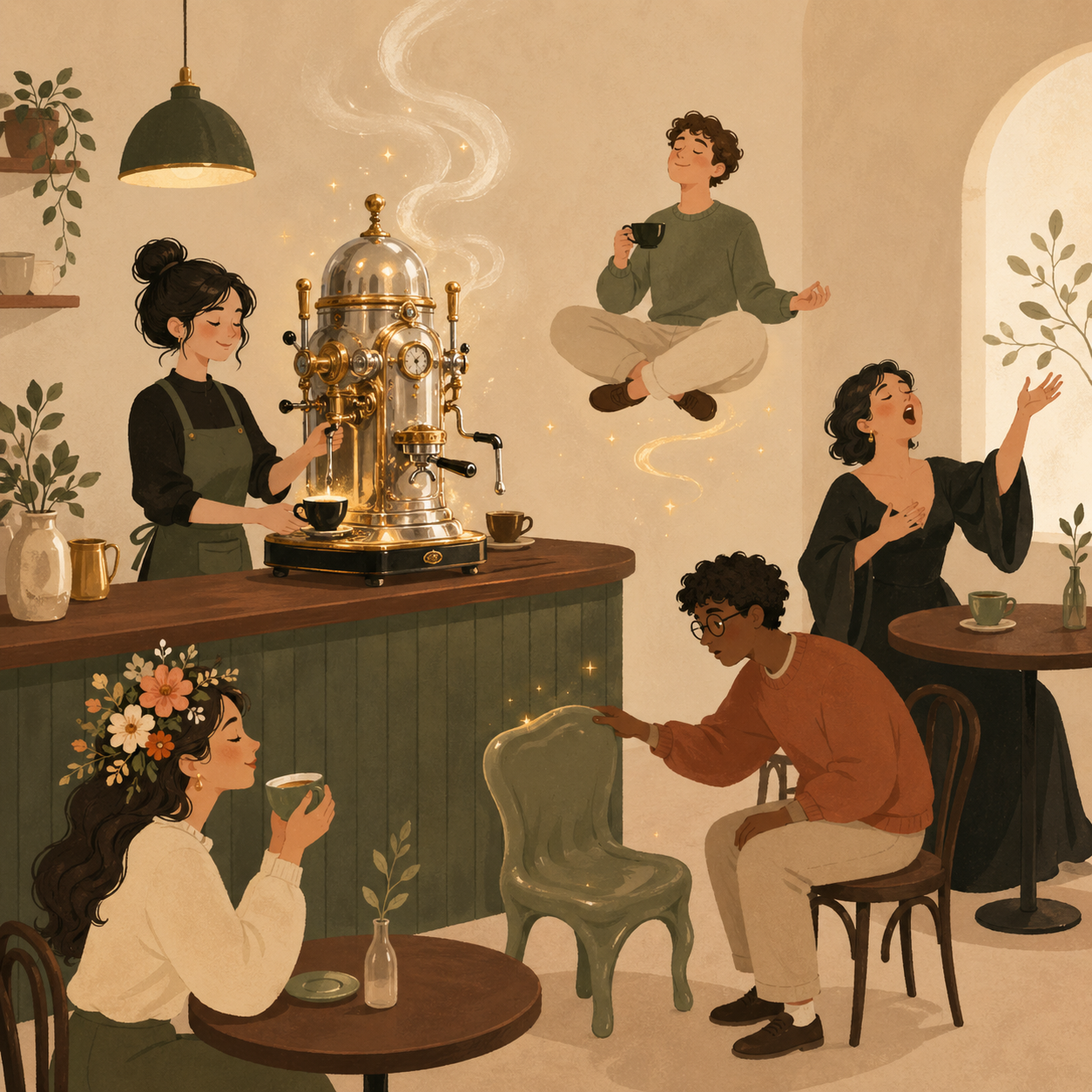
Mr. Devlin added his sugar, stirred, took another sip, and rose gently into the air.
His shoes left the floor by three inches, then six, then twelve. The umbrella dropped from his hand. His face did not change at first. He looked down at the floor, then at Mira, then at the latte.
“Miss Quill,” he said very calmly, “I appear to be ascending.”
“Yes,” Mira said. “I can see that.”
“Is this intentional?”
“No.”
He floated higher. His knees reached the counter. His coat tails drifted around him.
Mira hurried around the bar and grabbed his ankle. “Don’t panic.”
“I am not panicking.”
“Good.”
“I am, however, reconsidering several assumptions.”
“That’s fair.”
By the time she pulled him down, three more customers had entered: Anya from the florist, who smelled of eucalyptus and roses; Professor Bram, who taught history at the university and once argued with a muffin; and a courier named Jax with silver hair, a bicycle helmet, and the exhausted expression of someone who had already climbed too many hills.
They all stared at Mr. Devlin, whose feet were hovering several inches above the floor while Mira held him by the trouser cuff.
Anya said, “Is there a promotion today?”
“No,” Mira said.
Professor Bram adjusted his spectacles. “Remarkable.”
Jax grinned. “I want whatever he had.”
“No one is having anything,” Mira said.
Mr. Devlin took another sip.
“Stop drinking it!”
“But it’s excellent,” he said, offended.
The situation might have remained containable if Mr. Pell had not chosen that moment to enter.
He was a small man with a magnificent mustache and the moral flexibility of a cat burglar. He wore his brown hat, his brown coat, and his brown gloves, giving him the appearance of a serious mushroom. He paused at the door, taking in Mr. Devlin’s floating feet, Professor Bram’s hungry curiosity, Anya’s delight, Jax’s grin, and Mira’s grip on the locksmith’s ankle.
Mr. Pell’s eyes lit up.
“Oh,” he said. “Oh my.”
“No,” Mira said immediately.
“I haven’t said anything.”
“You were about to say something terrible.”
“I was about to say something visionary.”
“No.”
He shut the door behind him and turned the sign from CLOSED to OPEN.
Mira released Mr. Devlin, who drifted toward a table and hooked one hand around the back of a chair.
“Mr. Pell,” Mira said, “we need to close.”
“We need to diversify.”
“We need a priest. Or a mechanic. Or both.”
“We need a chalkboard.”
He took the chalkboard from beside the pastry case and wiped away the day’s soup special, which no one ever bought because The Moon & Spoon did not serve soup. In sweeping letters, he wrote:
MAGICAL LATTES
ONE PER CUSTOMER
NO REFUNDS FOR TEMPORARY WONDER
Mira snatched the chalk from him. “Absolutely not.”
The door opened again. Two office workers entered, saw the sign, saw Mr. Devlin floating sideways near the window, and reached for their phones.
Mira pointed at them. “No pictures.”
They lowered their phones with the guilty speed of children caught stealing jam.
Mr. Pell leaned toward Mira and whispered, “This could save the café.”
That stopped her.
The Moon & Spoon was failing. Everyone knew it, although they pretended not to. The pastry supplier had started requiring payment up front. The landlord had visited twice in one month. Mr. Pell had been watering down the vanilla syrup and pretending it was a “lighter seasonal profile.” Mira had begun taking inventory with the grim care of a ship captain counting lifeboats.
The café was the only place she had ever felt anchored. Her mother had worked there before her, back when the walls were green and Belladonna’s levers were polished every week. Mira had learned to count change behind the counter, to sleep through the grinder’s roar, to judge people by whether they returned borrowed teaspoons. After her mother died, the café became not only a workplace but a memory with doors.
She looked at Belladonna.
The machine’s brass levers gleamed.
“You knew?” Mira asked Mr. Pell.
“Knew what?”
“That she could do this.”
“Do you think I would have waited until we were behind on rent?”
A fair point.
Professor Bram approached the counter. “In the interest of research, I would like a cappuccino.”
“No,” Mira said.
“I will sign a waiver.”
“No.”
Anya raised her hand. “I’ll have a mocha.”
“No.”
Jax leaned over the pastry case. “Can I get something that makes me invisible?”
“This is not a menu of superpowers,” Mira snapped. “It is an old machine having a breakdown.”
Belladonna released a puff of steam shaped suspiciously like a heart.
Mr. Pell put both hands on the counter. “Mira. One morning. We test it. Carefully. Imagine it: rent paid, staff retained, perhaps even new chairs without gum underneath.”
“We don’t know what it does.”
“Then we learn.”
“On customers?”
Professor Bram raised a finger. “Volunteers.”
The office workers nodded eagerly.
Mr. Devlin, still holding his chair, said, “I would like to note that the levitation is not unpleasant.”
Mira looked around at their faces. Curiosity, hope, mischief, greed, impatience. They were adults, technically. They could choose to be foolish.
But Belladonna was her responsibility.
“Fine,” Mira said. “One drink each. Small sizes. No one gets a second. No children. No hot drinks to go. Everyone stays inside until effects wear off. If anyone grows extra limbs, we close permanently.”
Mr. Pell clapped. “Excellent.”
“No advertising.”
He slowly lowered the chalkboard he had been angling toward the window.
“And you,” she said to Belladonna, “behave.”
The machine sang one bright note.
The first official magical drink went to Professor Bram: a dry cappuccino, no sugar. Mira made it under intense observation. Mr. Pell took notes on a receipt. Anya watched as if witnessing a flower bloom in winter. Jax bounced on his heels. Mr. Devlin drifted near the ceiling now, one hand braced against a beam.
Professor Bram lifted his cup.
“To inquiry,” he said.
He drank.
For ten seconds, nothing happened. Then he opened his mouth and sang.
It was not a hum or a startled yelp. It was opera, full-throated and glorious, in Italian. At least, Mira assumed it was Italian, because Professor Bram’s ordinary speaking voice sounded like gravel in a teapot, and this sounded like velvet curtains, chandeliers, betrayal, and someone dying attractively beside a fountain.
Anya pressed both hands to her mouth.
Jax whispered, “That is incredible.”
Professor Bram looked alarmed, then attempted to speak. Instead, he sang a resonant phrase that made the teaspoons vibrate.
Mira covered her face. “Wonderful. He’s an aria.”
Mr. Pell wrote: Cappuccino = opera.
Professor Bram sang his way to a table and sat down with great dignity, though his eyebrows conveyed scholarly distress. Every time he tried to ask a question, the café filled with tragic melody.
Next came Anya. Mira made her a mocha and considered, for one strange second, whether the drink wanted chocolate. It seemed ridiculous to think of coffee as wanting anything, but Belladonna’s steam curled toward the cocoa tin until Mira added an extra spoonful.
Anya sipped.
Her hair turned into flowers.
Not metaphorically. Not with a decorative wreath or a faint floral fragrance. Her dark curls became living stems, leaves, and blossoms: small white jasmine near her temples, red poppies at the crown, trailing bluebells down one shoulder. The flowers opened and closed with her breathing.
Anya gasped. “Oh!”
Mira reached for a towel, as if towels solved botanical transformations.
Anya ran to the mirror near the restrooms and laughed. “I love it.”
Mr. Pell wrote: Mocha = personal garden.
“This is not a salon,” Mira muttered.
Jax ordered an espresso.
“No,” Mira said. “You are too excited.”
“That’s discrimination against enthusiasm.”
“It is safety.”
He begged. He promised restraint. He promised not to jump off anything, climb anything, lick anything, or test anything on strangers. In the end, Mira gave him the tiniest ristretto she could pull, no bigger than a thimble.
Jax drank it.
He turned the nearest chair to rubber.
It happened when he reached for it. His fingers brushed the wooden back, and the chair sagged into a wobbly, bendable version of itself. He yelped and jumped away. The chair bounced.
Everyone stared.
Jax touched a teaspoon. It drooped like warm taffy.
He touched the counter. The counter remained solid.
“Only objects,” Professor Bram sang in a mournful baritone.
“Don’t touch the floor,” Mira said.
Jax held both hands in the air like a surgeon. “I’m not touching anything.”
Mr. Pell wrote: Espresso = rubber touch.
By seven fifteen, The Moon & Spoon was no longer a café. It was a laboratory staffed by amateurs and powered by caffeine.
Mira tried to impose order. She made a list of drinks and effects. Latte: levitation. Cappuccino: opera. Mocha: flowering hair. Espresso: rubber touch. Americano, tested by one of the office workers, caused the drinker to understand pigeons. This became clear when he stood near the window and said, with deep concern, “They are planning something behind the statue.” Flat white, tested by his colleague, made her cast a second shadow that behaved independently and appeared to be very rude.
The first rush of customers arrived at eight, and with them came chaos.
Someone had posted online. Of course they had. No pictures had been taken, but that did not matter. The phrase “magic coffee” traveled through the city faster than any truth ever had. By eight ten, there was a line outside. By eight twenty, a bus driver, three students, an accountant, a violinist, two nurses coming off night shift, and a man dressed as a carrot were pressing their faces to the glass.
Mira flipped the sign to CLOSED.
Mr. Pell flipped it back to OPEN.
Mira flipped it to CLOSED again.
Belladonna blasted steam so forcefully that both of them stepped away.
The sign swung by itself and settled on OPEN.
Mira pointed at the machine. “Traitor.”
Belladonna ticked smugly.
They developed rules because civilization was rules balanced on panic. Every customer signed Mr. Pell’s rapidly drafted waiver, which said, in his handwriting, “I accept that wonder may happen.” Mira added, “Effects temporary. Stay on premises. Do not sue.” They cleared the chairs from the center of the café so levitators could float without kicking people. Jax stood by the door with his hands in oven mitts to prevent rubber incidents. Anya, thrilled with her flower hair, began handing out napkins and calming customers. Professor Bram, unable to speak except in opera, used a notepad to document observations.
The drinks did not always produce the same results. That was the real problem.
The latte made Mr. Devlin levitate, but when a nurse named Priya drank one, she began to glow softly, like a reading lamp. The cappuccino made Professor Bram sing opera, but gave the carrot man the ability to fold himself into impossible shapes. He used this to sit inside an empty umbrella stand until Mira ordered him out. A matcha latte, which Mira had not wanted Belladonna involved in at all because matcha was not coffee and she suspected the machine would take offense, gave a student the power to make every written word near her rhyme. The menu became a poem. The waiver became legally useless but delightful.
“Temporary wonder,” Mr. Pell kept saying to the line. “That’s our promise.”
“Our promise is coffee,” Mira said, pulling another shot while watching a glowing nurse float napkins to tables. “Coffee is already enough.”
“Coffee has evolved.”
“Coffee is not supposed to make a man understand pigeons.”
The office worker at the window turned back, pale. “We must remove the statue.”
“No,” Mira said.
At nine, the landlord arrived.
Mr. Voss was tall, bald, and shaped like a closed door. He wore expensive shoes and never ordered anything. He came in carrying a folder, which meant bad news. Mira felt her stomach fall. The café, full of floating customers and rubber cutlery, went quiet in stages.
Mr. Voss looked around.
Professor Bram accidentally sang a dramatic greeting.
A woman with a rude shadow tried to hide behind the pastry case, but her shadow made faces at Mr. Voss from the wall. Mr. Devlin drifted down from the ceiling and attempted to look professional, despite being horizontal.
Mr. Voss said, “What is happening here?”
Mr. Pell stepped forward. “Innovation.”
“Is this licensed?”
Mira said, “We’re closed.”
Mr. Pell said, “We’re open.”
Mr. Voss opened his folder. “You are three months behind on rent.”
The café fell fully silent. Even Belladonna stopped humming.
Mira wiped her hands on her apron. “We know.”
“I have been patient.”
“You’ve been charging us twelve percent late fees,” Mr. Pell said.
“That is my patience.”
Mira could feel every customer listening. Her face burned. This was the private shame of a failing place made public under fluorescent light.
Mr. Voss looked at Belladonna. “You own this machine?”
“The café does,” Mira said quickly.
“I see.”
She did not like how he said it.
Mr. Voss closed the folder. “I will return tomorrow. With a new agreement. If payment cannot be made, I will begin removal of assets.”
“Assets?” Mira asked.
His eyes remained on Belladonna. “Equipment.”
Belladonna’s red light blinked.
Mira stepped in front of the machine.
Mr. Voss smiled without warmth. “Tomorrow.”
He left.
The bell above the door rang behind him, thin and helpless.
For a moment, no one moved.
Then Professor Bram sang something low and furious.
“Agreed,” Mira said.
The day continued because days did that, even when your landlord threatened to steal your possibly enchanted espresso machine.
By noon, The Moon & Spoon had served forty-seven magical drinks and twenty-three normal pastries. Mr. Pell had taken more money in five hours than the café usually made in a week. The tip jar overflowed. A local reporter arrived and was firmly denied entry by Mira, then less firmly denied entry by Mr. Pell, who gave an interview through the cracked door until Mira dragged him away by the back of his coat.
The effects wore off after roughly thirty minutes, sometimes forty, occasionally sooner if the customer ate a croissant. Mira noted that with interest. Croissants appeared to ground the magic. A levitating man descended quickly after eating two almond croissants, and the nurse’s glow dimmed after a plain butter one. Jax’s rubber touch ended when Anya fed him the corner of a pain au chocolat while keeping clear of his hands.
“Pastry as antidote,” Professor Bram wrote, then sang the phrase accidentally.
Mira boxed a dozen croissants and labeled them EMERGENCY.
By early afternoon, the crowd became harder to manage. People arrived not for coffee but for power. They wanted invisibility, flight, beauty, courage, revenge. A man in a navy suit demanded a drink that would help him win a court case. A teenager wanted something that would make his ex jealous. A woman asked, very quietly, if there was a potion that could let her speak to the dead.
Mira stopped.
The café noise blurred around her.
The woman was perhaps fifty, with tired hands and a wedding ring worn thin. Her eyes did not have the greedy shine Mira had started to recognize. They had grief in them. A familiar kind.
“I’m sorry,” Mira said gently. “It doesn’t work like that.”
“How do you know?”
Mira looked at Belladonna.
The machine was silent.
“I just know.”
The woman nodded, embarrassed. “Of course. Sorry.”
“Don’t be.”
Mira made her a normal tea from the kettle, far from Belladonna, and did not charge her.
After that, Mira stopped taking new magical orders.
Mr. Pell protested. The line groaned. Someone outside booed and was immediately shamed by three nurses. Mira stood on a chair and raised both hands.
“That’s enough,” she said.
The café quieted.
“These drinks do strange things. Fun things, sometimes. But they’re not toys, and they’re not solutions. We don’t know what the machine is, how it chooses effects, or what it might do if we keep pushing.”
A man near the door said, “But I waited an hour.”
“Then you have developed patience. Congratulations.”
Anya laughed. Several others did too.
Mr. Pell pulled Mira aside. “We need the money.”
“I know.”
“We almost have enough for one month.”
“I know.”
“Then why stop?”
Mira lowered her voice. “Because something is wrong.”
He looked at Belladonna. “It seems fine.”
“You think everything seems fine until it bites.”
The machine had changed as the day went on. At first its music had been playful. Now it was deeper, slower. The chrome felt warm even on surfaces that should have been cool. The red light blinked in patterns Mira almost understood. More troubling, the effects were growing stronger. A boy who drank a hot chocolate—not made with espresso, merely steamed on Belladonna’s wand—had briefly turned transparent enough for his mother to see the pastry case through him. A cyclist who ordered a macchiato sneezed bubbles that lifted tables. A lawyer’s cortado caused every lie spoken near her to appear as smoke above the speaker’s head, which had resulted in three arguments, one breakup, and Mr. Pell’s mustache emitting a steady gray cloud whenever he discussed café finances.
Belladonna was not simply making magic.
Belladonna was waking up.
At three o’clock, the machine refused to turn off.
Mira flicked the switch. The red light stayed on.
She unplugged it. The boiler continued humming.
Mr. Pell stared at the cord in her hand. “That seems unusual.”
“Thank you.”
The pressure gauge climbed to eleven.
Mira grabbed the emergency shutoff under the counter. Nothing. Steam rolled across the floor. Cups rattled on their shelves. Customers backed toward the walls. Professor Bram began singing in alarm, which did not help but added atmosphere.
Belladonna’s levers moved by themselves.
One pulled down. Espresso poured into an empty cup.
Another lever dropped. Milk steamed in a pitcher Mira was not holding.
The cup and pitcher lifted into the air, swirled together, and combined. A latte assembled itself, foam forming a shape on top: not a heart, not a rosetta, but an eye.
The café went cold.
The cup floated toward Mira.
“No,” she whispered.
It hovered in front of her.
Belladonna sang one note, low and pleading.
Mira understood then, not in words but in the way one understands a hand reaching out in the dark. The machine was offering her something. Not randomly. Not as a trick. It wanted her to drink.
“Mira,” Anya said softly, “don’t.”
Mr. Pell swallowed. “Perhaps we should consider—”
“Be quiet,” Mira said.
She looked at the cup. The latte smelled like her mother’s kitchen. Like cinnamon. Like rain on the morning of a funeral. Like every dawn she had opened the café alone and said good morning to a machine because no one else was there.
Her hands shook as she took it.
Professor Bram stopped singing.
Mira drank.
The café vanished.
Or rather, it unfolded.
She was still standing in The Moon & Spoon, but she could see all its years at once. The walls shifted through old colors: green, yellow, blue, cream. Tables changed shape. Customers flickered in and out like candle flames. A young Mr. Pell laughed behind the counter, his mustache smaller and his hopes larger. Mira saw her mother, Liora, wearing the same apron Mira now wore, hair wrapped in a red scarf, hands moving with calm precision over Belladonna’s levers.
Mira tried to speak, but the vision pulled her backward.
The café before her mother. A woman with silver braids serving soldiers. Before that, a man with round spectacles grinding beans by hand. Before that, the room as a tailor shop, then a reading room, then a place where travelers warmed their hands around bitter coffee and told stories in languages the walls remembered even after the speakers were gone.
And always Belladonna.
Not always chrome. Not always levers. Once brass and wood. Once copper and glass. Once something like a kettle set over coals, carved with symbols that glowed when people laughed or wept nearby.
Mira saw the machine being built by a woman in a black dress under a moonlit roof. The woman’s hands were stained with coffee and ink. She whispered into the metal as if tucking a child into bed.
“Brew what is needed,” the woman said. “Not what is wanted. Needed.”
The vision shifted.
Mira saw people drink. A coward given bravery for ten minutes, long enough to apologize. A grieving widow given the voice of her lost husband, not to keep, only to say goodbye to herself. A cruel mayor turned temporarily into glass so the town could see the small frightened thing inside him. A lonely baker floating near the ceiling, laughing for the first time in years. A liar surrounded by smoke. A child glowing warm through fever. A tired mother growing flowers in her hair and remembering she was beautiful.
Then Mira saw darkness. Owners who sold wonder as spectacle. Men who tried to bottle it. A magician who fed Belladonna gold dust until the machine spat fire. A king who demanded immortality and received, instead, three minutes as a tortoise. Years of silence. Storage rooms. Dust. Estate sales. Mr. Pell bidding because the machine looked expensive and no one else wanted to move something so heavy.
Finally, Mira saw herself. Day after day, hand on chrome, saying, “Good morning, Bella.”
The machine had not awakened because of the beans.
It had awakened because Mira loved it without asking for anything impossible.
The café returned with a snap.
Mira staggered. Anya caught her. The cup slipped from Mira’s hand but did not break; it landed gently on the counter, empty.
Belladonna’s pressure gauge trembled at twelve.
Mira knew what was wrong.
“She’s not a machine,” she said.
Mr. Pell blinked. “What?”
“Not just a machine. She’s an enchantment. She brews what people need.”
Jax, still in oven mitts though his power had faded hours earlier, said, “I needed to turn chairs into rubber?”
“You needed to stop grabbing everything without thinking.”
He considered this. “Rude, but accurate.”
“Professor Bram needed to stop hiding behind footnotes and feel something out loud. Anya needed to see herself as alive, not just useful. Mr. Devlin needed to loosen his grip on the ground.”
Mr. Devlin, standing now with one hand on a chair, looked uncomfortable. “Possibly.”
“And the café?” Anya asked.
Mira looked at Belladonna. “The café needed help. But we turned help into a circus.”
Mr. Pell’s smoke mustache returned faintly.
The pressure gauge climbed higher.
“She’s overbrewing,” Mira said. “Too many wants, too much noise. Everyone came demanding magic, and she tried to answer.”
“What happens if she can’t?” Jax asked.
Belladonna groaned.
Every cup in the café rose one inch.
“That,” Mira said, “is probably the beginning.”
The windows fogged from the inside. The rude shadow detached from its owner again and ducked under a table. The flowers in Anya’s hair reopened despite the effect having worn off. Outside, the line pressed closer, sensing drama the way gulls sense chips.
Mr. Voss chose that moment to return early.
He opened the door without knocking, carrying two men in work jackets and a clipboard.
“I have reconsidered,” he said. “Given reports of unusual activity, I believe immediate inspection of equipment is necessary.”
Mira stood between him and Belladonna. “Get out.”
Mr. Voss smiled. “This property is mine.”
“The machine isn’t.”
“Debatable.”
The pressure gauge hit thirteen.
Belladonna’s music became a warning.
Mr. Voss gestured to the men. “Disconnect it.”
One of them stepped forward.
The floor turned to rubber under his boot.
He bounced backward into Mr. Voss, and both men stumbled. Jax looked at his oven-mitted hands. “Wasn’t me.”
A spoon shot across the room and embedded itself in the wall beside Mr. Voss’s head, quivering.
Everyone froze.
Belladonna hissed.
Mira placed her palm on the machine’s hot side. It should have burned her. It didn’t.
“Bella,” she whispered. “Stop.”
The machine shuddered.
Mr. Voss straightened, face red. “This is dangerous. I will have it removed by city order.”
“You’ll have to get through us,” Anya said.
It was a ridiculous sentence for a florist with blossoms in her hair, but she said it firmly. Mr. Devlin stepped beside her. Professor Bram rose from his chair. Jax moved in front of the door, oven mitts raised. The nurses stood. The office workers stood. Even the man dressed as a carrot unfolded himself from the corner and stood with surprising dignity.
Mr. Pell did not stand at first. He looked at the money in the till, then at Belladonna, then at Mira. Something shifted in his face. Perhaps, for once, he did not calculate.
He stepped beside Mira.
Mr. Voss looked at the room full of customers. “You are all trespassing.”
“This is a café,” Mr. Devlin said. “We are patrons.”
“You are witnesses,” Professor Bram sang, with devastating vibrato.
The crowd outside began chanting. At first Mira could not make out the words. Then she realized they were chanting, “Let the coffee stay!” which was not elegant but had spirit.
Mr. Voss turned toward the window, alarmed.
The pressure gauge hit fourteen.
Mira could feel Belladonna straining under her hand. Magic gathered in the machine like a storm in a kettle. If it burst, the café might fill with opera-singing furniture, rubber bricks, levitating stoves, transparent pedestrians, or something worse. Not malicious. Just too much need, too much want, too much pressure.
“Everyone quiet,” Mira said.
No one heard.
She climbed onto the counter.
“Quiet!”
Her voice cracked like a cup dropped on tile.
Silence fell.
Mira looked out at the room, then through the glass at the crowd beyond. “No more wishes. No more demands. No more asking what you can get.”
The chant died outside.
Mira turned to Belladonna. “She brews what is needed. So what does this place need?”
Mr. Pell opened his mouth, likely to say “money,” but Mira glared, and he closed it.
Anya touched the flowers in her hair. “Community.”
Mr. Devlin said, after a pause, “Trust.”
Jax said, “A better landlord.”
Several people murmured agreement.
Professor Bram wrote something on his notepad, then held it up: A story worth keeping.
The woman who had asked about the dead stood near the back. She said, “A place to sit when the world is too much.”
One of the nurses said, “Warmth.”
The office worker who understood pigeons said, “Protection from the statue birds.”
“No,” Mira said. “But thank you.”
The pressure gauge dipped slightly.
Mira closed her eyes. The café needed rent, yes. Repairs. Chairs. A landlord with a soul. But underneath all that, it needed what it had always needed: people who did not treat it like a transaction. People who came in not only to consume warmth but to create it.
She climbed down and took the emergency croissant box from the counter.
“Everybody gets one piece,” she said. “Not as antidote. As offering.”
Mr. Pell looked pained. “Those are expensive.”
Mira handed him the first croissant.
He accepted it.
They passed pastries through the café. Croissants, scones, almond twists, the last three cinnamon buns. People broke pieces and shared them. Someone opened the door, and the crowd outside passed pieces backward until even those on the lane had crumbs in their hands. The florist gave petals from her hair. Mr. Devlin placed a key on the counter. Jax contributed his bicycle bell. Professor Bram tore a page from his notebook containing the words, A story worth keeping. The nurses offered a roll of bandage. The woman with the wedding ring added a button from her coat.
Mira did not know why these things mattered. She only knew they did.
She placed them around Belladonna: crumbs, petals, key, bell, paper, bandage, button. Ordinary things. Needed things. Tokens of people not asking, but giving.
Belladonna’s music softened.
The pressure gauge fell to twelve. Then ten. Then nine.
Steam curled upward, white and gentle. The floating cups settled. The rubber floor firmed. Anya’s flowers became hair again, except for one jasmine blossom tucked behind her ear. Professor Bram cleared his throat and, for the first time in hours, spoke normally.
“Oh,” he said. “I rather miss it.”
Jax flexed his hands. “Can I take these off now?”
“Please,” Mira said.
Mr. Voss watched all this with the expression of a man who had seen a door open where he was certain there had been a wall.
Then Belladonna pulled one lever by herself.
A single espresso poured into a small cup. It did not glitter. It did not foam with eyes. It was dark, fragrant, and still.
The cup slid across the counter toward Mr. Voss.
He stared at it. “No.”
Belladonna hissed.
The crowd leaned in.
Mira said, “She thinks you need it.”
“I do not drink coffee.”
“Today you do.”
Mr. Voss’s jaw tightened. He looked at the door, but Jax stood there holding oven mitts. He looked at the windows, but the crowd outside watched eagerly. He looked at Mira, and for the first time since she had known him, he seemed uncertain.
“This is coercion,” he said.
“No,” Mira replied. “This is hospitality.”
Slowly, Mr. Voss took the cup.
He drank.
Nothing happened.
He gave a short, victorious laugh. “There. You see? Tricks.”
Then his folder began to speak.
Not in a human voice. In Mr. Voss’s voice.
“Raise rent after renewal. Target vulnerable tenants. Delay repairs. Claim plumbing damage as tenant fault. Remove espresso machine if profitable. Sell to private collector. Deny prior conversation. Deny everything.”
Mr. Voss went gray.
The folder kept talking.
“Late fee structure designed to trigger default. Florist next. Locksmith after. Convert lane to luxury retail. Historic charm marketing language. Evict before winter if possible.”
The café was silent.
Anya’s face hardened. Mr. Devlin’s hands curled. The crowd outside began muttering like weather.
Mr. Voss lunged for the folder, but it flapped upward, scattering papers. They did not fall randomly. They arranged themselves in the air, every page visible, every clause exposed.
Professor Bram whispered, “Documentary coffee.”
Mira looked at Belladonna. “Good girl.”
Mr. Voss backed toward the door. “Those are private documents.”
The lawyer who had earlier produced lie-smoke stepped forward. “Not anymore, if they concern illegal eviction practices. I would be very interested in discussing this with you.”
“So would I,” said one of the nurses. “My brother works for the tenants’ union.”
“And I,” said Mr. Devlin, “have copies of every repair request you ignored.”
Anya smiled sweetly. “My customers include half the city council.”
Mr. Pell leaned over the counter. “Would you like to negotiate?”
Mr. Voss left without his folder.
No one stopped him. They were too busy cheering.
That evening, after the last customer departed and the lane outside emptied, The Moon & Spoon looked as if a parade had passed through and politely tried to clean up after itself. There were crumbs everywhere. A rubber teaspoon still drooped over the edge of one saucer. Someone had left a hat floating near the ceiling, though it came down after Mira threw a croissant piece at it. The chalkboard read, in someone else’s handwriting:
MAGIC COFFEE PAUSED
ORDINARY COFFEE STILL MIRACULOUS
Mr. Pell sat at a table counting money, then stopped and pushed the stack away as if embarrassed by it.
“We have enough for one month,” he said. “Almost two, if I don’t pay myself.”
“You never pay yourself,” Mira said.
“I frequently intend to.”
Anya had stayed to help sweep. Mr. Devlin repaired the loose hinge on the bathroom door without being asked. Jax stacked chairs, testing each one first to ensure it had stopped wobbling. Professor Bram sat with a normal tea, writing furiously.
The landlord’s folder lay on the counter. Copies had already been made. The lawyer had promised to return in the morning. The florist, locksmith, café, and half the lane suddenly had more leverage than they had possessed at dawn.
Belladonna was quiet.
Mira wiped the machine slowly. The chrome was warm, not hot. The red light glowed steady.
“I’m sorry,” she whispered.
Tick.
“I didn’t understand.”
Tick.
“No more circus.”
The steam wand released one soft puff.
Mr. Pell approached, hat in hand. “Mira.”
“If you suggest franchising, I will pour syrup in your shoes.”
“I was going to say thank you.”
She looked at him.
He shrugged awkwardly. “Also, perhaps, sorry.”
“Perhaps?”
“Definitely. Sorry.”
She nodded. That would do for now.
“What do we do tomorrow?” he asked.
Mira looked around the café. The patched chairs. The tired walls. The people who had stayed. The machine that brewed what was needed, not wanted.
“We open,” she said. “We serve coffee. Normal coffee, unless Bella decides otherwise. No promises. No menu of powers. No waivers that rhyme.”
“And if people come asking for magic?”
Mira smiled. “We give them decaf.”
The next morning, there was a line before six.
Mira saw it when she unlocked the door: reporters, neighbors, curiosity seekers, and regulars who looked slightly annoyed that their usual café had become famous. Mr. Devlin stood at the front with a toolbox. Anya brought flowers for every table. The nurses brought a petition. Professor Bram brought a draft article titled On the Ethical Implications of Beverage-Based Enchantment, which Mira refused to read before coffee.
Mr. Pell arrived wearing his brown hat and a new expression of cautious humility.
Mira turned the sign to OPEN.
The first customer was the woman with the wedding ring worn thin.
She stepped to the counter. “Just tea, please.”
Mira smiled. “Of course.”
Belladonna remained silent while Mira filled the kettle.
The second customer was Mr. Devlin. “Usual,” he said, then added, “Floor-based, preferably.”
Mira made him a small latte. It was normal. He drank with visible relief and perhaps a little disappointment.
The third customer was a little girl with her father. Mira pointed to the chalkboard rule: NO MAGICAL DRINKS FOR CHILDREN. The girl ordered a hot chocolate anyway. Mira made it on the side, without Belladonna. The girl drank, smiled, and declared it magic. Mira accepted this as proof that some enchantments required no machinery.
All morning, Belladonna behaved.
Mostly.
At eight seventeen, she gave a bitter espresso to a man who had been shouting into his phone. After one sip, his voice became a whisper for twenty minutes. At nine, she served a cappuccino to a woman trembling before a job interview, and the woman walked out with a lion’s mane of golden courage that faded by the time she reached the corner. At ten thirty, Mr. Pell drank his own coffee and became unable to discuss money without telling the truth. Mira considered making that one permanent.
Word changed. Not magic coffee. Not potions. Not powers.
The café where you got what you needed.
That reputation was stranger and quieter. Some people stopped coming when they learned they could not order levitation like an extra shot. Others came because of that very thing. They came with broken hearts, bad habits, secret hopes, stubborn fears. Often Belladonna gave them nothing but excellent coffee. Sometimes that was enough. Sometimes she gave them five minutes of song, or a shadow that revealed their impatience, or hands that turned unpaid bills into butterflies until they laughed hard enough to face them.
The legal battle with Mr. Voss lasted months. His own folder proved talkative in court. The lane organized. Repairs were made. Rent was reduced. Mr. Pell discovered, to his amazement, that honest accounting did not kill him. The café survived.
Years later, people would ask Mira when she first knew Belladonna was magical, and she would not tell them about the floating sponge. That felt private. She would not tell them about the vision, either, except sometimes in dreams.
She would say, “I always knew she had moods.”
And when customers asked what the machine could do, Mira would polish the chrome, glance at the red light, and answer truthfully.
“Depends what you need.”
One rainy evening, long after the first wild day had become local legend, Mira closed the café alone. The chairs were up, the pastry case empty, the floor mopped. Outside, the lane shone under streetlamps. Inside, Belladonna gleamed in the low light, old and patient and impossible.
Mira made herself one final drink.
Not because she wanted power. Not because she wanted answers. She was tired, and it was raining, and some nights a person simply needed warmth in both hands.
Belladonna hummed.
The espresso poured dark and perfect. The milk steamed soft. Mira poured a small heart in the foam and carried the cup to the window.
She drank.
For a moment, nothing happened.
Then, from somewhere deep inside the machine, came the sound of her mother laughing.
Not a ghost. Not a summoning. Not even a message. Just the memory of laughter, brewed warm enough to hold.
Mira closed her eyes.
Outside, rain tapped the glass like fingertips. Inside, the café smelled of coffee, old wood, and tomorrow.
Behind her, Belladonna ticked once, pleased with herself.
Mira smiled into her cup.
“Good night, Bella,” she said.
The red light blinked softly in reply.